
Online Database of Chemicals from Around the World
| wuhan chemi Pharmacy Chemical Technology Co., Ltd. | China | |||
|---|---|---|---|---|
 | www.chemipharm.com.cn | |||
 | +86 13971619949 | |||
 | gmn424@chemipharm.com.cn | |||
 | QQ Chat | |||
 | WeChat: 13971619949 | |||
| Chemical manufacturer since 2014 | ||||
| chemBlink Standard supplier since 2026 | ||||
| Classification | Organic raw materials >> Amino compound >> Amide compound |
|---|---|
| Name | 2,2,2-Trifluoroacetimidamide hydrochloride |
| Molecular Structure | 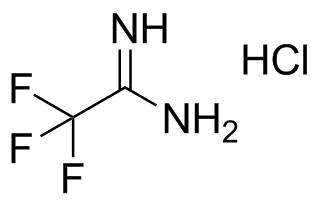 |
| Molecular Formula | C2H4ClF3N2 |
| Molecular Weight | 148.51 |
| CAS Registry Number | 39560-95-7 |
| SMILES | C(=N)(C(F)(F)F)N.Cl |
| Hazard Symbols |  GHS07 Warning Details GHS07 Warning Details |
|---|---|
| Risk Statements | H302-H315-H319-H335 Details |
| Safety Statements | P261-P305+P351+P338 Details |
| SDS | Available |
 chemBlink Chemical Story
|
2,2,2-Trifluoroacetimidamide hydrochloride is a fluorinated amidine salt derived from trifluoroacetic acid and imidamide functional chemistry. It belongs to the class of highly electron-deficient imidamide (amidine) derivatives in which the strongly electron-withdrawing trifluoromethyl group modulates the reactivity and basicity of the amidine core. The compound is typically isolated as a hydrochloride salt, reflecting protonation of the imidamide nitrogen and stabilization by chloride counterion. The broader chemistry of amidines and imidamides has been studied since the development of nitrogen-containing functional groups in organic chemistry, particularly for their role as strongly basic and nucleophilic motifs. Amidine derivatives are characterized by resonance stabilization between a C=N and C–NH functionality, giving rise to a delocalized cationic system upon protonation. The introduction of electron-withdrawing substituents such as trifluoromethyl groups represents a later development in fluorine chemistry, which expanded significantly in the mid-to-late twentieth century with the growing importance of fluorinated building blocks in medicinal and synthetic chemistry. In 2,2,2-trifluoroacetimidamide hydrochloride, the trifluoromethyl group is attached to the carbonyl-derived carbon center of the imidamide framework. The strong inductive electron-withdrawing effect of the CF3 group significantly reduces electron density at the imidamide carbon, altering both its nucleophilicity and proton affinity. This makes trifluoroacetimidamide derivatives chemically distinct from unsubstituted amidines, often increasing their electrophilic character and modifying their acid–base behavior. The hydrochloride form of the compound reflects protonation of the amidine nitrogen atoms under acidic conditions. Protonation stabilizes the molecule as a crystalline salt and is common for amidines, which are among the more basic neutral functional groups in organic chemistry. Salt formation is frequently used to improve handling, stability, and isolation of reactive nitrogen-containing compounds. Fluorinated amidine derivatives such as this compound are of interest in synthetic organic chemistry due to the unique properties imparted by the trifluoromethyl group. The CF3 substituent increases lipophilicity while simultaneously decreasing electron density through strong inductive effects. This dual influence can significantly alter reaction pathways, making such compounds useful intermediates in the synthesis of more complex fluorinated heterocycles and nitrogen-containing scaffolds. The development of fluorinated building blocks gained momentum in the second half of the twentieth century as organofluorine chemistry became increasingly important in pharmaceutical and agrochemical research. The incorporation of fluorine atoms or trifluoromethyl groups into organic molecules was found to influence metabolic stability, binding affinity, and physicochemical properties. As a result, fluorinated functional groups, including trifluoroacetamide- and trifluoroacetimidamide-derived structures, became valuable synthetic tools. From a reactivity standpoint, 2,2,2-trifluoroacetimidamide hydrochloride can participate in transformations characteristic of amidine chemistry, including nucleophilic addition, condensation reactions, and cyclization processes leading to heterocyclic systems. The electron-deficient nature of the trifluoro-substituted carbon center can also influence selectivity in such reactions, making these derivatives useful in controlled synthetic applications. Physically, compounds of this type are typically polar due to the presence of charged or strongly polarized nitrogen centers and the highly electronegative fluorine atoms. The hydrochloride salt form further increases polarity and enhances solubility in polar solvents. The combination of fluorination and protonation leads to a distinct balance of stability and reactivity that is often exploited in laboratory-scale synthesis. Overall, 2,2,2-trifluoroacetimidamide hydrochloride is a fluorinated amidine salt characterized by a strongly electron-withdrawing trifluoromethyl group and a protonated imidamide framework. Its significance lies in its role as a specialized fluorinated building block in organic synthesis and in the broader context of fluorine-modified nitrogen functional group chemistry used to tune reactivity and molecular properties in advanced chemical research. |
| Market Analysis Reports |