
Online Database of Chemicals from Around the World
| Shanghai Neutron Star ChemTech Co., Ltd. | China | |||
|---|---|---|---|---|
 | www.zzxchem.com | |||
 | +86 (21) 3401-0531 +86 15901735774 | |||
 | +86 (21) 3401-0530 | |||
 | zzxchem@163.com | |||
| Chemical manufacturer since 2010 | ||||
| chemBlink Standard supplier since 2012 | ||||
| Hangzhou Leap Chem Co., Ltd. | China | |||
|---|---|---|---|---|
| www.leapchem.com | |||
| +86 (571) 8771-1850 | |||
| market19@leapchem.com | |||
 | QQ Chat | |||
| Chemical manufacturer since 2006 | ||||
| chemBlink Standard supplier since 2015 | ||||
| Shanghai Worldyang Chemical Co., Ltd. | China | |||
|---|---|---|---|---|
| www.worldyachem.com | |||
| +86 13651600618 +86 (21) 5679-5779 | |||
| +86 (21) 5679-5266 | |||
| sales7777@worldyachem.com | |||
| QQ Chat | |||
 | WeChat: 13651600618 | |||
 | WhatsApp:+86 13651600618 | |||
| Chemical manufacturer since 2012 | ||||
| Colonial Metals, Inc. | USA | |||
|---|---|---|---|---|
| www.colonialmetals.com | |||
| +1 (410) 398-7200 (800) 962-1537 | |||
| +1 (410) 398-2918 | |||
| sales@colonialmetals.com | |||
| Chemical manufacturer | ||||
| Classification | Organic raw materials >> Organometallic compound >> Organic ruthenium |
|---|---|
| Name | Tetrachlorobis(mesitylene)diruthenium |
| Synonyms | (Mesitylene)dichlororuthenium dimer; Bis(dichloro(1,3,5-trimethylbenzene)ruthenium) |
| Molecular Structure | 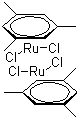 |
| Molecular Formula | C18H24Cl4Ru2 |
| Molecular Weight | 584.34 |
| CAS Registry Number | 52462-31-4 |
| EC Number | 610-845-2 |
| SMILES | Cl[Ru]1[Cl][Ru](Cl)[Cl]1.C[C]2[CH][C](C)[CH][C](C)[CH]2.C[C]3[CH][C](C)[CH][C](C)[CH]3 |
| Melting point | >300 °C (Expl.) |
|---|---|
| Hazard Symbols |  GHS07 Warning Details GHS07 Warning Details | ||||||||||||||||
|---|---|---|---|---|---|---|---|---|---|---|---|---|---|---|---|---|---|
| Risk Statements | H302-H319 Details | ||||||||||||||||
| Safety Statements | P264-P270-P280-P301+P312-P305+P351+P338-P337+P313 Details | ||||||||||||||||
| Hazard Classification | |||||||||||||||||
| |||||||||||||||||
| SDS | Available | ||||||||||||||||
 chemBlink Chemical Story
|
Tetrachlorobis(mesitylene)diruthenium is an organometallic complex consisting of two ruthenium atoms bridged or coordinated by chloride ligands and bound to mesitylene ligands. The compound typically has the formula Ru2Cl4(C9H12)2, where each ruthenium center is coordinated to a mesitylene (1,3,5-trimethylbenzene) ligand and associated with chloride ligands. This complex belongs to the class of ruthenium arene complexes and diruthenium chlorides, which have been extensively studied for their structural, electronic, and catalytic properties. The synthesis of tetrachlorobis(mesitylene)diruthenium generally involves the reaction of ruthenium(III) chloride with mesitylene under conditions that allow for ligand substitution and complex formation. Often, this can be achieved by refluxing ruthenium(III) chloride hydrate in mesitylene or using other reducing agents and solvents that facilitate coordination of the arene ligand to the metal center. The resulting product is a stable, well-defined complex that can be isolated as a solid. Structurally, the complex exhibits a metal-metal interaction between the two ruthenium centers. The two ruthenium atoms are bridged by chloride ligands, and each ruthenium atom is η6-coordinated to a mesitylene ligand, meaning the aromatic ring of mesitylene binds to ruthenium through all six carbon atoms of the ring. This η6-arene coordination imparts stability and influences the electronic properties of the metal centers. Tetrachlorobis(mesitylene)diruthenium is of interest primarily for its catalytic activity in various organic transformations. Ruthenium complexes containing arene ligands are known to catalyze hydrogenation, oxidation, and carbon–carbon bond-forming reactions with high selectivity and efficiency. The diruthenium complex can serve as a precursor to other ruthenium catalysts by ligand exchange or activation under reaction conditions. In addition to catalysis, the complex has been studied for its electronic and magnetic properties, which are influenced by the metal-metal bonding and the electronic effects of the mesitylene ligands. Spectroscopic methods such as nuclear magnetic resonance (NMR), infrared (IR), and ultraviolet-visible (UV-Vis) spectroscopy, along with X-ray crystallography, have been used to characterize the complex’s structure and bonding. Analytical characterization reveals that the mesitylene ligands contribute to the overall hydrophobicity and solubility profile of the complex, making it soluble in organic solvents like dichloromethane, toluene, and benzene. The complex is typically a solid at room temperature and exhibits stability under inert atmosphere conditions, although it may be sensitive to air or moisture depending on storage. In summary, tetrachlorobis(mesitylene)diruthenium is a diruthenium complex coordinated with mesitylene ligands and chloride bridges, notable for its structural features, metal-metal interactions, and catalytic applications. It serves as a versatile compound in organometallic chemistry and homogeneous catalysis research. |
| Market Analysis Reports |