
Online Database of Chemicals from Around the World
| Wuhan Dingxintong Pharmaceutical Co., Ltd. | China | |||
|---|---|---|---|---|
 | www.dxtph.com | |||
 | +86 15871722230 | |||
 | 15871722230@163.com | |||
 | QQ Chat | |||
| Chemical distributor since 2019 | ||||
| chemBlink Standard supplier since 2023 | ||||
| Shandong Binlaichem Pharmaceutical Co., Ltd. | China | |||
|---|---|---|---|---|
| www.binlaichem.com | |||
| +86 15963310191 | |||
| sales@binlaichem.com | |||
| QQ Chat | |||
| Chemical distributor since 2022 | ||||
| chemBlink Standard supplier since 2023 | ||||
| Shanghai Worldyang Chemical Co., Ltd. | China | |||
|---|---|---|---|---|
| www.worldyachem.com | |||
| +86 13651600618 +86 (21) 5679-5779 | |||
 | +86 (21) 5679-5266 | |||
| sales7777@worldyachem.com | |||
| QQ Chat | |||
 | WeChat: 13651600618 | |||
 | WhatsApp:+86 13651600618 | |||
| Chemical manufacturer since 2012 | ||||
| Classification | Biological >> Proteins and peptides >> Hormone |
|---|---|
| Name | 9-Hydroxy-4-androstene-3,17-dione |
| Synonyms | (8S,9R,10S,13S,14S)-9-hydroxy-10,13-dimethyl-1,2,6,7,8,11,12,14,15,16-decahydrocyclopenta[a]phenanthrene-3,17-dione |
| Molecular Structure | 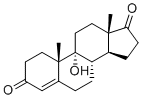 |
| Molecular Formula | C19H26O3 |
| Molecular Weight | 302.41 |
| CAS Registry Number | 560-62-3 |
| EC Number | 611-349-9 |
| SMILES | C[C@]12CC[C@]3([C@H]([C@@H]1CCC2=O)CCC4=CC(=O)CC[C@@]43C)O |
| Solubility | 3258 mg/L (25 °C water) |
|---|---|
| Density | 1.2±0.1 g/cm3, Calc.* |
| Index of Refraction | 1.572, Calc.* |
| Melting point | 172.69 °C |
| Boiling Point | 414.57 °C, 470.3±45.0 °C (760 mmHg), Calc.* |
| Flash Point | 252.3±25.2 °C, Calc.* |
| * | Calculated using Advanced Chemistry Development (ACD/Labs) Software. |
| Hazard Symbols |   HGS07;HGS08 Danger Details HGS07;HGS08 Danger Details | ||||||||||||||||||||||||
|---|---|---|---|---|---|---|---|---|---|---|---|---|---|---|---|---|---|---|---|---|---|---|---|---|---|
| Risk Statements | H302-H351-H360-H362 Details | ||||||||||||||||||||||||
| Safety Statements | P203-P260-P263-P264-P270-P280-P301+P317-P318-P330-P405-P501 Details | ||||||||||||||||||||||||
| Hazard Classification | |||||||||||||||||||||||||
| |||||||||||||||||||||||||
 chemBlink Chemical Story
|
9-Hydroxy-4-androsten-3,17-dione, commonly referred to as 9-OH-AD, is an intermediate in the biosynthesis of steroid hormones with potential therapeutic applications in medicine. 9-Hydroxy-4-androsten-3,17-dione was first identified and described as a natural metabolite in the androgen biosynthetic pathway. It is derived from 4-androstenedione by enzymatic oxidation at the 9th carbon position, resulting in the formation of a hydroxyl group (-OH) at this position. This compound plays an important role in the biosynthesis of potent androgens such as testosterone and dihydrotestosterone (DHT) in humans. 9-Hydroxy-4-androstenedione-3,17-dione can be prepared by chemical oxidation of 4-androstenedione using a suitable oxidant under controlled conditions. The synthesis involves organic chemistry techniques to ensure high yield and purity of the final product, which is essential for its biomedical applications. 9-Hydroxy-4-androsten-3,17-dione is a key intermediate in the production of biologically active androgens, including testosterone, in humans. This metabolic pathway is important for the development and maintenance of male sexual characteristics and reproductive function. In addition to its role in androgen synthesis, 9-OH-AD is involved in a variety of physiological processes, including muscle growth, bone density maintenance, and sexual desire regulation. In clinical medicine, 9-hydroxy-4-androstene-3,17-dione and its derivatives have been investigated for their potential in hormone replacement therapy (HRT). These compounds can be used to supplement or replace natural androgens in patients with hormone deficiencies or imbalances, such as hypogonadism. HRT aims to restore normal physiological levels of androgens and improve symptoms and overall health. Research on 9-hydroxy-4-androstene-3,17-dione extends beyond its physiological effects to explore potential therapeutic applications: Studies have explored the antiproliferative effects of 9-OH-AD and its derivatives on hormone-sensitive cancers, such as prostate cancer. These compounds may inhibit the growth of cancer cells by interfering with androgen receptor signaling pathways. Due to their role in muscle growth and strength maintenance, derivatives of 9-hydroxy-4-androstene-3,17-dione are being used to develop anabolic steroids for the treatment of muscular dystrophy and to promote tissue repair in certain diseases. Ongoing research focuses on optimizing the synthesis and pharmacological properties of 9-hydroxy-4-androstene-3,17-dione derivatives. Advances in medicinal chemistry are aimed at developing selective agonists or antagonists against androgen receptors for the treatment of various related diseases. References 2023. Engineering strategies for enhanced 9α-hydroxy-androst-4-ene-3,17-dione production in Mycobacterium neoaurum. Bioresources and Bioprocessing, 10(1). DOI: 10.1007/s43393-023-00190-3 2022. Metabolic engineering of Mycobacterium neoaurum for enhanced production of 9-hydroxy-4-androstene-3,17-dione. Microbial Cell Factories, 21(1). DOI: 10.1186/s12934-022-02008-8 1983. 9α-Hydroxylation of 4-androstene-3,17-dione by gel-entrapped Corynebacterium sp. cells. Applied Microbiology and Biotechnology, 18(2). DOI: 10.1007/bf00510416 |
| Market Analysis Reports |