
Online Database of Chemicals from Around the World
| Ereztech LLC | USA | |||
|---|---|---|---|---|
 | www.ereztech.com | |||
 | +1 (888) 658-1221 | |||
 | sales@ereztech.com | |||
| Chemical distributor since 2010 | ||||
| chemBlink Standard supplier since 2011 | ||||
| Intatrade Chemicals GmbH | Germany | |||
|---|---|---|---|---|
| www.intatrade.de | |||
| +49 (3493) 605-465 | |||
 | +49 (3493) 605-470 | |||
| sales@intatrade.de | |||
| Chemical distributor | ||||
| chemBlink Standard supplier since 2011 | ||||
| Zhengzhou Kingorgchem Chemical Technology Co., Ltd. | China | |||
|---|---|---|---|---|
| www.kingorgchem.com | |||
| +86 (371) 6551-1006 | |||
| +86 (371) 6575-6965 | |||
| sales@kingorgchem.com | |||
 | QQ Chat | |||
 | WeChat: 18625597674 | |||
| Chemical manufacturer since 2015 | ||||
| chemBlink Standard supplier since 2016 | ||||
| Shanghai Fuxin Pharmaceutical Co., Ltd. | China | |||
|---|---|---|---|---|
| www.fuxinpharm.com | |||
| +86 (21) 3130-0828 +86 18645121291 | |||
| +86 (21) 3130-0828 | |||
| contact@fuxinpharm.com | |||
| Chemical manufacturer since 2016 | ||||
| chemBlink Standard supplier since 2018 | ||||
| Anvia Chemicals, LLC | USA | |||
|---|---|---|---|---|
| www.anviachem.com | |||
| +1 (414) 534-7845 | |||
| +1 (414) 762-5539 | |||
| sales@anviachem.com | |||
| Chemical manufacturer | ||||
| Achemica | Switzerland | |||
|---|---|---|---|---|
| www.achemica.com | |||
| +41 (24) 466-2929 | |||
| +41 (24) 466-2800 | |||
| contact@achemica.com | |||
| Chemical manufacturer since 2010 | ||||
| Classification | Organic raw materials >> Organic phosphine compound |
|---|---|
| Name | 1,4-Bis(dicyclohexylphosphino)butane |
| Synonyms | dicyclohexyl(4-dicyclohexylphosphanylbutyl)phosphane |
| Molecular Structure | 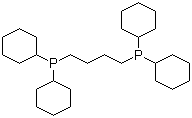 |
| Molecular Formula | C28H52P2 |
| Molecular Weight | 450.66 |
| CAS Registry Number | 65038-36-0 |
| SMILES | C1CCC(CC1)P(CCCCP(C2CCCCC2)C3CCCCC3)C4CCCCC4 |
| Melting point | 99-104 °C |
|---|---|
| Hazard Symbols |  GHS07 Warning Details GHS07 Warning Details |
|---|---|
| Risk Statements | H315-H319 Details |
| Safety Statements | P264-P280-P302+P352-P337+P313-P305+P351+P338-P362+P364-P332+P313 Details |
| SDS | Available |
 chemBlink Chemical Story
|
1,4-Bis(dicyclohexylphosphino)butane, commonly referred to as DCyPB, is an important organophosphorus compound known for its unique structural properties and significant role in various catalytic processes. The compound, characterized by two dicyclohexylphosphino groups linked by a butane backbone, serves as a bidentate ligand, offering flexibility and steric bulk that can be tailored to specific catalytic applications. Its discovery and subsequent use in chemical synthesis have highlighted its versatility and effectiveness in promoting various chemical reactions, particularly in homogeneous catalysis. The discovery of 1,4-Bis(dicyclohexylphosphino)butane was motivated by the need to develop ligands that could provide both steric hindrance and flexibility in metal coordination environments. The synthesis of DCyPB involves the reaction of dicyclohexylphosphine with 1,4-dibromobutane, leading to the formation of a bidentate phosphine ligand with two phosphorus atoms spaced by a butane linker. This spacing allows the ligand to coordinate with metal centers in a manner that can accommodate different geometries, making it a valuable tool in the design of catalytic systems. One of the primary applications of 1,4-Bis(dicyclohexylphosphino)butane is in transition metal-catalyzed reactions, particularly those involving palladium, nickel, and rhodium complexes. In palladium-catalyzed cross-coupling reactions, such as the Suzuki-Miyaura and Stille reactions, DCyPB acts as an effective ligand that stabilizes the palladium center while allowing for efficient bond formation between aryl halides and organometallic reagents. The steric bulk provided by the dicyclohexyl groups helps to prevent undesired side reactions, improving the selectivity and yield of the desired products. DCyPB is also employed in hydroformylation reactions, where it serves as a ligand for rhodium complexes. In these reactions, the bidentate nature of the ligand allows for the formation of stable rhodium complexes that can effectively catalyze the addition of carbon monoxide and hydrogen to alkenes, resulting in the formation of aldehydes. The ability of DCyPB to influence the regioselectivity of the hydroformylation process, favoring the formation of linear or branched aldehydes, is a key factor in its application in industrial processes, particularly in the production of fine chemicals and pharmaceuticals. In addition to its role in cross-coupling and hydroformylation reactions, 1,4-Bis(dicyclohexylphosphino)butane is also used in asymmetric catalysis. The flexibility of the butane backbone allows the ligand to create a chiral environment around the metal center, which can induce enantioselectivity in various reactions. This is particularly valuable in the synthesis of chiral molecules, where the control of stereochemistry is essential for the production of enantiomerically pure compounds. The use of DCyPB in asymmetric hydrogenation and other enantioselective processes has made it an important ligand in the development of chiral catalysts for pharmaceutical synthesis. Moreover, DCyPB is utilized in the preparation of metal-organic frameworks (MOFs) and coordination polymers, where its bidentate phosphine groups can link metal centers, creating extended networks with specific porosity and functionality. These materials have applications in gas storage, separation, and catalysis, where the structural properties of the ligand play a crucial role in determining the overall performance of the material. The versatility of 1,4-Bis(dicyclohexylphosphino)butane extends to its use in various other catalytic transformations, including carbon-carbon bond formation, carbon-heteroatom bond formation, and olefin polymerization. Its ability to stabilize transition metal complexes while providing flexibility in coordination geometry makes it a valuable ligand in both academic research and industrial applications. The ongoing development of new catalytic processes continues to highlight the importance of DCyPB as a key ligand in modern synthetic chemistry. References 2021. Nickel-Catalyzed Photodehalogenation of Aryl Bromides. Synlett, 32(8). DOI: 10.1055/a-1457-2399 2009. Synthesis from Dialkylphosphides or Dialkylphosphines and Polyhaloalkanes. Science of Synthesis, 42. URL: SD-042-00110 2007. Evaluation of C4 diphosphine ligands in rhodium catalysed methanol carbonylation under a syngas atmosphere: synthesis, structure, stability and reactivity of rhodium(i) carbonyl and rhodium(iii) acetyl intermediates. Dalton transactions (Cambridge, England : 2003), (47). DOI: 10.1039/b712974b |
| Market Analysis Reports |