
Online Database of Chemicals from Around the World
| Intatrade Chemicals GmbH | Germany | |||
|---|---|---|---|---|
 | www.intatrade.de | |||
 | +49 (3493) 605-465 | |||
 | +49 (3493) 605-470 | |||
 | sales@intatrade.de | |||
| Chemical distributor | ||||
| chemBlink Standard supplier since 2011 | ||||
| Hangzhou Leap Chem Co., Ltd. | China | |||
|---|---|---|---|---|
| www.leapchem.com | |||
| +86 (571) 8771-1850 | |||
| market19@leapchem.com | |||
 | QQ Chat | |||
| Chemical manufacturer since 2006 | ||||
| chemBlink Standard supplier since 2015 | ||||
| Zhengzhou Kingorgchem Chemical Technology Co., Ltd. | China | |||
|---|---|---|---|---|
| www.kingorgchem.com | |||
| +86 (371) 6551-1006 | |||
| +86 (371) 6575-6965 | |||
| sales@kingorgchem.com | |||
| QQ Chat | |||
 | WeChat: 18625597674 | |||
| Chemical manufacturer since 2015 | ||||
| chemBlink Standard supplier since 2016 | ||||
| Zhengzhou Changkuan Technology Co., Ltd. | China | |||
|---|---|---|---|---|
| www.changkuantech.com | |||
| +86 (371) 6376-9919 +86 18530983798 | |||
| +86 (371) 6360-3986 | |||
| sales5@changkuantech.com | |||
| QQ Chat | |||
| Chemical manufacturer since 2012 | ||||
| chemBlink Standard supplier since 2016 | ||||
| Dalchem | Russia | |||
|---|---|---|---|---|
| www.dalchem.com | |||
| +7 (8312) 753-772 | |||
| +7 (8312) 750-799 | |||
| dregichy@dalchem.com | |||
| Chemical manufacturer since 1997 | ||||
| City Chemical LLC | USA | |||
|---|---|---|---|---|
| www.citychemical.com | |||
| +1 (203) 932-2489 | |||
| +1 (203) 937-8400 | |||
| sales@citychemical.com | |||
| Chemical distributor | ||||
| abcr GmbH | Germany | |||
|---|---|---|---|---|
| www.abcr.de | |||
| +49 (721) 950-610 | |||
| +49 (721) 950-6180 | |||
| info@abcr.de | |||
| Chemical manufacturer | ||||
| Strem Chemicals, Inc. | USA | |||
|---|---|---|---|---|
| www.strem.com | |||
| +1 (978) 499-1600 | |||
| +1 (978) 465-3104 | |||
| info@strem.com | |||
| Chemical manufacturer | ||||
| Acros Organics | Belgium | |||
|---|---|---|---|---|
| www.acros.com | |||
| +86 (21) 5258-1100 | |||
| +86 (21) 5258-0119 | |||
| info@acros.com | |||
| Chemical manufacturer | ||||
| Classification | Organic raw materials >> Organic phosphine compound |
|---|---|
| Name | Tris(3,5-dimethylphenyl)phosphine |
| Molecular Structure | 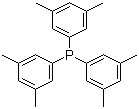 |
| Molecular Formula | C24H27P |
| Molecular Weight | 346.44 |
| CAS Registry Number | 69227-47-0 |
| EC Number | 624-162-2 |
| SMILES | CC1=CC(=CC(=C1)P(C2=CC(=CC(=C2)C)C)C3=CC(=CC(=C3)C)C)C |
| Melting point | 160-165 °C |
|---|---|
| Hazard Symbols |  GHS07 Warning Details GHS07 Warning Details | ||||||||||||||||
|---|---|---|---|---|---|---|---|---|---|---|---|---|---|---|---|---|---|
| Risk Statements | H302 Details | ||||||||||||||||
| Safety Statements | P264-P270-P301+P317-P330-P501 Details | ||||||||||||||||
| Hazard Classification | |||||||||||||||||
| |||||||||||||||||
| SDS | Available | ||||||||||||||||
 chemBlink Chemical Story
|
Tri(3,5-dimethylphenyl)phosphine is a special organophosphorus compound that has attracted much attention due to its unique structural and electronic properties. The compound, often abbreviated as P(3,5-Me2Ph)3, consists of a phosphorus atom bonded to three 3,5-dimethylphenyl groups. The presence of the meta-methyl group on the benzene ring affects the electronic environment around the phosphorus atom, making it a valuable ligand in coordination chemistry and catalysis. The discovery of tri(3,5-dimethylphenyl)phosphine can be traced back to the ongoing search for new ligands that can provide enhanced performance in metal-catalyzed reactions. Phosphines have long been considered versatile ligands in coordination chemistry due to their ability to donate electron density to metal centers, thereby stabilizing metal complexes and modulating their reactivity. The introduction of substituents on the benzene ring of phosphines is an important strategy to fine-tune their electronic and steric properties. Tri(3,5-dimethylphenyl)phosphine is part of this effort to create ligands with specific properties that can be used in catalytic applications. The synthesis of tri(3,5-dimethylphenyl)phosphine generally involves the reaction of phosphorus trichloride (PCl3) with three equivalents of 3,5-dimethylphenyllithium, which is generated in situ from 3,5-dimethylbromobenzene and lithium metal. This approach allows the formation of the desired phosphine ligand in high purity. The product is typically obtained as a colorless to pale yellow solid that is soluble in common organic solvents such as dichloromethane, toluene, and tetrahydrofuran. The resulting tri(3,5-dimethylphenyl)phosphine exhibits unique properties, which are mainly attributed to the presence of the methyl group, which affects the steric bulk and electron donor ability of the ligand. One of the major applications of tri(3,5-dimethylphenyl)phosphine is in the field of homogeneous catalysis. The steric and electronic properties of this ligand make it an excellent choice for stabilizing the active metal center in the catalytic cycle. It has been widely used in palladium-catalyzed cross-coupling reactions such as the Suzuki-Miyaura, Heck, and Negishi reactions. These reactions are fundamental tools in organic synthesis, allowing the formation of carbon-carbon bonds between different organic fragments. Tri(3,5-dimethylphenyl)phosphine, when coordinated to palladium, provides an optimal balance of steric hindrance and electron donation, promoting high catalytic activity and selectivity in these transformations. In addition to palladium-catalyzed reactions, tri(3,5-dimethylphenyl)phosphine can also be used in gold-catalyzed transformations. Gold catalysts have become increasingly important in modern organic synthesis, particularly for reactions involving activation of alkynes and carbon-heteroatom bond formation. The use of tri(3,5-dimethylphenyl)phosphine in gold catalysis has been shown to enhance the reactivity and selectivity of these processes, enabling the efficient synthesis of complex molecules of interest in pharmaceutical and materials science fields. The effects of the 3,5-dimethylphenyl group on the properties of phosphines extend beyond their use in catalysis. The bulk properties of these substituents have been exploited to stabilize unusual oxidation states in metal complexes. For example, tri(3,5-dimethylphenyl)phosphine has been used to synthesize low-coordination metal complexes with interesting electronic and magnetic properties. These complexes are of interest in the development of new materials for electronic, magnetic, and catalytic applications. Additionally, tri(3,5-dimethylphenyl)phosphine has been used to study metal-ligand interactions and design new ligands with tailored properties. The ability to systematically alter the ligand environment by introducing different substituents on the benzene ring allows chemists to explore the effects of these changes on the reactivity and stability of metal complexes. This has led to the discovery of new catalytic processes and the development of ligands with enhanced properties for specific applications. References 2018. Two tris(3,5-disubstituted phenyl)phosphines and their isostructural PV oxides. Acta crystallographica. Section E, Crystallographic communications, 74(6). DOI: 10.1107/s2056989018007831 2015. Cationic mononuclear ruthenium carboxylates as catalyst prototypes for self-induced hydrogenation of carboxylic acids. Nature Communications, 6. DOI: 10.1038/ncomms9140 2007. Silicon-Stereogenic Silanes in Asymmetric Catalysis. Synlett, 2007(10). DOI: 10.1055/s-2007-980385 |
| Market Analysis Reports |