
Online Database of Chemicals from Around the World
| wuhan chemi Pharmacy Chemical Technology Co., Ltd. | China | |||
|---|---|---|---|---|
 | www.chemipharm.com.cn | |||
 | +86 13971619949 | |||
 | gmn424@chemipharm.com.cn | |||
 | QQ Chat | |||
 | WeChat: 13971619949 | |||
| Chemical manufacturer since 2014 | ||||
| chemBlink Standard supplier since 2026 | ||||
| Classification | Pharmaceutical intermediate >> Heterocyclic compound intermediate >> Pyridine compound |
|---|---|
| Name | Copper(II) dichlorobipyridyl |
| Synonyms | dichlorocopper;2-piperidin-1-id-2-ylpiperidin-1-ide |
| Molecular Structure | 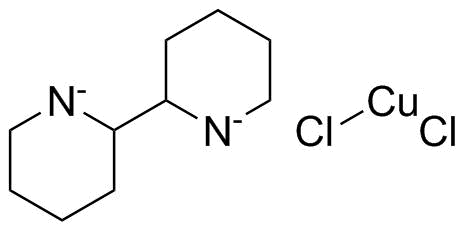 |
| Molecular Formula | C10H18Cl2CuN2+2 |
| Molecular Weight | 300.72 |
| CAS Registry Number | 22393-36-8 |
| EC Number | 878-385-7 |
| SMILES | C1CC[N-]C(C1)C2CCCC[N-]2.Cl[Cu]Cl |
| Hazard Symbols |  GHS07 Warning Details GHS07 Warning Details | ||||||||||||
|---|---|---|---|---|---|---|---|---|---|---|---|---|---|
| Risk Statements | H315-H319 Details | ||||||||||||
| Safety Statements | P264-P280-P302+P352-P337+P313-P305+P351+P338-P362+P364-P332+P313 Details | ||||||||||||
| Hazard Classification | |||||||||||||
| |||||||||||||
| SDS | Available | ||||||||||||
 chemBlink Chemical Story
|
Copper(II) dichlorobipyridyl is a coordination compound consisting of a copper(II) center bound to a bipyridyl ligand and two chloride ligands. The bipyridyl ligand, commonly 2,2′-bipyridine, is a bidentate nitrogen-donor ligand that forms stable five-membered chelate rings with transition metals. Compounds of this type belong to the broader class of mixed-ligand copper(II) complexes, which have been widely studied in coordination chemistry for their structural diversity, redox behavior, and spectroscopic properties. The development of copper–bipyridine coordination chemistry is closely tied to the evolution of modern coordination theory in the late nineteenth and twentieth centuries. The recognition that transition metal ions could form stable complexes with multidentate ligands such as bipyridine provided key experimental support for chelation concepts. Bipyridine ligands became particularly important because their rigid aromatic structure and two nitrogen donor atoms allow for strong and predictable coordination to metal centers, including copper(II). In copper(II) dichlorobipyridyl, the copper center is coordinated by one bipyridyl ligand and two chloride ions. The resulting coordination environment is typically described as distorted square-planar or distorted octahedral depending on whether additional weak interactions or solvent molecules are present. Copper(II) has a d9 electronic configuration, which often leads to Jahn–Teller distortion in octahedral geometries. This effect results in elongation or compression of coordination bonds and contributes to the structural variability observed in copper(II) complexes. The bipyridyl ligand plays a central role in stabilizing the copper(II) center through chelation. The formation of a five-membered ring involving the metal and the two nitrogen atoms increases thermodynamic stability relative to monodentate amine ligands. At the same time, chloride ligands contribute to the overall charge balance and influence the electronic properties of the complex through their σ-donor and weak π-donor characteristics. One of the important aspects of copper(II) dichlorobipyridyl chemistry is its redox behavior. Copper complexes are well known for their ability to undergo reversible or quasi-reversible redox transitions between copper(II) and copper(I) oxidation states. The presence of bipyridyl ligands can stabilize both oxidation states by delocalizing electron density and supporting changes in coordination geometry. Chloride ligands may be displaced or retained depending on reaction conditions, influencing the redox properties and reactivity of the complex. Copper–bipyridyl complexes have been extensively studied in the context of electron transfer processes. Their well-defined coordination environments make them useful model systems for investigating how ligand fields influence redox potentials and electron transfer kinetics. These studies have contributed to a deeper understanding of transition metal redox chemistry and coordination dynamics. In addition to redox chemistry, copper(II) bipyridyl complexes exhibit characteristic spectroscopic properties. UV–visible spectroscopy typically shows d–d transitions associated with the copper(II) center, often appearing as broad absorption bands due to ligand field effects and Jahn–Teller distortion. Electron paramagnetic resonance spectroscopy is also particularly informative because copper(II) is paramagnetic, allowing detailed analysis of its electronic environment. From a structural standpoint, copper(II) dichlorobipyridyl complexes can participate in intermolecular interactions such as π–π stacking between bipyridyl ligands and weak coordination interactions involving chloride ions. These interactions can influence crystal packing and solid-state properties. X-ray crystallography has been widely used to determine coordination geometry and confirm ligand binding modes in such systems. Mixed-ligand copper–bipyridyl complexes have also been explored in catalytic chemistry. Copper complexes are widely used in oxidation reactions, coupling reactions, and other transformations in organic synthesis. While the active catalytic species may vary depending on reaction conditions, bipyridyl–copper systems serve as important precursors and model complexes for understanding catalytic behavior. Overall, copper(II) dichlorobipyridyl is a representative mixed-ligand coordination compound that illustrates key principles of copper coordination chemistry, including chelation by bipyridyl ligands, the influence of chloride coordination, and the effects of d-electron configuration on geometry and reactivity. Its significance lies in its role as a model system for studying structure, bonding, and redox behavior in transition metal complexes. |
| Market Analysis Reports |