
Online Database of Chemicals from Around the World
| PTG Advanced Catalyst Co. Limited | China | |||
|---|---|---|---|---|
 | www.ptgchem.com | |||
 | +86 (10) 6073-9051 | |||
 | +86 (10) 6073-9051 | |||
 | market@ptgchem.com | |||
| Chemical distributor since 2013 | ||||
| chemBlink Standard supplier since 2014 | ||||
| Bruc Chemicals Co., Ltd. | China | |||
|---|---|---|---|---|
| www.brucchem.com | |||
| +86 15820039489 | |||
| brucneochem@outlook.com | |||
| Chemical manufacturer since 2010 | ||||
| chemBlink Standard supplier since 2026 | ||||
| Achemica | Switzerland | |||
|---|---|---|---|---|
| www.achemica.com | |||
| +41 (24) 466-2929 | |||
| +41 (24) 466-2800 | |||
| contact@achemica.com | |||
| Chemical manufacturer since 2010 | ||||
| Classification | Pharmaceutical intermediate >> Heterocyclic compound intermediate >> Pyrimidine compound >> Amine |
|---|---|
| Name | N-(1,4-Dimethylamyl)-N'-phenyl-p-phenylenediamine |
| Synonyms | N-(5-Methyl-2-hexyl)-N'-phenyl-p-phenylenediamine; N-1,4-Dimethylpentyl-N'-phenyl-p-phenylenediamine; N-Phenyl-N'-(1,4-dimethylpentyl)-1,4-phenylenediamine; N-Phenyl-N'-(1,4-dimethylpentyl)-p-phenylenediamine; Naugard I 3; Santoflex 14 |
| Molecular Structure | 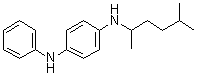 |
| Molecular Formula | C19H26N2 |
| Molecular Weight | 282.42 |
| CAS Registry Number | 3081-01-4 |
| EC Number | 221-374-3 |
| SMILES | CC(C)CCC(C)NC1=CC=C(C=C1)NC2=CC=CC=C2 |
| Solubility | Insoluble (1.0E-3 g/L) (25 °C), Calc.* |
|---|---|
| Density | 1.028±0.06 g/cm3 (20 °C 760 Torr), Calc.* |
| * | Calculated using Advanced Chemistry Development (ACD/Labs) Software V11.02 (©1994-2014 ACD/Labs) |
| Hazard Symbols |    GHS07;GHS08;GHS09 Danger Details GHS07;GHS08;GHS09 Danger Details | ||||||||||||||||||||||||||||
|---|---|---|---|---|---|---|---|---|---|---|---|---|---|---|---|---|---|---|---|---|---|---|---|---|---|---|---|---|---|
| Risk Statements | H302-H315-H317-H360-H400-H410 Details | ||||||||||||||||||||||||||||
| Safety Statements | P203-P261-P264-P270-P272-P273-P280-P301+P317-P302+P352-P318-P321-P330-P332+P317-P333+P317-P362+P364-P391-P405-P501 Details | ||||||||||||||||||||||||||||
| Hazard Classification | |||||||||||||||||||||||||||||
| |||||||||||||||||||||||||||||
| SDS | Available | ||||||||||||||||||||||||||||
 chemBlink Chemical Story
|
N-(1,4-Dimethylamyl)-N'-phenyl-p-phenylenediamine, commonly known as 7PPD, is a substituted p-phenylenediamine developed as an antidegradant for rubber. Like other members of the PPD family, its importance comes from a fundamental weakness of many elastomers: the same unsaturated molecular structures that help make rubber flexible also leave it vulnerable to oxygen, ozone, heat, and repeated mechanical deformation. 7PPD was designed to intervene in these degradation processes before they cause irreversible damage to the polymer. Rubber aging is not a single chemical reaction. Heat and oxygen can initiate radical oxidation, gradually changing polymer chains and reducing elasticity. Ozone presents a different problem. Even at very low atmospheric concentrations, ozone reacts readily with carbon-carbon double bonds in unsaturated elastomers. When rubber is stretched, this attack can generate characteristic surface cracks. Repeated flexing then places additional mechanical stress on already weakened material, allowing microscopic damage to grow into visible cracking and eventual failure. Substituted p-phenylenediamines became important because they provide chemical rather than merely physical protection. 7PPD can intercept reactive species associated with oxidation and can react preferentially with ozone. In effect, the additive accepts chemical attack that might otherwise be directed toward the rubber itself. This type of sacrificial protection became particularly valuable in products that experience repeated deformation, where maintaining resistance to flex cracking is essential. Published studies specifically describe 7PPD as effective in preventing rubber flex cracking under dynamic conditions. Industrial production has commonly used reductive alkylation chemistry, in which p-aminodiphenylamine reacts with 5-methyl-2-hexanone to form an intermediate imine that is subsequently hydrogenated. Research on this manufacturing route has examined catalyst activity, selectivity, water effects, and catalyst durability, illustrating how even an established rubber additive continues to involve significant process-chemistry optimization. 7PPD has been used as an antioxidant and antiozonant in natural and synthetic rubber. Its molecular structure combines the reactive p-phenylenediamine center with a hydrophobic alkyl substituent, helping provide compatibility with the rubber phase while retaining the chemical reactivity required for antidegradant performance. Related applications have included stabilization during monomer processing and certain fuel-additive uses. The protective chemistry of PPDs, however, has also created an important modern research question. These compounds are deliberately designed to react with oxidants. When rubber particles and additives are released through tire and other rubber wear, the chemistry does not necessarily stop. 7PPD has been detected in tire-wear-related materials and environmental samples, and its occurrence has contributed to increasing interest in the environmental fate of substituted PPDs. This issue became especially prominent after research on another member of the family, 6PPD, demonstrated that its ozone transformation product 6PPD-quinone can be acutely toxic to coho salmon. That finding should not be automatically transferred to 7PPD: individual PPDs and their transformation products require their own environmental and toxicological evaluation. Nevertheless, it changed the scientific questions being asked about the entire antidegradant family. Researchers increasingly investigate not only how effectively a PPD protects rubber, but also where the additive travels, how it transforms, and what biological effects its products may have after release. 7PPD therefore represents both the achievement and the evolving challenge of additive chemistry. For decades, polymer scientists learned to extend rubber lifetime by placing reactive protective molecules inside the material. Today, materials chemistry is moving toward a broader objective: maintaining that protection while considering the complete lifecycle of the additive and its transformation products. The underlying principle remains elegant. A small molecule can protect an enormous polymer network because it is deliberately designed to react first. But modern chemistry adds another requirement to that idea: the story of a protective molecule must be followed even after its protective work is finished. References 1. Yu, W.; Ding, J.; Yu, S.; Liu, F. (2018). "Effects of water on a catalytic system for preparation of N-(1,4-dimethylamyl)-N'-phenyl-p-phenylenediamine by reductive alkylation." RSC Advances, 8, 23262-23267. https://doi.org/10.1039/C8RA03397H 2. Washington State Department of Ecology / ToxServices (2021). GreenScreen Assessment for N-(1,4-Dimethylpentyl)-N'-phenylbenzene-1,4-diamine, CAS 3081-01-4. 3. Tian, Z. et al. (2021). "A ubiquitous tire rubber-derived chemical induces acute mortality in coho salmon." Science, 371, 185-189. https://doi.org/10.1126/science.abd6951 |
| Market Analysis Reports |