
Online Database of Chemicals from Around the World
| Taizhou Crene Biotechnology Co., Ltd. | China | |||
|---|---|---|---|---|
 | www.pharm-intermediates.com | |||
 | +86 (576) 8881-3233 8820-5808 +86 13396860566 | |||
 | +86 (576) 8822-9589 | |||
 | sales@pharm-intermediates.com | |||
 | QQ Chat | |||
| Chemical manufacturer since 2011 | ||||
| chemBlink Standard supplier since 2009 | ||||
| BOC Sciences | USA | |||
|---|---|---|---|---|
| www.bocsci.com | |||
| +1 (631) 485-4226 | |||
| +1 (631) 614-7828 | |||
| info@bocsci.com | |||
| Chemical manufacturer | ||||
| chemBlink Standard supplier since 2010 | ||||
| Selleck China | China | |||
|---|---|---|---|---|
| www.selleckchem.cn | |||
| +86 (21) 6859-1985 | |||
| selleckchina@gmail.com | |||
| Chemical manufacturer since 2006 | ||||
| chemBlink Standard supplier since 2013 | ||||
| Selleck Chemicals LLC | USA | |||
|---|---|---|---|---|
| www.selleckchem.com | |||
| +1 (713) 535-9129 | |||
| +1 (832) 582-8590 | |||
| info@selleckchem.com | |||
| Chemical manufacturer | ||||
| chemBlink Standard supplier since 2014 | ||||
| Shanghai Zehan Biopharma Technology Co., Ltd. | China | |||
|---|---|---|---|---|
| www.zehanbiopharma.com | |||
| +86 (21) 6135-0663 +86 13052117465 | |||
| +86 (21) 6135-0662 | |||
| sales@zehanbiopharma.com | |||
| QQ Chat | |||
| Chemical manufacturer since 2015 | ||||
| chemBlink Standard supplier since 2015 | ||||
| Amadis Chemical Co., Ltd. | China | |||
|---|---|---|---|---|
| www.amadischem.com | |||
| +86 (571) 8992-5085 | |||
| +86 (571) 8992-5065 | |||
| sales@amadischem.com | |||
| Chemical manufacturer since 2010 | ||||
| chemBlink Standard supplier since 2015 | ||||
| Targetmol Chemicals Inc. | USA | |||
|---|---|---|---|---|
| www.targetmol.com | |||
| +1 (781) 999-5354 | |||
| +1 (781) 281-9145 | |||
| sales@targetmol.com | |||
| Chemical manufacturer since 2013 | ||||
| chemBlink Standard supplier since 2025 | ||||
| LKT Laboratories, Inc. | USA | |||
|---|---|---|---|---|
| www.lktlabs.com | |||
| +1 (888) 558-5227 | |||
| +1 (651) 644-8357 | |||
| peacerli@mbolin-lktlabs.com | |||
| Chemical manufacturer | ||||
| Santa Cruz Biotechnology, Inc. | USA | |||
|---|---|---|---|---|
| www.scbt.com | |||
| +1 (831) 457-3800 | |||
| +1 (831) 457-3801 | |||
| scbt@scbt.com | |||
| Chemical manufacturer | ||||
| Classification | Biochemical >> Inhibitor >> Cell cycle >> ROCK inhibitor |
|---|---|
| Name | Y 27632 dihydrochloride |
| Synonyms | (+)-trans-N-(4-Pyridyl)-4-[(R)-1-aminoethyl]cyclohexanecarboxamide dihydrochloride; trans-4-[(R)-1-Aminoethyl]-N-(4-pyridyl)cyclohexanecarboxamide dihydrochloride |
| Molecular Structure | 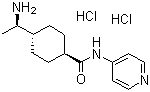 |
| Molecular Formula | C14H21N3O.2(HCl) |
| Molecular Weight | 320.26 |
| CAS Registry Number | 129830-38-2 |
| EC Number | 813-428-5 |
| SMILES | C[C@H](C1CCC(CC1)C(=O)NC2=CC=NC=C2)N.Cl.Cl |
| Solubility | DMSO 3 mg/mL, Water $lessThan$1 mg/mL, Ethanol 4 mg/mL (Expl.) |
|---|---|
| Hazard Symbols |  GHS07 Warning Details GHS07 Warning Details | ||||||||||||||||
|---|---|---|---|---|---|---|---|---|---|---|---|---|---|---|---|---|---|
| Risk Statements | H302-H302-H312-H332 Details | ||||||||||||||||
| Safety Statements | P261-P264-P270-P271-P280-P301+P317-P302+P352-P304+P340-P317-P321-P330-P362+P364-P501 Details | ||||||||||||||||
| Hazard Classification | |||||||||||||||||
| |||||||||||||||||
| SDS | Available | ||||||||||||||||
 Discovery and Applications
|
Y-27632 dihydrochloride is a small-molecule inhibitor that targets Rho-associated, coiled-coil containing protein kinase (ROCK), specifically the ROCK1 and ROCK2 isoforms. It was developed in the late 1990s as part of efforts to understand the Rho/ROCK signaling pathway, which plays a central role in the regulation of cytoskeletal dynamics, cell contraction, motility, adhesion, proliferation, and apoptosis. The discovery of Y-27632 provided researchers with a highly selective and cell-permeable tool to investigate the physiological and pathological functions of ROCK enzymes in various tissues and disease models. Y-27632 is a pyridine derivative that functions by competitively inhibiting ATP binding at the catalytic site of ROCK. This inhibition reduces the phosphorylation of downstream targets such as myosin light chain (MLC) and LIM kinase, thereby decreasing actomyosin contractility and modifying actin cytoskeleton organization. The compound has been extensively used in vitro and in vivo to study processes related to cell shape, migration, and mechanical force generation. Because of its specificity and reversible binding characteristics, Y-27632 has become a standard pharmacological tool in cell biology and molecular research. One of the most widely known applications of Y-27632 is in the field of regenerative medicine and stem cell biology. The compound significantly enhances the survival and proliferation of dissociated human embryonic stem cells (hESCs) and induced pluripotent stem cells (iPSCs), which are otherwise prone to apoptosis upon single-cell dissociation. The inclusion of Y-27632 in stem cell culture protocols has allowed for more efficient passaging and clonal expansion, enabling the generation of uniform cell populations for research and therapeutic purposes. Y-27632 has also been used to investigate the role of ROCK signaling in neurological diseases, cardiovascular disorders, and cancer. In models of neurodegenerative diseases, the inhibition of ROCK activity with Y-27632 has demonstrated neuroprotective effects, including the promotion of axonal regeneration and neuronal survival. In cardiovascular research, the compound has shown the ability to reduce vascular smooth muscle contraction, lower blood pressure, and prevent cardiac remodeling in experimental models of hypertension and heart failure. In the context of ophthalmology, Y-27632 has been studied for its potential to lower intraocular pressure in models of glaucoma by improving aqueous humor outflow through the trabecular meshwork. In dermatology, the compound has shown promise in promoting wound healing and re-epithelialization due to its effects on keratinocyte migration and adhesion. The compound has been evaluated for its role in modulating immune cell function, particularly in the context of inflammation and autoimmune diseases. By inhibiting ROCK-mediated pathways, Y-27632 can influence leukocyte adhesion, migration, and cytokine production, making it a potential therapeutic candidate in conditions involving chronic inflammation. Despite its wide utility in research, Y-27632 has limitations for clinical application, primarily due to its short half-life and off-target effects at high concentrations. However, it has served as a foundational molecule that inspired the development of second-generation ROCK inhibitors with improved pharmacokinetic properties for therapeutic use. These derivatives are being tested in clinical trials for a variety of diseases, including pulmonary arterial hypertension, fibrotic disorders, and diabetic complications. Y-27632 dihydrochloride remains a valuable tool compound in scientific research, facilitating the exploration of Rho/ROCK pathway biology and contributing to the development of novel therapeutic approaches. Its discovery marked a pivotal moment in the understanding of cytoskeletal regulation and continues to impact a wide range of biomedical disciplines. References 2004. Synthesis and evaluation of 4-(1-aminoalkyl)-N-(4-pyridyl)cyclohexanecarboxamides as Rho kinase inhibitors and neurite outgrowth promoters. Bioorganic & Medicinal Chemistry Letters, 14(19). DOI: 10.1016/j.bmcl.2004.07.025 2014. The Rho-kinase inhibitor HA-1077 suppresses proliferation/migration and induces apoptosis of urothelial cancer cells. BMC Cancer, 14. DOI: 10.1186/1471-2407-14-412 2023. Target Class Profiling of Small-Molecule Methyltransferases. ACS Chemical Biology, 18(4). DOI: 10.1021/acschembio.3c00124 |
| Market Analysis Reports |