
Online Database of Chemicals from Around the World
| Taizhou Crene Biotechnology Co., Ltd. | China | |||
|---|---|---|---|---|
 | www.pharm-intermediates.com | |||
 | +86 (576) 8881-3233 8820-5808 +86 13396860566 | |||
 | +86 (576) 8822-9589 | |||
 | sales@pharm-intermediates.com | |||
 | QQ Chat | |||
| Chemical manufacturer since 2011 | ||||
| chemBlink Standard supplier since 2009 | ||||
| BOC Sciences | USA | |||
|---|---|---|---|---|
| www.bocsci.com | |||
| +1 (631) 485-4226 | |||
| +1 (631) 614-7828 | |||
| info@bocsci.com | |||
| Chemical manufacturer | ||||
| chemBlink Standard supplier since 2010 | ||||
| Creative Peptides | USA | |||
|---|---|---|---|---|
| www.creative-peptides.com | |||
| +1 (631) 624-4882 | |||
| +1 (631) 614-7828 | |||
| info@creative-peptides.com | |||
| Chemical manufacturer | ||||
| chemBlink Standard supplier since 2010 | ||||
| ShangHai Anfen Chemical Co., Ltd. | China | |||
|---|---|---|---|---|
| www.anfenchemical.com | |||
| +86 (21) 6054-1996 +86 13816959437 | |||
| +86 (21) 6192-4103 | |||
| sales@anfenchemical.com anfenchem@163.com | |||
| Chemical manufacturer since 2011 | ||||
| chemBlink Standard supplier since 2012 | ||||
| Apexbio Technology LLC | USA | |||
|---|---|---|---|---|
| www.apexbt.com | |||
| +1 (832) 696-8203 | |||
| +1 (855) 527-3928 | |||
| info@apexbt.com | |||
| Chemical manufacturer since 2012 | ||||
| chemBlink Standard supplier since 2013 | ||||
| Selleck China | China | |||
|---|---|---|---|---|
| www.selleckchem.cn | |||
| +86 (21) 6859-1985 | |||
| selleckchina@gmail.com | |||
| Chemical manufacturer since 2006 | ||||
| chemBlink Standard supplier since 2013 | ||||
| Selleck Chemicals LLC | USA | |||
|---|---|---|---|---|
| www.selleckchem.com | |||
| +1 (713) 535-9129 | |||
| +1 (832) 582-8590 | |||
| info@selleckchem.com | |||
| Chemical manufacturer | ||||
| chemBlink Standard supplier since 2014 | ||||
| Shanghai Zehan Biopharma Technology Co., Ltd. | China | |||
|---|---|---|---|---|
| www.zehanbiopharma.com | |||
| +86 (21) 6135-0663 +86 13052117465 | |||
| +86 (21) 6135-0662 | |||
| sales@zehanbiopharma.com | |||
| QQ Chat | |||
| Chemical manufacturer since 2015 | ||||
| chemBlink Standard supplier since 2015 | ||||
| Amadis Chemical Co., Ltd. | China | |||
|---|---|---|---|---|
| www.amadischem.com | |||
| +86 (571) 8992-5085 | |||
| +86 (571) 8992-5065 | |||
| sales@amadischem.com | |||
| Chemical manufacturer since 2010 | ||||
| chemBlink Standard supplier since 2015 | ||||
| Targetmol Chemicals Inc. | USA | |||
|---|---|---|---|---|
| www.targetmol.com | |||
| +1 (781) 999-5354 | |||
| +1 (781) 281-9145 | |||
| sales@targetmol.com | |||
| Chemical manufacturer since 2013 | ||||
| chemBlink Standard supplier since 2025 | ||||
| LKT Laboratories, Inc. | USA | |||
|---|---|---|---|---|
| www.lktlabs.com | |||
| +1 (888) 558-5227 | |||
| +1 (651) 644-8357 | |||
| peacerli@mbolin-lktlabs.com | |||
| Chemical manufacturer | ||||
| VDM Biochemicals | USA | |||
|---|---|---|---|---|
| www.vdmbio.com | |||
| +1 (330) 252-8181 | |||
| +1 (330) 252-8171 | |||
| sales@vdmbio.com info@vdmbio.com | |||
| Chemical manufacturer | ||||
| Santa Cruz Biotechnology, Inc. | USA | |||
|---|---|---|---|---|
| www.scbt.com | |||
| +1 (831) 457-3800 | |||
| +1 (831) 457-3801 | |||
| scbt@scbt.com | |||
| Chemical manufacturer | ||||
| Classification | Biochemical >> Inhibitor >> Proteases >> Proteasome inhibitor |
|---|---|
| Name | MG 132 |
| Synonyms | Calpain inhibitor IV-2; N-[(Phenylmethoxy)carbonyl]-L-leucyl-N-[(1S)-1-formyl-3-methylbutyl]-L-leucinamide |
| Molecular Structure | 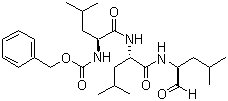 |
| Molecular Formula | C26H41N3O5 |
| Molecular Weight | 475.62 |
| Protein Sequence | LLL |
| CAS Registry Number | 133407-82-6 |
| EC Number | 849-040-8 |
| SMILES | CC(C)C[C@@H](C=O)NC(=O)[C@H](CC(C)C)NC(=O)[C@H](CC(C)C)NC(=O)OCC1=CC=CC=C1 |
| Density | 1.1±0.1 g/cm3 Calc.* |
|---|---|
| Boiling point | 682.0±55.0 °C 760 mmHg (Calc.)* |
| Flash point | 366.3±31.5 °C (Calc.)* |
| Solubility | 100mM (DMSO), 100mM (ethanol) (Expl.) |
| Index of refraction | 1.506 (Calc.)* |
| * | Calculated using Advanced Chemistry Development (ACD/Labs) Software. |
| Hazard Symbols |  GHS07 Warning Details GHS07 Warning Details | ||||||||||||||||
|---|---|---|---|---|---|---|---|---|---|---|---|---|---|---|---|---|---|
| Risk Statements | H315-H319-H335 Details | ||||||||||||||||
| Safety Statements | P261-P264-P264+P265-P271-P280-P302+P352-P304+P340-P305+P351+P338-P319-P321-P332+P317-P337+P317-P362+P364-P403+P233-P405-P501 Details | ||||||||||||||||
| Hazard Classification | |||||||||||||||||
| |||||||||||||||||
| SDS | Available | ||||||||||||||||
 Discovery and Applications
|
MG 132 is a potent, reversible, and cell-permeable proteasome inhibitor that has been widely used in biological research to study protein degradation and the ubiquitin-proteasome system. It is a peptide aldehyde that specifically inhibits the chymotrypsin-like activity of the 26S proteasome, a large protease complex responsible for the regulated degradation of intracellular proteins. This compound has significantly contributed to the understanding of cellular protein turnover and its role in numerous physiological and pathological processes. The discovery of MG 132 emerged from efforts to identify small molecules capable of blocking proteasome function, particularly those affecting antigen presentation and cell cycle progression. As a synthetic derivative of the naturally occurring proteasome inhibitor MG-115, MG 132 showed improved stability and efficacy in cell-based assays. It operates by covalently binding to the active site threonine residue of the proteasome’s catalytic subunit, thereby preventing the breakdown of polyubiquitinated proteins. MG 132 has been extensively used as a research tool to induce the accumulation of ubiquitinated proteins in cells, thereby enabling the study of proteasomal degradation mechanisms and related cellular pathways. Its inhibition of proteasomal activity leads to the stabilization of short-lived regulatory proteins, including p53, IκBα, and cyclins. These effects have helped uncover the roles of protein degradation in processes such as apoptosis, cell cycle regulation, and inflammation. One of the critical applications of MG 132 is in studying the nuclear factor kappa-light-chain-enhancer of activated B cells (NF-κB) signaling pathway. Normally, NF-κB is retained in the cytoplasm by its inhibitor IκBα. Upon stimulation, IκBα is phosphorylated, ubiquitinated, and degraded by the proteasome, allowing NF-κB to translocate to the nucleus. MG 132 blocks this degradation, thereby preventing NF-κB activation and enabling detailed investigations into inflammatory signaling and immune responses. In cancer research, MG 132 has been instrumental in elucidating the dependency of tumor cells on proteasome-mediated protein turnover. It induces cell cycle arrest and apoptosis in various cancer cell lines, primarily through the accumulation of pro-apoptotic proteins and inhibition of anti-apoptotic signaling. These findings have helped validate the proteasome as a target for anticancer therapy and have contributed to the development of clinically approved drugs such as bortezomib. Beyond oncology, MG 132 has also been used to model neurodegenerative diseases, in which impaired proteasome function and protein aggregation play key roles. By inhibiting proteasome activity in neuronal cells, MG 132 induces the accumulation of misfolded proteins, mimicking the cellular stress observed in disorders like Parkinson’s and Alzheimer’s diseases. This model system has been used to investigate mechanisms of neuronal death and to evaluate potential neuroprotective compounds. Despite its utility, MG 132 exhibits certain limitations, including its relatively low specificity and potential off-target effects due to its reactive aldehyde group. It can inhibit other proteases such as calpains and lysosomal cysteine proteases at higher concentrations. Additionally, its use is primarily confined to in vitro and cell-based studies, as it lacks the pharmacokinetic properties suitable for in vivo therapeutic applications. Nonetheless, MG 132 remains a cornerstone compound in molecular and cellular biology. Its capacity to disrupt proteasome function with high potency has provided researchers with a reliable tool to study a wide range of cellular events linked to protein homeostasis. The compound’s discovery has greatly advanced the field of proteostasis research and has paved the way for the development of more refined and clinically viable proteasome inhibitors. References 2003. Proteasome inhibition: a new anti-inflammatory strategy. Journal of Molecular Medicine, 81(4). DOI: 10.1007/s00109-003-0422-2 2007. The co-chaperone CHIP is induced in various stresses and confers protection to cells. Biochemical and Biophysical Research Communications, 357(2). DOI: 10.1016/j.bbrc.2007.04.018 2024. Light-Induced Degradation and Nocturnal Retrograde Movement of Nonexpressor of Pathogenesis-Related Genes 1 from the Chloroplasts to the Nucleus. Journal of Plant Biology, 67(2). DOI: 10.1007/s12374-024-09432-w |
| Market Analysis Reports |