
Online Database of Chemicals from Around the World
| Trademax Pharmaceuticals & Chemicals Co., Ltd. | China | |||
|---|---|---|---|---|
 | www.trademaxchem.com | |||
 | +86 (21) 5238-7770 | |||
 | +86 (21) 5238-7129 | |||
 | trademax@trademaxchem.com | |||
| Chemical distributor since 2001 | ||||
| chemBlink Standard supplier since 2006 | ||||
| Capot Chemical Co., Ltd. | China | |||
|---|---|---|---|---|
| www.capotchem.com | |||
| +86 (571) 8558-6718 +86 13336195806 | |||
| +86 (571) 8586-4795 | |||
| capotchem@gmail.com sales@capotchem.com | |||
 | QQ Chat | |||
| Chemical manufacturer | ||||
| chemBlink Standard supplier since 2006 | ||||
| Tyger Scientific Inc. | USA | |||
|---|---|---|---|---|
| www.tygersci.com | |||
| +1 (609) 434-0144 | |||
| +1 (609) 434-0143 | |||
| sales@tygersci.com | |||
| Chemical manufacturer since 1992 | ||||
| chemBlink Standard supplier since 2008 | ||||
| Jilin Optical and Electronic Materials Co., Ltd. | China | |||
|---|---|---|---|---|
| www.jl-oled.com | |||
| +86 (431) 8583-4771 | |||
| +86 (431) 8583-4772 | |||
| sales1@jl-oled.com | |||
| Chemical manufacturer since 2005 | ||||
| chemBlink Standard supplier since 2010 | ||||
| Earlier HK Company Limited | China | |||
|---|---|---|---|---|
| www.earlierchem.com | |||
| +86 (10) 6142-6769 +86 18616907430 | |||
| +86 (10) 6142-6769 | |||
| info@earlierchem.com | |||
| QQ Chat | |||
| Chemical manufacturer since 2011 | ||||
| chemBlink Standard supplier since 2013 | ||||
| Hangzhou Leap Chem Co., Ltd. | China | |||
|---|---|---|---|---|
| www.leapchem.com | |||
| +86 (571) 8771-1850 | |||
| market19@leapchem.com | |||
| QQ Chat | |||
| Chemical manufacturer since 2006 | ||||
| chemBlink Standard supplier since 2015 | ||||
| Luminescence Technology Corp. | Taiwan | |||
|---|---|---|---|---|
| www.lumtec.com.tw | |||
| +886 (2) 2697-5600 | |||
| +886 (2) 2697-5601 | |||
| sales@lumtec.com.tw | |||
| Chemical manufacturer since 1999 | ||||
| chemBlink Standard supplier since 2024 | ||||
| H. W. Sands | USA | |||
|---|---|---|---|---|
| www.hwsands.com | |||
| +1 (561) 743-8090 | |||
| +1 (561) 743-4088 | |||
| customerservice@hwsands.com | |||
| Chemical manufacturer since 1983 | ||||
| Springchem & Jadetextile Group Limited | China | |||
|---|---|---|---|---|
| www.spring-chem.com | |||
| +86 (21) 5175-2788 5175-2786 | |||
| +86 (21) 5175-2789 | |||
| shachunyu@spring-chem.com | |||
| Chemical manufacturer | ||||
| Classification | Pharmaceutical intermediate >> OLED material intermediate |
|---|---|
| Name | 4,4',4''-Tris(carbazol-9-yl)-triphenylamine |
| Synonyms | TCTA; 4-carbazol-9-yl-N,N-bis(4-carbazol-9-ylphenyl)aniline |
| Molecular Structure | 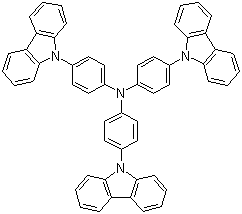 |
| Molecular Formula | C54H36N4 |
| Molecular Weight | 740.90 |
| CAS Registry Number | 139092-78-7 |
| EC Number | 625-738-6 |
| SMILES | C1=CC=C2C(=C1)C3=CC=CC=C3N2C4=CC=C(C=C4)N(C5=CC=C(C=C5)N6C7=CC=CC=C7C8=CC=CC=C86)C9=CC=C(C=C9)N1C2=CC=CC=C2C2=CC=CC=C21 |
| Density | 1.2±0.1 g/cm3, Calc.* |
|---|---|
| Melting point | 179-183 °C (Expl.) |
| Index of Refraction | 1.718, Calc.* |
| * | Calculated using Advanced Chemistry Development (ACD/Labs) Software. |
| Hazard Symbols |  GHS07 Warning Details GHS07 Warning Details | ||||||||||||||||
|---|---|---|---|---|---|---|---|---|---|---|---|---|---|---|---|---|---|
| Risk Statements | H315-H319-H335 Details | ||||||||||||||||
| Safety Statements | P261-P264-P264+P265-P271-P280-P302+P352-P304+P340-P305+P351+P338-P319-P321-P332+P317-P337+P317-P362+P364-P403+P233-P405-P501 Details | ||||||||||||||||
| Hazard Classification | |||||||||||||||||
| |||||||||||||||||
| SDS | Available | ||||||||||||||||
 Discovery and Applications
|
4,4',4''-Tris(carbazol-9-yl)-triphenylamine is an organic compound that has gained significant attention in the field of organic electronics, particularly for its use in organic light-emitting diodes (OLEDs) and organic solar cells. The molecule is composed of a triphenylamine core with three carbazole groups attached at the 9-position of each carbazole ring. This structure confers excellent electronic properties, making it a valuable material for a wide range of optoelectronic applications. The discovery of 4,4',4''-Tris(carbazol-9-yl)-triphenylamine can be traced back to the need for high-performance organic materials in electronic devices. Researchers sought to design molecules that could enhance charge transport and light-emitting efficiency in OLEDs. The incorporation of carbazole units into the triphenylamine structure was found to improve both the stability and the electronic properties of the compound. The carbazole groups, known for their good electron-donating abilities, help facilitate charge injection and transport in OLEDs, while the triphenylamine core provides the molecule with stability and excellent electronic characteristics. The primary application of 4,4',4''-Tris(carbazol-9-yl)-triphenylamine is in OLEDs, where it is used as a hole transport material. In OLED devices, efficient charge transport is essential for optimal performance, and this compound has been shown to significantly improve the efficiency of OLEDs by enhancing hole injection and transport. The molecule’s high thermal stability and good solubility in common organic solvents also make it suitable for solution-based processing techniques, such as spin-coating and inkjet printing, which are commonly used in the fabrication of organic electronic devices. In addition to OLEDs, 4,4',4''-Tris(carbazol-9-yl)-triphenylamine has been explored for use in organic solar cells. The molecule’s ability to facilitate charge transport and its high hole mobility make it an attractive candidate for use as a hole transport material in these devices as well. By improving the efficiency of charge collection and transport in the active layer, the compound can help enhance the overall power conversion efficiency of organic solar cells, making them more viable for commercial applications. The compound has also been investigated for its potential in other optoelectronic devices, such as organic field-effect transistors (OFETs) and light-emitting field-effect transistors (LEFETs). Its electronic properties, coupled with its ease of processing and stability, make it a versatile material in the development of flexible and lightweight electronic devices. Despite its promising applications, the commercial use of 4,4',4''-Tris(carbazol-9-yl)-triphenylamine is still limited by challenges related to its production cost and scalability. As research continues into improving the synthesis and processing techniques for this compound, it is expected that its role in organic electronics will continue to expand, contributing to the development of more efficient and cost-effective devices in the future. References 2010. Highly Luminescent Tetradentate Bis-Cyclometalated Platinum Complexes: Design, Synthesis, Structure, Photophysics, and Electroluminescence Application. Inorganic Chemistry. DOI: 10.1021/ic1002226 2022. Recent advances in solution-processed organic and perovskite nanocrystal light-emitting devices. Polymer Journal. DOI: 10.1038/s41428-022-00640-0 2023. Ultrapure green organic light-emitting diodes based on highly distorted fused π-conjugated molecular design. Nature Photonics. DOI: 10.1038/s41566-022-01106-8 |
| Market Analysis Reports |