
Online Database of Chemicals from Around the World
| Wuhan Kemi-works Chemical Co., Ltd. | China | |||
|---|---|---|---|---|
 | www.kemiworks.net | |||
 | +86 (27) 8573-6489 | |||
 | +86 (27) 8573-6485 | |||
 | info@kemiworks.net sales@kemiworks.com | |||
| Chemical manufacturer | ||||
| chemBlink Premium supplier since 2011 | ||||
| Classification | Chemical reagent >> Silane reagent |
|---|---|
| Name | Phenyltris(trimethylsiloxy)silane |
| Synonyms | Tris(trimethylsiloxy)phenylsilane |
| Molecular Structure | 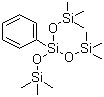 |
| Molecular Formula | C15H32O3Si4 |
| Molecular Weight | 372.76 |
| CAS Registry Number | 2116-84-9 (9076-37-3) |
| EC Number | 218-320-6 |
| SMILES | C[Si](C)(C)O[Si](C1=CC=CC=C1)(O[Si](C)(C)C)O[Si](C)(C)C |
| Density | 0.9±0.1 g/cm3, Calc.*, 0.924 g/mL (Expl.) |
|---|---|
| Melting point | -102 °C (Expl.) |
| Index of Refraction | 1.458, Calc.*, 1.437 (Expl.) |
| Boiling Point | 315.4±25.0 °C (760 mmHg), Calc.*, 264 °C (Expl.) |
| Flash Point | 128.6±23.6 °C, Calc.*, 127 °C (Expl.) |
| * | Calculated using Advanced Chemistry Development (ACD/Labs) Software. |
| Hazard Symbols |   GHS06;GHS07 Danger Details GHS06;GHS07 Danger Details | ||||||||||||||||||||||||
|---|---|---|---|---|---|---|---|---|---|---|---|---|---|---|---|---|---|---|---|---|---|---|---|---|---|
| Risk Statements | H315-H319-H330-H335 Details | ||||||||||||||||||||||||
| Safety Statements | P260-P261-P264-P264+P265-P271-P280-P284-P302+P352-P304+P340-P305+P351+P338-P316-P319-P320-P321-P332+P317-P337+P317-P362+P364-P403+P233-P405-P501 Details | ||||||||||||||||||||||||
| Hazard Classification | |||||||||||||||||||||||||
| |||||||||||||||||||||||||
| SDS | Available | ||||||||||||||||||||||||
 chemBlink Chemical Story
|
Phenyltris(trimethylsiloxy)silane is an organosilicon compound with the molecular formula C9H12O3Si, consisting of a phenyl group attached to a silicon atom, which is further bonded to three trimethylsiloxy groups. The structure of the compound contributes to its distinctive chemical properties, particularly its versatility and reactivity in various industrial applications. This compound is part of the broader class of silane compounds, which are widely studied and utilized due to their ability to form strong bonds with both organic and inorganic materials. The discovery and synthesis of phenyltris(trimethylsiloxy)silane is often attributed to ongoing research in the field of siloxane chemistry, which has led to a variety of compounds with unique properties useful in numerous industrial and commercial applications. The development of phenyltris(trimethylsiloxy)silane can be traced back to the exploration of silane chemistry in the 20th century. Silanes, compounds containing silicon atoms bonded to organic groups, became a key area of research due to their usefulness as intermediates in the synthesis of various materials, such as adhesives, coatings, and electronic devices. The modification of the silicon atom with different organic groups, such as phenyl and trimethylsiloxy, leads to compounds with enhanced stability, solubility, and reactivity, enabling their use in a wide range of applications. Phenyltris(trimethylsiloxy)silane, in particular, has attracted attention due to the combined presence of both phenyl and trimethylsiloxy groups, which contribute to its unique set of properties. The synthesis of phenyltris(trimethylsiloxy)silane is typically achieved through a process involving the reaction of phenylsilane with trimethylsiloxy groups in the presence of a catalyst. The reaction conditions, including temperature, solvent, and time, are carefully controlled to ensure the efficient formation of the desired compound. The process is relatively straightforward, but the choice of catalyst and reaction conditions plays a significant role in determining the yield and purity of the final product. This compound is typically produced on a small to medium scale in specialized laboratories and chemical production facilities, where silane-based compounds are synthesized for various applications. One of the primary applications of phenyltris(trimethylsiloxy)silane is as a coupling agent in the production of silicone-based materials. In this role, the compound serves as a bridge between organic and inorganic materials, promoting better adhesion between surfaces that would otherwise have difficulty bonding. The presence of both the phenyl group and trimethylsiloxy groups enhances the interaction between the silane and the materials being bonded, making it an essential component in the production of high-performance adhesives, sealants, and coatings. These materials are widely used in industries such as construction, automotive, and electronics, where strong, durable bonds are essential for product reliability and performance. In addition to its use as a coupling agent, phenyltris(trimethylsiloxy)silane is also employed in the manufacture of advanced coatings and surface treatments. The compound's ability to form stable bonds with various substrates makes it useful in applications where surface protection is critical. For example, it is used in the production of water-repellent coatings for glass, metal, and plastic surfaces. These coatings provide enhanced resistance to moisture, chemicals, and environmental degradation, extending the lifespan of the materials they protect. In electronics, phenyltris(trimethylsiloxy)silane is used to create protective layers for semiconductor devices, where its properties contribute to the reliability and longevity of the components. Another area where phenyltris(trimethylsiloxy)silane has found significant use is in the field of polymer modification. The compound is incorporated into polymers to improve their mechanical properties, such as tensile strength, flexibility, and resistance to wear and tear. The addition of phenyltris(trimethylsiloxy)silane to polymer matrices enhances the overall performance of the material, making it more suitable for demanding applications in industries such as automotive manufacturing and aerospace. Additionally, the compound's ability to improve the surface characteristics of polymers makes it useful in applications where adhesion to other materials is required, such as in composite materials. In conclusion, phenyltris(trimethylsiloxy)silane is a versatile and important compound in organosilicon chemistry, with a wide range of applications in adhesives, coatings, electronics, and polymer modification. Its unique structure, featuring both phenyl and trimethylsiloxy groups, contributes to its excellent properties, including strong bonding capabilities and enhanced stability. As research into silane chemistry continues to evolve, the potential for new applications and improvements in existing technologies utilizing phenyltris(trimethylsiloxy)silane remains vast. References 2024. Features of polymerization kinetics and heat realize of epoxy resin modified with silicone, silane and siloxane additives. Polymer Bulletin, 81(17). DOI: 10.1007/s00289-024-05357-z 2019. Analysis of Cleaning Efficacy and Clearance of Silicone-Based Pickering-Type Emulsions Used in the Cleaning of Water-Miscible Oil Paints. Conservation of Modern Oil Paintings. DOI: 10.1007/978-3-030-19254-9_42 2015. Cosmetic Products and Hair Health. Healthy Hair. DOI: 10.1007/978-3-319-18386-2_7 |
| Market Analysis Reports |