
Online Database of Chemicals from Around the World
| BOC Sciences | USA | |||
|---|---|---|---|---|
 | www.bocsci.com | |||
 | +1 (631) 485-4226 | |||
 | +1 (631) 614-7828 | |||
 | info@bocsci.com | |||
| Chemical manufacturer | ||||
| chemBlink Standard supplier since 2010 | ||||
| Topscience Co. Ltd. | China | |||
|---|---|---|---|---|
| www.tsbiochem.com | |||
| +86 (400) 820-0310 | |||
| +86 (021) 3469-2979 | |||
| sales@tsbiochem.com | |||
| Chemical manufacturer since 2013 | ||||
| chemBlink Standard supplier since 2012 | ||||
| Caerulum Pharma Discovery Co., Ltd. | China | |||
|---|---|---|---|---|
| www.caerulumpharm.com | |||
| +86 (21) 6455-6180 +86 189149758185 | |||
| +86 (21) 6455-6180 | |||
| sales-cpd@caerulumpharma.com | |||
 | QQ Chat | |||
 | Skype Chat | |||
| Chemical manufacturer since 2012 | ||||
| chemBlink Standard supplier since 2019 | ||||
| R&D Scientific Inc. | Canada | |||
|---|---|---|---|---|
| www.rdscientific.com | |||
| +1 (226) 600-0236 | |||
| sales@rdscientific.com | |||
| Chemical manufacturer since 2016 | ||||
| chemBlink Standard supplier since 2023 | ||||
| Classification | Biochemical >> Inhibitor >> G protein coupled receptor(GPCR & G Protein) |
|---|---|
| Name | Adagrasib |
| Synonyms | 2-[(2S)-4-[7-(8-chloronaphthalen-1-yl)-2-[[(2S)-1-methylpyrrolidin-2-yl]methoxy]-6,8-dihydro-5H-pyrido[3,4-d]pyrimidin-4-yl]-1-(2-fluoroprop-2-enoyl)piperazin-2-yl]acetonitrile |
| Molecular Structure | 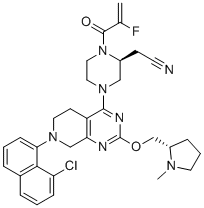 |
| Molecular Formula | C14H13BrO2 |
| Molecular Weight | 604.12 |
| CAS Registry Number | 2326521-71-3 |
| EC Number | 870-640-0 |
| SMILES | CN1CCC[C@H]1COC2=NC3=C(CCN(C3)C4=CC=CC5=C4C(=CC=C5)Cl)C(=N2)N6CCN([C@H](C6)CC#N)C(=O)C(=C)F |
| Density | 1.3±0.1 g/cm3, Calc.* |
|---|---|
| Index of Refraction | 1.618, Calc.* |
| Boiling Point | 860.2±75.0 °C (760 mmHg), Calc.* |
| Flash Point | 474.0±37.1 °C, Calc.* |
| * | Calculated using Advanced Chemistry Development (ACD/Labs) Software. |
| Hazard Symbols |  GHS07 Warning Details GHS07 Warning Details | ||||||||||||||||||||
|---|---|---|---|---|---|---|---|---|---|---|---|---|---|---|---|---|---|---|---|---|---|
| Risk Statements | H302-H315-H319-H335 Details | ||||||||||||||||||||
| Safety Statements | P261-P280-P301+P312-P302+P352-P305+P351+P338 Details | ||||||||||||||||||||
| Hazard Classification | |||||||||||||||||||||
| |||||||||||||||||||||
| SDS | Available | ||||||||||||||||||||
 Discovery and Applications
|
Adagrasib is a targeted small-molecule inhibitor developed to selectively inhibit the KRAS G12C mutant protein, which is a common oncogenic driver mutation found in various cancers, including non-small cell lung cancer (NSCLC), colorectal cancer, and pancreatic cancer. The discovery of adagrasib was motivated by the need to directly target mutant KRAS proteins, which had long been considered “undruggable” due to their high affinity for GTP/GDP and lack of suitable binding pockets. The compound was developed through structure-based drug design, exploiting a unique allosteric pocket that becomes accessible when KRAS is in its inactive GDP-bound state. Adagrasib covalently binds to the cysteine residue at position 12 of the KRAS G12C mutant, locking the protein in an inactive conformation and preventing downstream signaling through the RAS/MAPK pathway, which is critical for cancer cell proliferation and survival. Adagrasib’s development marked a significant breakthrough in cancer therapeutics, as it provided a selective approach to inhibit KRAS G12C-driven tumors with minimal effects on wild-type KRAS, reducing potential toxicity. Its efficacy has been demonstrated in preclinical models, showing potent inhibition of tumor growth and induction of cancer cell death. Clinically, adagrasib has been evaluated in multiple clinical trials for patients with advanced or metastatic cancers harboring the KRAS G12C mutation. It has shown promising results, particularly in NSCLC patients who have received prior therapies, with manageable safety profiles and durable responses. Adagrasib’s approval and ongoing studies have expanded the treatment landscape for cancers driven by KRAS mutations, addressing a critical unmet need. The compound is administered orally, offering convenience and potential for combination therapies with other anticancer agents, including immunotherapies and chemotherapy. Research continues to explore adagrasib’s full therapeutic potential, resistance mechanisms, and its use in various cancer types beyond NSCLC. Adagrasib represents a paradigm shift in precision oncology by successfully targeting a key oncogenic mutation that was once difficult to drug, providing new hope for patients with KRAS G12C-mutant cancers. References 2023. Adagrasib in Advanced Solid Tumors Harboring a KRASG12C Mutation. Journal of Clinical Oncology, 41(25). DOI: 10.1200/JCO.23.00434 2024. Efficacy and Safety of Adagrasib plus Cetuximab in Patients with KRASG12C-Mutated Metastatic Colorectal Cancer. Cancer Discovery, 14(8). DOI: 10.1158/2159-8290.CD-24-0217 2024. Adagrasib in the Treatment of KRAS p.G12C Positive Advanced NSCLC: Design, Development and Place in Therapy. Drug Design, Development and Therapy, 18. DOI: 10.2147/DDDT.S466217 |
| Market Analysis Reports |