
Online Database of Chemicals from Around the World
| Shanghai Worldyang Chemical Co., Ltd. | China | |||
|---|---|---|---|---|
 | www.worldyachem.com | |||
 | +86 13651600618 +86 (21) 5679-5779 | |||
 | +86 (21) 5679-5266 | |||
 | sales7777@worldyachem.com | |||
 | QQ Chat | |||
 | WeChat: 13651600618 | |||
 | WhatsApp:+86 13651600618 | |||
| Chemical manufacturer since 2012 | ||||
| Classification | Dyes and pigments >> Dyes |
|---|---|
| Name | Indigoidine |
| Synonyms | 3-(5-amino-2-hydroxy-6-oxo-1H-pyridin-3-yl)-5-iminopyridine-2,6-dione |
| Molecular Structure | 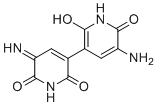 |
| Molecular Formula | C10H8N4O4 |
| Molecular Weight | 248.19 |
| CAS Registry Number | 2435-59-8 |
| SMILES | C1=C(C(=O)NC(=O)C1=N)C2=C(NC(=O)C(=C2)N)O |
| Density | 1.6±0.1 g/cm3, Calc.* |
|---|---|
| Index of Refraction | 1.68, Calc.* |
| Boiling Point | 285.6±40.0 °C (760 mmHg), Calc.* |
| Flash Point | 126.6±27.3 °C, Calc.* |
| * | Calculated using Advanced Chemistry Development (ACD/Labs) Software. |
| Hazard Symbols |   GHS05;GHS07 Danger Details GHS05;GHS07 Danger Details |
|---|---|
| Risk Statements | H302-H314 Details |
| Safety Statements | P264-P270-P271-P280-P303+P361+P353-P304+P340-P305+P351+P338-P310-P330-P331-P363-P403+P233-P501 Details |
| Transport Information | UN 3259 |
| SDS | Available |
 chemBlink Chemical Story
|
Indigoidine is a naturally occurring blue pigment produced by certain bacteria, particularly *Streptomyces* species. The compound has garnered attention due to its potential applications in biotechnology, dye production, and possibly in pharmaceutical fields. Indigoidine’s structure is characterized by a combination of nitrogen-containing heterocycles, contributing to its blue color. Indigoidine was first identified in the late 20th century when researchers were investigating the metabolic pathways of *Streptomyces* species. These microorganisms are known for their ability to produce a variety of bioactive natural products. The discovery of indigoidine highlighted the capacity of *Streptomyces* species to synthesize complex pigments, and it was soon recognized for its structural similarity to indigo, one of the most famous blue dyes. This similarity has led to studies exploring its potential as a sustainable, natural alternative to synthetic indigo, which has traditionally been derived from petrochemical sources. The production of indigoidine in microorganisms is mediated by a biosynthetic pathway that involves multiple enzymatic steps. Central to this pathway is the enzyme indigoidine synthase, which catalyzes the final step of the synthesis, converting precursor molecules into indigoidine. The gene encoding this enzyme, along with other associated genes, has been identified and sequenced in various *Streptomyces* strains, offering insights into the metabolic machinery responsible for its production. In biotechnology, indigoidine has been utilized as a biosynthetic marker or indicator in microbial production processes. Its ability to produce a visible blue color upon synthesis allows researchers to track metabolic activities and monitor the progress of biochemical transformations. This feature makes indigoidine particularly useful in synthetic biology, where color changes can serve as a simple and efficient method to measure the success of genetic modifications in microorganisms. Beyond its role in biotechnology, indigoidine has been explored for its potential applications in the dye industry. Given its blue color and its natural origin, indigoidine has been considered as an alternative to synthetic dyes, which often involve environmentally harmful chemicals and processes. As industries seek more sustainable and eco-friendly alternatives, indigoidine could provide a biotechnologically produced pigment that could be used in textile dyes and other applications requiring blue coloration. The use of indigoidine in such applications could reduce the environmental impact associated with traditional synthetic dyes, which are often derived from non-renewable resources. In addition to its applications in biotechnology and the dye industry, indigoidine has also drawn interest for its potential biological activity. Some studies have suggested that it may possess antimicrobial properties, although further research is needed to explore this potential. Given the increasing demand for natural and bio-based compounds with antimicrobial activities, indigoidine may offer a new avenue for the development of novel bioactive materials, although its medical applications remain an area of ongoing investigation. In conclusion, indigoidine is a naturally occurring blue pigment with potential applications in biotechnology, dye production, and possibly medicine. The compound’s discovery in *Streptomyces* species has contributed to the growing interest in microbial biosynthesis of pigments and other valuable metabolites. Ongoing research into its production, properties, and applications may lead to expanded uses of indigoidine in various industries, particularly in efforts to promote sustainability and reduce reliance on synthetic chemicals. References Jiang, Y., et al., 2017. Microbial biosynthesis of indigoidine: A blue pigment with applications in synthetic biology and dye production. Frontiers in Microbiology, 8, article 1123. DOI: 10.3389/fmicb.2017.01123 Zhao, M., et al., 2024. Establishment of an efficient expression and regulation system in Streptomyces for economical and high-level production of the natural blue pigment indigoidine. Journal of Agricultural and Food Chemistry, 72(1), pp. 483-492. DOI: 10.1021/acs.jafc.3c05696 Nazari, B., et al., 2017. Biosynthesis and biological activity of indigoidine: A microbial blue pigment with potential applications. MedChemComm, 8(2), pp. 333-340. DOI: 10.1039/C6MD00637J |
| Market Analysis Reports |