
Online Database of Chemicals from Around the World
| Gou Hebei Chemicals | India | |||
|---|---|---|---|---|
 | gouhebeichems.store | |||
 | +86 15874272473 | |||
 | info@gouhebeichems.store | |||
| Chemical distributor since 2009 | ||||
| chemBlink Standard supplier since 2023 | ||||
| Name | N-Pyrrolidino etonitazene |
|---|---|
| Synonyms | 2-[(4-ethoxyphenyl)methyl]-5-nitro-1-(2-pyrrolidin-1-ylethyl)benzimidazole |
| Molecular Structure | 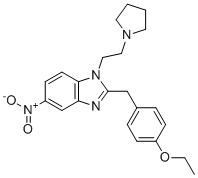 |
| Molecular Formula | C22H26N4O3 |
| Molecular Weight | 394.47 |
| CAS Registry Number | 2785346-75-8 |
| SMILES | CCOC1=CC=C(C=C1)CC2=NC3=C(N2CCN4CCCC4)C=CC(=C3)[N+](=O)[O-] |
| Density | 1.3±0.1 g/cm3, Calc.* |
|---|---|
| Index of Refraction | 1.640, Calc.* |
| Boiling Point | 608.6±50.0 °C (760 mmHg), Calc.* |
| Flash Point | 321.9±30.1 °C, Calc.* |
| * | Calculated using Advanced Chemistry Development (ACD/Labs) Software. |
| SDS | Available |
|---|---|
 chemBlink Chemical Story
|
N-pyrrolidinyl etonizine is a compound belonging to the class of etonizine derivatives and is a potent opioid analgesic. This substance has attracted pharmacological attention due to its high affinity for opioid receptors and potent analgesic properties. N-pyrrolidinyl etonizine was first synthesized and characterized by modification of the structure of etonizine. Etonizine itself is a synthetic opioid that was developed in the mid-20th century and is known for its potent analgesic effects. By introducing a pyrrolidine group into the structure, researchers aimed to alter the pharmacokinetic and pharmacodynamic properties of etonizine, potentially improving its therapeutic properties. The synthesis is the reaction of etonizine with a pyrrolidine derivative under controlled conditions to form N-pyrrolidinyl etonizine. This modification changes the pharmacological properties of the compound, enhances the potency, and may affect its interaction with opioid receptors in the central nervous system. N-pyrrolidinyl etonizine acts primarily as an agonist at the μ-opioid receptor, a key target mediating pain relief and euphoria. Like other opioids, it works by binding to these receptors, thereby modulating the release of neurotransmitters and altering pain perception. It is significantly more potent than morphine, making it ideal for use in situations where intense pain relief is needed. Due to its high efficacy and opioid receptor selectivity, N-pyrrolidinyl etonizine has potential applications in clinical settings where strong analgesia is needed, such as palliative care, anesthesia, and the treatment of severe acute pain. However, its use is strictly regulated due to the potential for dependence, tolerance, and overdose. In medicine, opioids such as N-pyrrolidinyl etonizine are very useful for pain control, especially when other treatments have failed. They are closely supervised in hospital settings and are typically used to treat severe pain when their benefits outweigh the risks. Research on etonizine derivatives, including N-pyrrolidinyl etonizine, continues to explore how to optimize their therapeutic effects while minimizing adverse effects. This includes investigating new methods of administration and formulations to improve safety and efficacy. Although opioids such as N-pyrrolidinoetonizone have potent analgesic effects, they also carry significant risks, including respiratory depression, addiction, and overdose. As a result, their use is strictly regulated and limited to medical professionals trained in opioid pharmacology and pain management. References 21 CFR Sections 1308.11-1308.15. https://www.ecfr.gov/current/title-21/chapter-II/part-1308 |
| Market Analysis Reports |