
Online Database of Chemicals from Around the World
| Beijing Hope International Pharmaceutical Technology Development Co., Ltd. | China | |||
|---|---|---|---|---|
 | www.hopelife.cn | |||
 | +86 (10) 6788-6402 | |||
 | +86 (10) 6788-7110 ex 8016 | |||
 | market@hopelife.cn andychina0528@hotmail.com | |||
| Chemical manufacturer | ||||
| chemBlink Standard supplier since 2007 | ||||
| Extrasynthese Chemical S.A.S. | France | |||
|---|---|---|---|---|
| www.extrasynthese.com | |||
| +33 (47) 898-2034 | |||
| +33 (47) 898-1945 | |||
| info@extrasynthese.com | |||
| Chemical manufacturer | ||||
| chemBlink Standard supplier since 2009 | ||||
| Wilshire Technologies, Inc. | USA | |||
|---|---|---|---|---|
| www.wilshiretechnologies.com | |||
| +1 (609) 683-1117 | |||
| +1 (732) 274-0049 | |||
| Wilshire-info@evonik.com | |||
| Chemical manufacturer since 1997 | ||||
| chemBlink Standard supplier since 2010 | ||||
| Shaanxi Green Bio-Engineering Co., Ltd. | China | |||
|---|---|---|---|---|
| www.sxgreenfine.com | |||
| +86 (29) 8621-5910 8621-5920 8621-5930 | |||
| +86 (29) 8621-5580 | |||
| sxgreenfine@gmail.com rql1107@hotmail.com | |||
| Chemical manufacturer | ||||
| chemBlink Standard supplier since 2010 | ||||
| BOC Sciences | USA | |||
|---|---|---|---|---|
| www.bocsci.com | |||
| +1 (631) 485-4226 | |||
| +1 (631) 614-7828 | |||
| info@bocsci.com | |||
| Chemical manufacturer | ||||
| chemBlink Standard supplier since 2010 | ||||
| Jiangsu Alpha Hawk Chemicals Industrial Corp. | China | |||
|---|---|---|---|---|
| www.njfinechem.com | |||
| +86 (25) 8451-3928 8451-3958 8451-3978 | |||
| +86 (25) 8451-3998 | |||
| salesnjchem@gmail.com | |||
| Chemical manufacturer since 1988 | ||||
| chemBlink Standard supplier since 2011 | ||||
| Shannxi Huike Botanical Development Co., Ltd. | China | |||
|---|---|---|---|---|
| www.huikes.com | |||
| +86 (29) 6266-9896 6266-9893 6266-9894 | |||
| +86 (29) 6266-9899 | |||
| cxj@huikes.com | |||
| Chemical manufacturer since 1998 | ||||
| chemBlink Standard supplier since 2011 | ||||
| Aktin Chemicals Inc | China | |||
|---|---|---|---|---|
| www.aktinchem.com | |||
| +86 400-028-7725 | |||
| +86 (28) 8515-2372 | |||
| info@aktinchem.com | |||
 | QQ Chat | |||
| Chemical manufacturer | ||||
| chemBlink Standard supplier since 2011 | ||||
| Apexbio Technology LLC | USA | |||
|---|---|---|---|---|
| www.apexbt.com | |||
| +1 (832) 696-8203 | |||
| +1 (855) 527-3928 | |||
| info@apexbt.com | |||
| Chemical manufacturer since 2012 | ||||
| chemBlink Standard supplier since 2013 | ||||
| Labseeker Inc | USA | |||
|---|---|---|---|---|
| www.labseeker.com | |||
| +1 (858) 750-1632 | |||
| +1 (858) 412-1220 | |||
| marketing@labseeker.com | |||
| Chemical manufacturer since 2002 | ||||
| chemBlink Standard supplier since 2015 | ||||
| Hangzhou Leap Chem Co., Ltd. | China | |||
|---|---|---|---|---|
| www.leapchem.com | |||
| +86 (571) 8771-1850 | |||
| market19@leapchem.com | |||
| QQ Chat | |||
| Chemical manufacturer since 2006 | ||||
| chemBlink Standard supplier since 2015 | ||||
| Carbosynth China Ltd. | China | |||
|---|---|---|---|---|
| www.carbosynth.cn | |||
| +86 (512) 6260-5585 | |||
| +86 (512) 6260-5576 | |||
| sales@carbosynth.com | |||
| QQ Chat | |||
| Chemical manufacturer since 2006 | ||||
| chemBlink Standard supplier since 2016 | ||||
| Chengdu Biopurify Phytochemicals Ltd. | China | |||
|---|---|---|---|---|
| www.phytopurify.com | |||
| +86 (28) 8263-3860 8263-3987 | |||
| +86 (28) 8263-3165 | |||
| sales@biopurify.com biopurify@gmail.com | |||
| QQ Chat | |||
 | Skype Chat | |||
| Chemical manufacturer | ||||
| chemBlink Standard supplier since 2017 | ||||
| Neostar United (Changzhou) Industrial Co., Ltd. | China | |||
|---|---|---|---|---|
| www.neostarunited.com | |||
| +86 (519) 8555-7386 +86 18015025600 | |||
| +86 (519) 8555-7389 | |||
| marketing1@neostarunited.com | |||
| Chemical distributor since 2014 | ||||
| chemBlink Standard supplier since 2020 | ||||
| Cfm Oskar Tropitzsch GmbH | Germany | |||
|---|---|---|---|---|
| www.cfmot.de | |||
| +49 (9231) 9619-0 | |||
| +49 (9231) 9619-60 | |||
| info@cfmot.de | |||
| Chemical distributor since 1985 | ||||
| chemBlink Standard supplier since 2022 | ||||
| Weiyel Inc | China | |||
|---|---|---|---|---|
| www.weiyel.com | |||
| +44 7421898692 | |||
| ivy@weiyelbncc.com | |||
| QQ Chat | |||
 | WeChat: +8615672728568 | |||
 | WhatsApp:+44 7421898692 | |||
| Chemical manufacturer since 2007 | ||||
| chemBlink Standard supplier since 2024 | ||||
| Chemos GmbH & Co. KG | Germany | |||
|---|---|---|---|---|
| www.chemos.de | |||
| +49 871-966346-0 | |||
| +49 871-966346-13 | |||
| chemos@chemos.de | |||
| Chemical distributor | ||||
| Indofine Chemical Company, Inc. | USA | |||
|---|---|---|---|---|
| www.indofinechemical.com | |||
| +1 (888) 463-6346 | |||
| +1 (908) 359-1179 | |||
| info@indofinechemical.com | |||
| Chemical manufacturer since 1981 | ||||
| Ascent Scientific | UK | |||
|---|---|---|---|---|
| www.ascentscientific.com | |||
| +44 (117) 982-9988 | |||
| +44 (2030) 700-369 | |||
| customerservice@ascentscientific.co.uk | |||
| Chemical manufacturer | ||||
| LKT Laboratories, Inc. | USA | |||
|---|---|---|---|---|
| www.lktlabs.com | |||
| +1 (888) 558-5227 | |||
| +1 (651) 644-8357 | |||
| peacerli@mbolin-lktlabs.com | |||
| Chemical manufacturer | ||||
| Natland International Corporation | USA | |||
|---|---|---|---|---|
| www.natland.com | |||
| +1 (919) 380-9775 | |||
| +1 (919) 380-9886 | |||
| info@natland.com | |||
| Chemical manufacturer | ||||
| Santa Cruz Biotechnology, Inc. | USA | |||
|---|---|---|---|---|
| www.scbt.com | |||
| +1 (831) 457-3800 | |||
| +1 (831) 457-3801 | |||
| scbt@scbt.com | |||
| Chemical manufacturer | ||||
| Ivy Fine Chemicals | USA | |||
|---|---|---|---|---|
| www.ivychem.com | |||
| +1 (856) 465-8550 | |||
| +1 (856) 616-1161 | |||
| sales@ivychem.com | |||
| Chemical manufacturer | ||||
| VDM Biochemicals | USA | |||
|---|---|---|---|---|
| www.vdmbio.com | |||
| +1 (330) 252-8181 | |||
| +1 (330) 252-8171 | |||
| sales@vdmbio.com info@vdmbio.com | |||
| Chemical manufacturer | ||||
| Cambridge Isotope Laboratories, Inc. | USA | |||
|---|---|---|---|---|
| www.isotope.com | |||
| +1 (978) 749-8000 | |||
| +1 (978) 749-2768 | |||
| cilsales@isotope.com | |||
| Chemical manufacturer | ||||
| Sinova Corporation | USA | |||
|---|---|---|---|---|
| www.sinovainc.com | |||
| +1 (301) 961-1525 | |||
| +1 (240) 235-4288 | |||
| sales@sinovainc.com | |||
| Chemical manufacturer | ||||
| Classification | Biochemical >> Natural biochemical product |
|---|---|
| Name | Kaempferol |
| Synonyms | 3,4',5,7-Tetrahydroxyflavone; 3,5,7-Trihydroxy-2-(4-hydroxyphenyl)-4H-1-benzopyran-4-one |
| Molecular Structure | 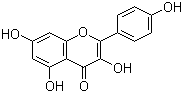 |
| Molecular Formula | C15H10O6 |
| Molecular Weight | 286.24 |
| CAS Registry Number | 520-18-3 |
| EC Number | 208-287-6 |
| SMILES | C1=CC(=CC=C1C2=C(C(=O)C3=C(C=C(C=C3O2)O)O)O)O |
| Density | 1.7±0.1 g/cm3, Calc.* |
|---|---|
| Melting point | 276 °C |
| Index of Refraction | 1.785, Calc.* |
| Boiling Point | 582.1±50.0 °C (760 mmHg), Calc.* |
| Flash Point | 226.1±23.6 °C, Calc.* |
| * | Calculated using Advanced Chemistry Development (ACD/Labs) Software. |
| Hazard Symbols |   GHS06;GHS08 Danger Details GHS06;GHS08 Danger Details | ||||||||||||||||||||||||||||||||
|---|---|---|---|---|---|---|---|---|---|---|---|---|---|---|---|---|---|---|---|---|---|---|---|---|---|---|---|---|---|---|---|---|---|
| Risk Statements | H301-H341 Details | ||||||||||||||||||||||||||||||||
| Safety Statements | P203-P260-P263-P264-P270-P280-P301+P316-P318-P321-P330-P405-P501 Details | ||||||||||||||||||||||||||||||||
| Hazard Classification | |||||||||||||||||||||||||||||||||
| |||||||||||||||||||||||||||||||||
| SDS | Available | ||||||||||||||||||||||||||||||||
 chemBlink Chemical Story
|
Kaempferol is a naturally occurring flavonoid belonging to the flavonol class, widely found in various plants, fruits, and vegetables. The discovery of kaempferol dates back to the early 19th century, with its first identification reported by the German chemist and botanist, K. H. H. G. J. von Kaempfer, after whom the compound is named. Kaempferol is primarily isolated from sources such as kale, spinach, tea, and various fruits like grapes and apples. Its chemical structure consists of a flavone backbone, which contributes to its diverse biological activities. The applications of kaempferol are extensive, particularly in the fields of nutrition and medicine. Research has indicated that kaempferol possesses potent antioxidant properties, which play a crucial role in neutralizing free radicals and reducing oxidative stress in the body. This antioxidant capability is linked to a decreased risk of chronic diseases, including cardiovascular diseases, diabetes, and certain types of cancer. The mechanisms through which kaempferol exerts its beneficial effects include the modulation of cellular signaling pathways and the activation of protective genes. In addition to its antioxidant effects, kaempferol exhibits anti-inflammatory properties. Studies have shown that it can inhibit the production of pro-inflammatory cytokines and enzymes, thereby reducing inflammation in various tissues. This characteristic has garnered interest in kaempferol's potential use as a therapeutic agent in managing inflammatory diseases, such as arthritis and other chronic inflammatory conditions. Kaempferol's role as a health-promoting compound extends to its potential antimicrobial activity. Research indicates that kaempferol can inhibit the growth of various bacteria and fungi, suggesting its usefulness as a natural preservative in food products. This antimicrobial property, combined with its antioxidant capacity, makes kaempferol an attractive candidate for incorporation into functional foods aimed at promoting health and well-being. Furthermore, kaempferol has been investigated for its neuroprotective effects. Some studies suggest that it may help protect neuronal cells from damage associated with neurodegenerative diseases, such as Alzheimer's and Parkinson's disease. Its ability to modulate neurotransmitter systems and reduce neuroinflammation has raised interest in its potential as a therapeutic agent for brain health. In the cosmetic industry, kaempferol is increasingly recognized for its skin-protective properties. Its antioxidant and anti-inflammatory characteristics make it a valuable ingredient in skincare formulations aimed at combating signs of aging and protecting the skin from environmental stressors. As research on kaempferol continues to evolve, its potential applications in dietary supplements, functional foods, and pharmaceutical products are being explored further. The compound’s diverse biological activities highlight its significance in health promotion and disease prevention. References 2007. Kaempferol: A review of its pharmacological properties. Phytochemistry, 68(13). DOI: 10.1016/j.phytochem.2007.03.001 2005. Synthesis and isolation of kaempferol from plant sources. Journal of Agricultural and Food Chemistry, 53(4). DOI: 10.1021/jf047864e 2003. Kaempferol in dietary supplements: Analytical methods. Journal of Agricultural and Food Chemistry, 51(18). DOI: 10.1021/jf025995e |
| Market Analysis Reports |