
Online Database of Chemicals from Around the World
| Alfa Chemistry | USA | Inquire | ||
|---|---|---|---|---|
 |
+1 (201) 478-8534 | |||
 |
inquiry@alfa-chemistry.com | |||
| Chemical distributor since 2012 | ||||
| chemBlink standard supplier since 2012 | ||||
| Shandong Huimeng Biotech Co., Ltd. | China | Inquire | ||
|---|---|---|---|---|
|
+86 (530) 884-2888 +86 18523002917 | |||
|
cindy@szgoldenunion.com | |||
| Chemical manufacturer since 2013 | ||||
| chemBlink standard supplier since 2016 | ||||
| Classification | Pharmaceutical intermediate >> Heterocyclic compound intermediate >> Pyridine compound >> Pyridine derivative |
|---|---|
| Name | 2-Chloro-4-(trichloromethyl)pyridine |
| Molecular Structure | 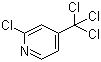 |
| Molecular Formula | C6H3Cl4N |
| Molecular Weight | 230.91 |
| CAS Registry Number | 52413-82-8 |
| SMILES | C1=CN=C(C=C1C(Cl)(Cl)Cl)Cl |
| Density | 1.582±0.1 g/cm3, Calc.* |
|---|---|
| Index of Refraction | 1.576, Calc.* |
| Boiling Point | 282.6±35.0 ºC (760 mmHg), Calc.* |
| Flash Point | 151.8±11.5 ºC, Calc.* |
| * | Calculated using Advanced Chemistry Development (ACD/Labs) Software. |
 Discovory and Applicatios
|
2-Chloro-4-(trichloromethyl)pyridine, with the molecular formula C7H3Cl4N, is an interesting compound in the field of organic chemistry, especially known for its usefulness in agricultural and industrial applications. The chemical's structural feature is that the pyridine ring is replaced by a chlorine atom and a trichloromethyl group, which gives it unique chemical properties. The discovery of 2-chloro-4-(trichloromethyl)pyridine is part of a broader exploration of halogenated pyridines, which are recognized for their reactivity and role as intermediates in chemical synthesis. Researchers have long been looking for compounds that can serve as versatile building blocks in various chemical reactions, and 2-chloro-4-(trichloromethyl)pyridine meets this need due to its ability to participate in many types of chemical transformations. In terms of applications, 2-chloro-4-(trichloromethyl)pyridine is mainly used in the agrochemical industry. It is used as an intermediate in the synthesis of herbicides and fungicides. The presence of the trichloromethyl group significantly increases the reactivity and stability of the compound, making it an important ingredient in the manufacture of effective crop protection agents. These agrochemicals are essential for controlling pests and diseases that affect agricultural productivity, thereby contributing to food security and crop yields. The compound's unique halogenated structure also makes it useful in pharmaceutical development. Its role in the synthesis of various active pharmaceutical ingredients (APIs) stems from its ability to undergo specific chemical transformations that are essential for making complex drug molecules. The trichloromethyl group, in particular, increases the compound's utility by affecting its reactivity and interactions with other chemical entities. In industrial applications beyond agrochemicals and pharmaceuticals, 2-chloro-4-(trichloromethyl)pyridine is used to make specialty chemicals and materials. Its chemical properties make it useful in the production of dyes, polymers, and other industrial chemicals that require precise control of molecular structure and reactivity. The compound's stability under a wide range of conditions makes it a solid choice for these applications. The synthesis of 2-chloro-4-(trichloromethyl)pyridine involves several key steps, typically starting with the chlorination of pyridine followed by the introduction of the trichloromethyl group. These reactions are performed under controlled conditions to achieve the desired substitution pattern on the pyridine ring. Advances in synthetic methods have increased the efficiency and yield of these processes, making the compound more accessible for a variety of uses. Safety and environmental considerations are important when handling 2-chloro-4-(trichloromethyl)pyridine due to its potential hazards. Appropriate safety measures must be taken to minimize exposure and environmental impact. Research into safer handling methods and more environmentally friendly synthetic routes remains an important area of focus for industries using this compound. |
| Market Analysis Reports |
| List of Reports Available for 2-Chloro-4-(trichloromethyl)pyridine |