
Online Database of Chemicals from Around the World
| Junkai (Tianjin) Chemical Co., Ltd. | China | |||
|---|---|---|---|---|
 | www.junkaichem.com | |||
 | +86 (22) 8568-9515 ex 8818 +86 13920864700 | |||
 | +86 (22) 2378-7875 | |||
 | sales@junkaichem.com jane-jkchem@hotmail.com | |||
 | QQ Chat | |||
| Chemical manufacturer since 2005 | ||||
| chemBlink Standard supplier since 2007 | ||||
| Simagchem Corporation | China | |||
|---|---|---|---|---|
| www.simagchem.com | |||
| +86 13806087780 | |||
| +86 (592) 268-0237 | |||
| sale@simagchem.com | |||
| Chemical manufacturer since 2002 | ||||
| chemBlink Standard supplier since 2008 | ||||
| Pratap Organics Pvt. Ltd. | India | |||
|---|---|---|---|---|
| www.prataporganics.com | |||
| +91 (22) 2767-0445 | |||
| +91 (22) 2763-3555 | |||
| marketing@prataporganics.com | |||
| Chemical manufacturer since 1989 | ||||
| chemBlink Standard supplier since 2010 | ||||
| Ningbo Syntame Biotech Co., Ltd. | China | |||
|---|---|---|---|---|
| www.syntame.com | |||
| +86 (574) 2880-2872 | |||
| sales@syntame.com | |||
| Chemical manufacturer since 2017 | ||||
| chemBlink Standard supplier since 2019 | ||||
| Euticals S.p.A. | Italy | |||
|---|---|---|---|---|
| www.euticals.com | |||
| +39 (371) 490-2339 | |||
| +39 (371) 417-635 | |||
| contact@archimica.com | |||
| Chemical manufacturer since 1946 | ||||
| Molekula Ltd | UK | |||
|---|---|---|---|---|
| www.molekula.com | |||
| +44 (1747) 831-066 | |||
| +44 (1747) 831-199 | |||
| info@molekula.com | |||
| Chemical manufacturer | ||||
| Nanjing Hicin Pharmaceutical Co., Ltd. | China | |||
|---|---|---|---|---|
| www.hicinchem.com | |||
| +86 (25) 8360-8920 8324-1000 | |||
| +86 (25) 8320-3820 / 8322-2891 | |||
| hxwang@hicinchem.com | |||
| Chemical manufacturer since 1998 | ||||
| Archimica Inc. | USA | |||
|---|---|---|---|---|
| www.archimica.com | |||
| +1 (302) 994-3043 | |||
| +1 (302) 994-3475 | |||
| contact@archimica.com | |||
| Chemical manufacturer since 1946 | ||||
| Shanghai Worldyang Chemical Co., Ltd. | China | |||
|---|---|---|---|---|
| www.worldyachem.com | |||
| +86 13651600618 +86 (21) 5679-5779 | |||
| +86 (21) 5679-5266 | |||
| sales7777@worldyachem.com | |||
| QQ Chat | |||
 | WeChat: 13651600618 | |||
 | WhatsApp:+86 13651600618 | |||
| Chemical manufacturer since 2012 | ||||
| Wako Pure Chemical Industries, Ltd. | Japan | |||
|---|---|---|---|---|
| www.wako-chem.co.jp | |||
| +81 (6) 6203-3741 | |||
| +81 (6) 6201-5964 | |||
| wkhk.info@fujifilm.com | |||
| Chemical manufacturer since 1922 | ||||
| Wuxi D-Stone International Co., Ltd. | China | |||
|---|---|---|---|---|
| www.d-stone.com.cn | |||
| +86 (510) 8274-0567 | |||
| +86 (510) 8271-1785 | |||
| sales@d-stone.com.cn | |||
| Chemical distributor | ||||
| Classification | Pharmaceutical intermediate >> Heterocyclic compound intermediate >> Piperazine |
|---|---|
| Name | 1-(2-Methoxyphenyl)piperazine hydrochloride |
| Molecular Structure | 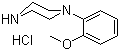 |
| Molecular Formula | C11H16N2O.HCl;C11H17ClN2O |
| Molecular Weight | 228.72 |
| CAS Registry Number | 5464-78-8 |
| EC Number | 226-762-6 |
| SMILES | COC1=CC=CC=C1N2CCNCC2.Cl |
| Melting point | 217-219 °C (Expl.) |
|---|---|
| Hazard Symbols |   GHS06;GHS07 Danger Details GHS06;GHS07 Danger Details | ||||||||||||||||||||||||
|---|---|---|---|---|---|---|---|---|---|---|---|---|---|---|---|---|---|---|---|---|---|---|---|---|---|
| Risk Statements | H301-H315-H319-H335 Details | ||||||||||||||||||||||||
| Safety Statements | P261-P264-P264+P265-P270-P271-P273-P280-P301+P316-P302+P352-P304+P340-P305+P351+P338-P319-P321-P330-P332+P317-P337+P317-P362+P364-P391-P403+P233-P405-P501 Details | ||||||||||||||||||||||||
| Hazard Classification | |||||||||||||||||||||||||
| |||||||||||||||||||||||||
| SDS | Available | ||||||||||||||||||||||||
 chemBlink Chemical Story
|
1-(2-Methoxyphenyl)piperazine hydrochloride is an organic compound that belongs to the class of phenylpiperazine derivatives, which have significant importance in medicinal chemistry. The molecular structure features a methoxy-substituted phenyl ring attached to a piperazine moiety, with the hydrochloride salt form improving its solubility and stability. This compound is widely recognized for its applications in pharmacological research and drug development due to its diverse biological activities. The discovery of 1-(2-methoxyphenyl)piperazine hydrochloride stems from the systematic exploration of piperazine derivatives as bioactive molecules. Early studies focused on modifying the phenyl ring to enhance interaction with biological targets such as neurotransmitter receptors. The introduction of the methoxy group at the ortho position (2-position) was found to confer unique pharmacological properties, improving the compound’s selectivity and efficacy. The hydrochloride salt form was subsequently adopted to facilitate formulation and delivery in experimental and clinical settings. This compound has been extensively studied for its role as a ligand in receptor-binding assays, particularly in serotonin (5-HT) receptor studies. It serves as a valuable tool in neuroscience research, helping to elucidate the mechanisms of neurotransmission and receptor modulation. Its ability to interact with various serotonin receptor subtypes has made it a reference compound in the development of drugs targeting psychiatric and neurological disorders, including depression, anxiety, and schizophrenia. In addition to receptor-binding studies, 1-(2-methoxyphenyl)piperazine hydrochloride has been investigated for its potential therapeutic applications. Modifications of its structure have led to the development of analogs with enhanced activity and specificity. These derivatives have shown promise as candidates for treating central nervous system (CNS) disorders. The compound’s structure-activity relationship (SAR) has provided insights into designing drugs with improved pharmacokinetic profiles and reduced side effects. Beyond its pharmacological applications, the compound has also found use in synthetic organic chemistry as an intermediate in the production of complex molecules. Its reactivity and functional versatility make it a key building block in the synthesis of heterocyclic compounds and other bioactive substances. The compound’s stability and compatibility with various reaction conditions further enhance its utility in chemical synthesis. Analytically, 1-(2-methoxyphenyl)piperazine hydrochloride is employed as a standard in chromatographic and spectroscopic methods, particularly for quality control and assay development in pharmaceutical research. Its well-defined chemical and physical properties make it suitable for method validation and calibration purposes. The role of 1-(2-methoxyphenyl)piperazine hydrochloride in both scientific research and industrial applications underscores its significance as a versatile and impactful chemical substance. Its contributions to understanding neurotransmitter systems and advancing therapeutic agents highlight its importance in the field of medicinal chemistry. References 2021. A target-agnostic screen identifies approved drugs to stabilize the endoplasmic reticulum-resident proteome. Cell Reports, 35(4). DOI: 10.1016/j.celrep.2021.109040 2018. Anti-aggregation effect of aroxyalkyl derivatives of 2-methoxyphenylpiperazine is due to their 5-HT2A and α2-adrenoceptor antagonistic properties. European Journal of Pharmacology, 818. DOI: 10.1016/j.ejphar.2017.10.053 2008. Underestimation of toluene diisocyanate concentration using long-term sampling with 1-(2-methoxyphenyl) piperazine impregnated filters. International Journal of Hygiene and Environmental Health, 211(3-4). DOI: 10.1016/j.ijheh.2007.08.003 |
| Market Analysis Reports |