
Online Database of Chemicals from Around the World
| Hangzhou Verychem Science And Technology Co., Ltd. | China | |||
|---|---|---|---|---|
 | www.verychem.com | |||
 | +86 (571) 8816-2785 +86 13606544505 | |||
 | +86 (571) 8816-2787 | |||
 | lucy@verychem.com | |||
| Chemical manufacturer since 2004 | ||||
| chemBlink Massive supplier since 2021 | ||||
| Epochem Co., Ltd. | China | |||
|---|---|---|---|---|
| www.epochem.com | |||
| +86 (21) 6760-1595 6760-1597 | |||
| +86 (21) 6760-1605 | |||
| seth_wang@epochem.com | |||
 | QQ Chat | |||
| Chemical manufacturer since 2006 | ||||
| chemBlink Standard supplier since 2005 | ||||
| Zhejiang Yixin Pharmaceutical Co., Ltd. | China | |||
|---|---|---|---|---|
| www.herbs-tech.com | |||
| +86 (579) 8886-5135 8886-5136 8886-5105 | |||
| +86 (579) 8886-5169 | |||
| sale@herbs-tech.com | |||
| Chemical manufacturer since 1989 | ||||
| chemBlink Standard supplier since 2006 | ||||
| Bio-sugars Technology Co., Ltd. | China | |||
|---|---|---|---|---|
| www.bio-sugars.com | |||
| +86 (579) 8901-8388 +86 15167971485 | |||
| +86 (579) 8855-6787 | |||
| syngars@hotmail.com | |||
| QQ Chat | |||
| Chemical manufacturer since 2008 | ||||
| chemBlink Standard supplier since 2006 | ||||
| Zhangjiagang Huachang Pharmaceutical Co., Ltd. | China | |||
|---|---|---|---|---|
| www.huachangpharm.com | |||
| +86 (512) 5818-5820 +86 13812985197 | |||
| +86 (512) 5818-2700 | |||
| huachangpharm@163.com | |||
| Chemical manufacturer | ||||
| chemBlink Standard supplier since 2007 | ||||
| Simagchem Corporation | China | |||
|---|---|---|---|---|
| www.simagchem.com | |||
| +86 13806087780 | |||
| +86 (592) 268-0237 | |||
| sale@simagchem.com | |||
| Chemical manufacturer since 2002 | ||||
| chemBlink Standard supplier since 2008 | ||||
| Discovery Fine Chemicals Ltd. | UK | |||
|---|---|---|---|---|
| www.discofinechem.com | |||
| +44 (1202) 874-517 | |||
| +44 (845) 094-4385 | |||
| pjc@discofinechem.com | |||
| Chemical manufacturer | ||||
| chemBlink Standard supplier since 2009 | ||||
| Extrasynthese Chemical S.A.S. | France | |||
|---|---|---|---|---|
| www.extrasynthese.com | |||
| +33 (47) 898-2034 | |||
| +33 (47) 898-1945 | |||
| info@extrasynthese.com | |||
| Chemical manufacturer | ||||
| chemBlink Standard supplier since 2009 | ||||
| Inalco S.p.A. | Italy | |||
|---|---|---|---|---|
| www.inalcogroup.com | |||
| +39 (2) 5521-3005 | |||
| +39 (2) 569-4518 | |||
| f.ottaviani@inalco.it | |||
| Chemical manufacturer | ||||
| chemBlink Standard supplier since 2010 | ||||
| Hefei TNJ Chemical Industry Co., Ltd. | China | |||
|---|---|---|---|---|
| www.tnjchem.com | |||
| +86 (551) 6541-8684 | |||
| +86 (551) 6541-8697 | |||
| sales@tnjchem.com | |||
| Chemical manufacturer since 2001 | ||||
| chemBlink Standard supplier since 2010 | ||||
| Wilshire Technologies, Inc. | USA | |||
|---|---|---|---|---|
| www.wilshiretechnologies.com | |||
| +1 (609) 683-1117 | |||
| +1 (732) 274-0049 | |||
| Wilshire-info@evonik.com | |||
| Chemical manufacturer since 1997 | ||||
| chemBlink Standard supplier since 2010 | ||||
| BOC Sciences | USA | |||
|---|---|---|---|---|
| www.bocsci.com | |||
| +1 (631) 485-4226 | |||
| +1 (631) 614-7828 | |||
| info@bocsci.com | |||
| Chemical manufacturer | ||||
| chemBlink Standard supplier since 2010 | ||||
| Beckmann-Kenko GmbH | Germany | |||
|---|---|---|---|---|
| www.beckmann-kenko.com | |||
| +49 (4241) 930-888 | |||
| +49 (4241) 930-889 | |||
| info@beckmann-kenko.com | |||
| Chemical distributor | ||||
| chemBlink Standard supplier since 2011 | ||||
| Intatrade Chemicals GmbH | Germany | |||
|---|---|---|---|---|
| www.intatrade.de | |||
| +49 (3493) 605-465 | |||
| +49 (3493) 605-470 | |||
| sales@intatrade.de | |||
| Chemical distributor | ||||
| chemBlink Standard supplier since 2011 | ||||
| Chiralblock Bioscience LLC | China | |||
|---|---|---|---|---|
| www.chiralblock.com | |||
| +86 18143482572 | |||
| +86 (571) 8848-7672 | |||
| info@chiralblock.com | |||
| Chemical manufacturer | ||||
| chemBlink Standard supplier since 2012 | ||||
| Nanjing Suntton (China) Co., Ltd. | China | |||
|---|---|---|---|---|
| www.sunttoncn.com | |||
| +86 (25) 8778-0309 | |||
| marketing@sunttoncn.com | |||
| Chemical distributor since 1998 | ||||
| chemBlink Standard supplier since 2012 | ||||
| Biosynth AG. | Switzerland | |||
|---|---|---|---|---|
| www.biosynth.com | |||
| +41 (71) 858-2020 | |||
| +41 (71) 858-2030 | |||
| welcome@biosynth.ch | |||
| Chemical manufacturer | ||||
| chemBlink Standard supplier since 2014 | ||||
| Labseeker Inc | USA | |||
|---|---|---|---|---|
| www.labseeker.com | |||
| +1 (858) 750-1632 | |||
| +1 (858) 412-1220 | |||
| marketing@labseeker.com | |||
| Chemical manufacturer since 2002 | ||||
| chemBlink Standard supplier since 2015 | ||||
| Hangzhou Leap Chem Co., Ltd. | China | |||
|---|---|---|---|---|
| www.leapchem.com | |||
| +86 (571) 8771-1850 | |||
| market19@leapchem.com | |||
| QQ Chat | |||
| Chemical manufacturer since 2006 | ||||
| chemBlink Standard supplier since 2015 | ||||
| Hangzhou Dingyan Chem Co., Ltd. | China | |||
|---|---|---|---|---|
| www.dingyanchem.com | |||
| +86 (571) 8715-7530 | |||
| +86 (571) 8715-6470 | |||
| sales@dingyanchem.com | |||
| Chemical distributor since 2013 | ||||
| chemBlink Standard supplier since 2015 | ||||
| Carbosynth China Ltd. | China | |||
|---|---|---|---|---|
| www.carbosynth.cn | |||
| +86 (512) 6260-5585 | |||
| +86 (512) 6260-5576 | |||
| sales@carbosynth.com | |||
| QQ Chat | |||
| Chemical manufacturer since 2006 | ||||
| chemBlink Standard supplier since 2016 | ||||
| Chengdu Biopurify Phytochemicals Ltd. | China | |||
|---|---|---|---|---|
| www.phytopurify.com | |||
| +86 (28) 8263-3860 8263-3987 | |||
| +86 (28) 8263-3165 | |||
| sales@biopurify.com biopurify@gmail.com | |||
| QQ Chat | |||
 | Skype Chat | |||
| Chemical manufacturer | ||||
| chemBlink Standard supplier since 2017 | ||||
| Anhui Hegeng Biotech Engineering Co., Ltd. | China | |||
|---|---|---|---|---|
| www.hegengbt.com | |||
| +86 (21) 6595-3622 | |||
| sales@hegengbt.com chenxk@hegengbt.com | |||
| QQ Chat | |||
| Chemical manufacturer since 2017 | ||||
| chemBlink Standard supplier since 2020 | ||||
| Neostar United (Changzhou) Industrial Co., Ltd. | China | |||
|---|---|---|---|---|
| www.neostarunited.com | |||
| +86 (519) 8555-7386 +86 18015025600 | |||
| +86 (519) 8555-7389 | |||
| marketing1@neostarunited.com | |||
| Chemical distributor since 2014 | ||||
| chemBlink Standard supplier since 2020 | ||||
| Zhejiang Medicines & Health Products Import & Export Co., Ltd. | China | |||
|---|---|---|---|---|
| www.zmcchina.com | |||
| +86 (0571) 281-9008 | |||
| anna@zmcchina.com | |||
| Chemical distributor since 1984 | ||||
| chemBlink Standard supplier since 2023 | ||||
| Melford Laboratories Limited | UK | |||
|---|---|---|---|---|
| www.melford.co.uk | |||
| +44 (1449) 741-178 | |||
| +44 (1449) 741-217 | |||
| pfranklin@melford.co.uk sales@melford.co.uk | |||
| Chemical manufacturer since 1985 | ||||
| Indofine Chemical Company, Inc. | USA | |||
|---|---|---|---|---|
| www.indofinechemical.com | |||
| +1 (888) 463-6346 | |||
| +1 (908) 359-1179 | |||
| info@indofinechemical.com | |||
| Chemical manufacturer since 1981 | ||||
| Omicron Biochemicals, Inc. | USA | |||
|---|---|---|---|---|
| www.omicronbio.com | |||
| +1 (574) 287-6910 | |||
| +1 (574) 287-7165 | |||
| omicron@omicronbio.com | |||
| Chemical manufacturer | ||||
| Orgentis Chemicals GmbH | Germany | |||
|---|---|---|---|---|
| www.orgentis.com | |||
| +49 39482-355 | |||
| +49 39482-79071 | |||
| sales@orgentis.com | |||
| Chemical manufacturer since 1991 | ||||
| City Chemical LLC | USA | |||
|---|---|---|---|---|
| www.citychemical.com | |||
| +1 (203) 932-2489 | |||
| +1 (203) 937-8400 | |||
| sales@citychemical.com | |||
| Chemical distributor | ||||
| ChemPur GmbH | Germany | |||
|---|---|---|---|---|
| www.chempur.de | |||
| +49 (721) 933-840 | |||
| +49 (721) 47-2001 | |||
| info@chempur.de | |||
| Chemical manufacturer | ||||
| Chemos GmbH & Co. KG | Germany | |||
|---|---|---|---|---|
| www.chemos.de | |||
| +49 871-966346-0 | |||
| +49 871-966346-13 | |||
| chemos@chemos.de | |||
| Chemical distributor | ||||
| Carbone Scientific Co., Ltd. | UK | |||
|---|---|---|---|---|
| www.carbonesci.com | |||
| +44 (870) 486-8629 | |||
| +44 (870) 288-7399 | |||
| sales@carbonesci.com | |||
| Chemical distributor | ||||
| Alfa Aesar. | USA | |||
|---|---|---|---|---|
| www.alfa.com | |||
| +1 (978) 521-6300 | |||
| +1 (978) 521-6350 | |||
| info@alfa.com | |||
| Chemical manufacturer | ||||
| Avonchem/Chromos Express Ltd. | UK | |||
|---|---|---|---|---|
| www.avonchem.co.uk | |||
| +44 (1625) 434-300 | |||
| +44 (1625) 869-777 | |||
| info@avonchem.co.uk | |||
| Chemical manufacturer | ||||
| Shanghai Worldyang Chemical Co., Ltd. | China | |||
|---|---|---|---|---|
| www.worldyachem.com | |||
| +86 13651600618 +86 (21) 5679-5779 | |||
| +86 (21) 5679-5266 | |||
| sales7777@worldyachem.com | |||
| QQ Chat | |||
 | WeChat: 13651600618 | |||
 | WhatsApp:+86 13651600618 | |||
| Chemical manufacturer since 2012 | ||||
| Classification | Biochemical >> Carbohydrate >> Monosaccharide |
|---|---|
| Name | D-Galactose |
| Molecular Structure | 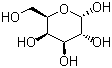 |
| Molecular Formula | C6H12O6 |
| Molecular Weight | 180.16 |
| CAS Registry Number | 59-23-4 |
| EC Number | 200-416-4 |
| SMILES | C([C@H]([C@@H]([C@@H]([C@H](C=O)O)O)O)O)O |
| Solubility | 100 mg/mL (water) |
|---|---|
| Density | 1.5 g/mL |
| Melting point | 165-168 °C |
| alpha | 80 |
| Hazard Symbols |  GHS07 Warning Details GHS07 Warning Details |
|---|---|
| Risk Statements | H302-H315-H319-H335 Details |
| Safety Statements | P261-P264-P270-P271-P280-P301+P312+P330-P302+P352-P304+P340+P312-P305+P351+P338-P332+P313-P337+P313-P362-P403+P233-P405-P501 Details |
| SDS | Available |
 Discovery and Applications
|
D-galactose is a monosaccharide and the C-4 diastereomer of glucose that was first isolated and identified in the early 20th century. Its discovery stemmed from studies of lactose hydrolysis, when it was found to form the disaccharide lactose together with D-glucose. Structurally, D-galactose has a six-carbon chain with an aldehyde group (CHO) on the first carbon and a hydroxyl group (-OH) on the fourth carbon, differing from glucose by the position of the hydroxyl group on C-4. In biological systems, D-galactose plays several important roles: It is primarily metabolized in the liver via the Leloir pathway, involving enzymes such as galactokinase, galactose-1-phosphate uridyltransferase (GALT), and UDP-galactose 4-epimerase. This pathway converts D-galactose to glucose-1-phosphate, which is used for energy production or glycogen synthesis. D-galactose is a component of cell surface glycoproteins, glycolipids, and glycosaminoglycans. These structures play important roles in cell-to-cell recognition, signaling, and immune responses. D-galactose is used in clinical diagnostics to assess liver function. The galactose challenge test assesses liver function by measuring the body's ability to metabolize D-galactose. Impaired metabolism indicates liver dysfunction. In biomedical research, D-galactose is used to induce aging models in experimental animals. Long-term administration of D-galactose can mimic oxidative stress and accelerate aging-related changes in various organs. D-galactose and its derivatives are used as sweeteners and flavor enhancers in food processing. They contribute to the taste of dairy products, and they occur naturally in lactose. D-galactose derivatives are building blocks for the synthesis of complex carbohydrates and pharmaceuticals. Its role in the glycosylation process is essential for the creation of bioactive compounds and vaccines. Galactosemia is a genetic disorder caused by a deficiency in GALT enzyme activity, resulting in the accumulation of galactose in tissues. This condition requires strict avoidance of galactose-containing foods, including dairy products, to prevent serious health complications. Research continues to explore the role of D-galactose in the mechanisms of aging and oxidative stress. Animal models using D-galactose provide insights into neurodegenerative diseases, cardiovascular diseases, and metabolic syndrome associated with aging. References 1979. Galactosemia: Alterations in Sulfate Metabolism Secondary to Galactose-1-Phosphate Uridyltransferase Deficiency. Science (New York, N.Y.), 205(4413). DOI: 10.1126/science.472754 2024. κ-Carrageenan Hydrogels as a Sustainable Alternative for Controlled Release of New Biodegradable Molecules with Antimicrobial Activities. Journal of Polymers and the Environment, 32(8). DOI: 10.1007/s10924-024-03189-6 2023. Synthesis and pharmacological evaluation of novel coumarin based triazolyl glycoconjugates as potential antibacterial and anti-proliferative agents. Medicinal Chemistry Research, 33(2). DOI: 10.1007/s00044-023-03178-9 |
| Market Analysis Reports |