
Online Database of Chemicals from Around the World
| Tianjin Zhongxin Chem-tech Co., Ltd. | China | |||
|---|---|---|---|---|
 | www.tjzxchem.com | |||
 | +86 (22) 6688-0623 | |||
 | +86 (22) 8988-0739 ex 8030 | |||
 | sales@tjzxchem.com | |||
| Chemical manufacturer since 2007 | ||||
| chemBlink Premium supplier since 2009 | ||||
| Classification | Catalysts and additives >> Antioxidant |
|---|---|
| Name | Pentaerythritol tetrakis(3-(3,5-di-tert-butyl-4-hydroxyphenyl)propionate) |
| Synonyms | [3-[3-(3,5-ditert-butyl-4-hydroxyphenyl)propanoyloxy]-2,2-bis[3-(3,5-ditert-butyl-4-hydroxyphenyl)propanoyloxymethyl]propyl] 3-(3,5-ditert-butyl-4-hydroxyphenyl)propanoate |
| Molecular Structure | 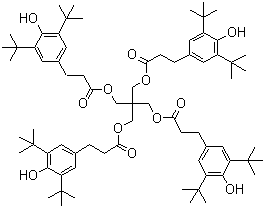 |
| Molecular Formula | C73H108O12 |
| Molecular Weight | 1177.65 |
| CAS Registry Number | 6683-19-8 |
| EC Number | 229-722-6 |
| SMILES | CC(C)(C)C1=CC(=CC(=C1O)C(C)(C)C)CCC(=O)OCC(COC(=O)CCC2=CC(=C(C(=C2)C(C)(C)C)O)C(C)(C)C)(COC(=O)CCC3=CC(=C(C(=C3)C(C)(C)C)O)C(C)(C)C)COC(=O)CCC4=CC(=C(C(=C4)C(C)(C)C)O)C(C)(C)C |
| Density | 1.1±0.1 g/cm3, Calc.* |
|---|---|
| Melting point | 115-118 °C (dec.) |
| Index of Refraction | 1.535, Calc.* |
| Boiling Point | 1005.8±60.0 °C (760 mmHg), Calc.* |
| Flash Point | 247.3±26.4 °C, Calc.* |
| * | Calculated using Advanced Chemistry Development (ACD/Labs) Software. |
| Hazard Symbols |  GHS07 Warning Details GHS07 Warning Details | ||||||||||||||||||||||||||||||||||||||||||||
|---|---|---|---|---|---|---|---|---|---|---|---|---|---|---|---|---|---|---|---|---|---|---|---|---|---|---|---|---|---|---|---|---|---|---|---|---|---|---|---|---|---|---|---|---|---|
| Risk Statements | H315-H319-H335 Details | ||||||||||||||||||||||||||||||||||||||||||||
| Safety Statements | P261-P305+P351+P338 Details | ||||||||||||||||||||||||||||||||||||||||||||
| Hazard Classification | |||||||||||||||||||||||||||||||||||||||||||||
| |||||||||||||||||||||||||||||||||||||||||||||
| SDS | Available | ||||||||||||||||||||||||||||||||||||||||||||
 Discovery and Applications
|
Pentaerythritol tetrakis(3-(3,5-di-tert-butyl-4-hydroxyphenyl)propionate), commonly referred to as Pentaerythritol tetrakis (mixed phenolic antioxidant), is a synthetic compound known for its antioxidant properties, which play a crucial role in stabilizing polymers and other materials against oxidative degradation. This compound has gained attention in various industries, including plastics, coatings, and food preservation, due to its effectiveness in prolonging the life and enhancing the performance of products. The discovery of pentaerythritol tetrakis began in the mid-20th century when researchers sought to develop effective stabilizers to combat the detrimental effects of oxidation in polymeric materials. The incorporation of pentaerythritol into the structure was a strategic choice, as it allows for multiple sites of reaction, thereby enhancing the overall stability of the compound. The phenolic groups provide the necessary hydrogen atoms to scavenge free radicals generated during oxidative processes, making the compound a potent antioxidant. Pentaerythritol tetrakis is predominantly utilized in the polymer industry, where it is incorporated into various plastic formulations. Its primary function is to prevent the degradation of polymers caused by heat, light, and oxygen exposure. By inhibiting oxidation, it helps maintain the mechanical properties and color of the polymers, ensuring that they perform effectively over extended periods. This application is particularly relevant in the production of polyethylene, polypropylene, and polystyrene, which are widely used in packaging materials, automotive components, and consumer goods. In addition to its role in plastics, pentaerythritol tetrakis is also employed in coatings and adhesives. Its antioxidant properties are vital in protecting these formulations from environmental stressors that can lead to premature failure. By stabilizing the coatings and adhesives, the compound contributes to improved durability and performance, making it an essential ingredient in various industrial applications. Another significant application of pentaerythritol tetrakis is in the food industry, where it is used as a food additive to extend the shelf life of products. The compound helps to prevent oxidative rancidity, which can negatively impact the flavor and quality of food items. Its use in food packaging materials ensures that the contents remain fresh and safe for consumption, contributing to food safety and reducing waste. Despite its numerous applications, the handling of pentaerythritol tetrakis requires careful consideration. Although it is generally regarded as safe, exposure to high concentrations may pose health risks. Therefore, manufacturers and users must adhere to safety guidelines, ensuring proper ventilation and protective equipment during handling. Regulatory agencies have established limits on the allowable concentrations of antioxidants in food products to ensure consumer safety. Recent research has focused on improving the efficiency and effectiveness of pentaerythritol tetrakis in various applications. Efforts are being made to develop new formulations that enhance its performance while minimizing any potential environmental impact. Additionally, studies are exploring its synergistic effects when combined with other stabilizers and antioxidants, which may lead to the development of more effective and sustainable solutions in polymer stabilization and food preservation. In summary, pentaerythritol tetrakis(3-(3,5-di-tert-butyl-4-hydroxyphenyl)propionate) is a vital compound with significant applications in the polymer, coatings, and food industries. Its antioxidant properties play a critical role in enhancing the stability and performance of materials, contributing to the longevity of products in various sectors. Ongoing research aims to optimize its use and explore new applications, reinforcing its importance in modern chemistry and material science. References 2024. Comparative analysis of additive decomposition using one-dimensional and two-dimensional gas chromatography: Part I - Irganox 1010, Irganox 1076, and BHT. Journal of chromatography. A, 1733. DOI: 10.1016/j.chroma.2024.465243 2023. Systematic Approaches on Extractable and Leachable Study Designs in Pharmaceuticals and Medical Devices: A Review. Journal of Packaging Technology and Research, 7(3). DOI: 10.1007/s41783-023-00157-8 1972. Preparation of tetra-(4-hydroxy-3,5-di-tert-butylphenylalkoxy)silanes and a study of their efficiency as heat stabilizers for polypropylene. Bulletin of the Academy of Sciences of the USSR, Division of chemical science, 21(6). DOI: 10.1007/bf00854560 |
| Market Analysis Reports |