
Online Database of Chemicals from Around the World
| Hangzhou Verychem Science And Technology Co., Ltd. | China | Inquire | ||
|---|---|---|---|---|
 |
+86 (571) 8816-2785 +86 13606544505 | |||
 |
lucy@verychem.com | |||
| Chemical manufacturer since 2004 | ||||
| chemBlink massive supplier since 2021 | ||||
| Beckmann-Kenko GmbH | Germany | Inquire | ||
|---|---|---|---|---|
|
+49 (4241) 930-888 | |||
|
info@beckmann-kenko.com | |||
| Chemical distributor | ||||
| chemBlink standard supplier since 2011 | ||||
| Alfa Chemistry | USA | Inquire | ||
|---|---|---|---|---|
|
+1 (201) 478-8534 | |||
|
inquiry@alfa-chemistry.com | |||
| Chemical distributor since 2012 | ||||
| chemBlink standard supplier since 2012 | ||||
| Classification | Biochemical >> Carbohydrate >> Polysaccharide |
|---|---|
| Name | Syrups hydrolyzed starch |
| Synonyms | D-Glucopyranose, monohydrate (3R,4S,5S,6R)-6-(hydroxymethyl)oxane-2,3,4,5-tetrol;hydrate |
| Molecular Structure | 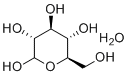 |
| Molecular Formula | C6H14O7 |
| Molecular Weight | 198.17 |
| CAS Registry Number | 8029-43-4 |
| EC Number | 232-436-4 |
| SMILES | O.OC[C@H]1OC(O)[C@H](O)[C@@H](O)[C@@H]1O |
 Discovory and Applicatios
|
Syrups derived from hydrolyzed starch represent an important class of carbohydrate-based materials widely used in the food, pharmaceutical, and industrial sectors. These syrups are produced by breaking down starch polymers into smaller saccharides through enzymatic or acid hydrolysis. Starch itself is a polysaccharide primarily composed of amylose and amylopectin, found in natural sources such as corn, wheat, potato, and tapioca. The hydrolysis process converts these large, insoluble macromolecules into soluble sugars with varying degrees of sweetness and viscosity, depending on the extent of hydrolysis and the method applied. The resulting mixtures may include glucose, maltose, and higher oligosaccharides, which determine the functional and sensory characteristics of the syrup. Historically, starch hydrolysis dates back to the early 19th century when acid hydrolysis was first used to produce glucose syrup from potato starch. Over time, enzymatic hydrolysis largely replaced acid methods due to improved control, milder reaction conditions, and fewer by-products. Enzymatic conversion typically employs α-amylase for the initial depolymerization of starch into dextrins, followed by glucoamylase or pullulanase to yield simpler sugars. The extent of hydrolysis is quantified by the dextrose equivalent (DE), which indicates the proportion of reducing sugars relative to pure dextrose. Low-DE syrups are less sweet and more viscous, suitable for bodying agents and humectants, whereas high-DE syrups possess greater sweetness and fermentability. The applications of syrups from hydrolyzed starch are extensive. In the food industry, they are used as sweeteners, texture modifiers, and stabilizers in confectionery, baked goods, beverages, and dairy products. Glucose syrups with intermediate DE values are favored for their ability to prevent crystallization of sucrose, improve mouthfeel, and retain moisture in finished goods. High-fructose corn syrup, a derivative obtained by enzymatic isomerization of glucose to fructose, has become a major sweetening ingredient in soft drinks and processed foods. Maltodextrins, which are partially hydrolyzed starches with low DE values, provide bulking and binding properties and are used to encapsulate flavors or vitamins. In pharmaceutical formulations, hydrolyzed starch syrups act as excipients, providing viscosity, sweetness, and stability in syrups, suspensions, and tablets. They improve the solubility and taste of active ingredients, facilitating oral administration. Additionally, they serve as fermentation substrates in biotechnological applications such as ethanol production and citric acid fermentation. In industrial contexts, these syrups are used as binders in adhesives, as carbon sources in microbial media, and as plasticizers in biodegradable polymers. Recent advances in starch hydrolysis technology emphasize process optimization and environmental sustainability. The introduction of thermostable and pH-tolerant enzymes has increased efficiency and reduced energy consumption. Moreover, modern biocatalytic systems allow selective production of specific oligosaccharides with targeted properties, such as prebiotic effects or reduced glycemic response. Continuous enzymatic reactors and membrane filtration methods have further refined product quality and uniformity. Despite their benefits, syrups from hydrolyzed starch are subject to health and nutritional scrutiny. Excessive intake of glucose or high-fructose syrups has been linked to metabolic concerns, prompting interest in lower-calorie or functional carbohydrate alternatives. Nevertheless, these syrups remain indispensable in both industrial and consumer products due to their versatility, cost-effectiveness, and well-established safety profile. Overall, syrups derived from hydrolyzed starch represent a cornerstone of carbohydrate chemistry and industrial biotechnology. They illustrate the transformation of a natural polysaccharide into a broad spectrum of functional materials that support multiple sectors, from food production to pharmaceuticals and sustainable materials. The combination of enzymatic innovation and industrial scaling continues to enhance the efficiency, purity, and application diversity of starch-derived syrups worldwide. |
| Market Analysis Reports |
| List of Reports Available for Syrups hydrolyzed starch |