
Online Database of Chemicals from Around the World
| Nanjing Finetech Chemical Co., Ltd. | China | |||
|---|---|---|---|---|
 | www.fine-chemtech.com | |||
 | +86 (25) 5207-8417 +86 17714198479 | |||
 | +86 (25) 5207-8417 | |||
 | sales@fine-chemtech.com | |||
 | QQ Chat | |||
| Chemical manufacturer since 2007 | ||||
| chemBlink Standard supplier since 2007 | ||||
| Beijing Eagle Sky Pharmatech Co., Ltd. | China | |||
|---|---|---|---|---|
| www.eagleskypharmatech.com | |||
| +86 (10) 5979-9429 8875-5821 | |||
| +86 (10) 5804-3698 | |||
| sophia_818@126.com contact@eagleskypharmatech.com | |||
| QQ Chat | |||
| Chemical manufacturer since 2009 | ||||
| chemBlink Standard supplier since 2010 | ||||
| Angene International Limited | Hong Kong | |||
|---|---|---|---|---|
| www.angenechemical.com | |||
| +852 8191-6999 | |||
| +852 2723-7175 | |||
| sales@angenechemical.com | |||
| QQ Chat | |||
 | Skype Chat | |||
| Chemical manufacturer since 2008 | ||||
| chemBlink Standard supplier since 2013 | ||||
| Qingdao Xinnuo Pharmaceutical Chemical Co., Ltd. | China | |||
|---|---|---|---|---|
| www.xinnuopharma.com | |||
| +86 (531) 6656-1050 +86 18615688656 +86 18653156686 | |||
| +86 (531) 6656-1050 | |||
| sales@xinnuopharma.com | |||
| QQ Chat | |||
| Skype Chat | |||
| Chemical manufacturer since 2013 | ||||
| chemBlink Standard supplier since 2014 | ||||
| Hangzhou Leap Chem Co., Ltd. | China | |||
|---|---|---|---|---|
| www.leapchem.com | |||
| +86 (571) 8771-1850 | |||
| market19@leapchem.com | |||
| QQ Chat | |||
| Chemical manufacturer since 2006 | ||||
| chemBlink Standard supplier since 2015 | ||||
| Shaoxing Fangxiao Chemicals Co., Ltd. | China | |||
|---|---|---|---|---|
| www.fangxiaochem.com | |||
| +86 (571) 2829-7060 +86 18969095308 | |||
| +86 (571) 2829-7065 | |||
| sales@fangxiaochem.com | |||
| QQ Chat | |||
| Chemical distributor since 2012 | ||||
| chemBlink Standard supplier since 2015 | ||||
| Shanghai Yingrui Biopharm Co., Ltd. | China | |||
|---|---|---|---|---|
| www.shyrchem.com | |||
| +86 (21) 3358-5366 3466-6753 +86 13311639313 | |||
| +86 (21) 3497-9012 | |||
| sales02@shyrchem.com | |||
| QQ Chat | |||
| Skype Chat | |||
| Chemical manufacturer since 2009 | ||||
| chemBlink Standard supplier since 2017 | ||||
| Shandong Chemed Pharmaceutical Technology Co., Ltd. | China | |||
|---|---|---|---|---|
| www.chemedpharma.com | |||
| +86 (531) 8880-3416 | |||
| +86 (531) 8880-3416 | |||
| sales@chemedpharma.com | |||
| Chemical manufacturer since 2017 | ||||
| chemBlink Standard supplier since 2017 | ||||
| Jinan Lead Pharm-chemical Co., Ltd. | China | |||
|---|---|---|---|---|
| www.leadchem.net | |||
| +86 13127158727 | |||
| leadqls@leadchem.net | |||
| Chemical manufacturer since 2013 | ||||
| chemBlink Standard supplier since 2020 | ||||
| Neostar United (Changzhou) Industrial Co., Ltd. | China | |||
|---|---|---|---|---|
| www.neostarunited.com | |||
| +86 (519) 8555-7386 +86 18015025600 | |||
| +86 (519) 8555-7389 | |||
| marketing1@neostarunited.com | |||
| Chemical distributor since 2014 | ||||
| chemBlink Standard supplier since 2020 | ||||
| Shandong Quehua Technology Co., Ltd. | China | |||
|---|---|---|---|---|
| www.qhpharmaceutical.com | |||
| +8618865952939 | |||
| 2812659817@qq.com | |||
| Chemical manufacturer since 2018 | ||||
| chemBlink Standard supplier since 2021 | ||||
| Taizhou Creating Bio-pharm Co., Ltd. | China | |||
|---|---|---|---|---|
| www.creatingbiopharm.com | |||
| +86 (0576) 8882-7176 | |||
| +86 (0576) 8882-2496 | |||
| post@creatingchemical.com | |||
| QQ Chat | |||
| Skype Chat | |||
 | WeChat: 18906581668 | |||
 | WhatsApp:+86 18906581668 | |||
| Chemical manufacturer since 2005 | ||||
| chemBlink Standard supplier since 2023 | ||||
| Classification | Pharmaceutical intermediate >> Heterocyclic compound intermediate >> Pyridine compound >> Cyanopyridine |
|---|---|
| Name | Methyl 2-cyanoisonicotinate |
| Molecular Structure | 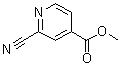 |
| Molecular Formula | C8H6N2O2 |
| Molecular Weight | 162.15 |
| CAS Registry Number | 94413-64-6 |
| EC Number | 833-113-6 |
| SMILES | COC(=O)C1=CC(=NC=C1)C#N |
| Solubility | Slightly soluble (6.2 g/L) (25 °C), Calc.* |
|---|---|
| Density | 1.25±0.1 g/cm3 (20 °C 760 Torr), Calc.* |
| Melting point | 107-109 °C** |
| Index of Refraction | 1.536, Calc.* |
| Boiling Point | 296.6±25.0 °C (760 mmHg), Calc.* |
| Flash Point | 133.2±23.2 °C, Calc.* |
| * | Calculated using Advanced Chemistry Development (ACD/Labs) Software V11.02 (©1994-2015 ACD/Labs) |
| ** | Tani, Hideo |
| Hazard Symbols |  GHS07 Warning Details GHS07 Warning Details | ||||||||||||||||||||||||||||
|---|---|---|---|---|---|---|---|---|---|---|---|---|---|---|---|---|---|---|---|---|---|---|---|---|---|---|---|---|---|
| Risk Statements | H302-H312-H315-H319-H332-H335 Details | ||||||||||||||||||||||||||||
| Safety Statements | P261-P264-P264+P265-P270-P271-P280-P301+P317-P302+P352-P304+P340-P305+P351+P338-P317-P319-P321-P330-P332+P317-P337+P317-P362+P364-P403+P233-P405-P501 Details | ||||||||||||||||||||||||||||
| Hazard Classification | |||||||||||||||||||||||||||||
| |||||||||||||||||||||||||||||
| SDS | Available | ||||||||||||||||||||||||||||
 chemBlink Chemical Story
|
Methyl 2-cyanoisonicotinate is an important organic compound that has gained significant attention in both synthetic chemistry and pharmaceutical development due to its versatile chemical properties. It belongs to the class of cyano derivatives of nicotinic acid and is structurally characterized by the presence of a cyano group (-CN) attached to the second carbon of an isonicotinic acid methyl ester. The combination of the cyano group with the isonicotinic acid framework imparts unique reactivity, making this compound valuable in a variety of chemical applications. The discovery of methyl 2-cyanoisonicotinate can be traced back to the growing interest in pyridine derivatives, particularly in the context of their biological and chemical activity. The isonicotinic acid core is a well-known scaffold in medicinal chemistry, providing a framework for the synthesis of a wide range of bioactive molecules. The introduction of the cyano group at the 2-position of the pyridine ring adds an electron-withdrawing functionality, which can enhance the reactivity of the compound and facilitate further chemical modifications. One of the primary applications of methyl 2-cyanoisonicotinate lies in the synthesis of pharmaceutical compounds. The cyano group is a versatile handle for the introduction of various substituents through nucleophilic addition reactions, leading to the creation of more complex molecules. In particular, the compound has been explored as a precursor in the synthesis of nicotinic acid derivatives that exhibit significant biological activity. These derivatives have been studied for their potential use in treating a range of conditions, including cancer, inflammation, and neurodegenerative diseases. Moreover, methyl 2-cyanoisonicotinate plays a role in the development of materials, particularly in the field of organic electronics. The cyano group, along with the pyridine ring, imparts electron-withdrawing properties that can be beneficial in designing materials with specific electronic characteristics. This includes applications in organic semiconductors, where the compound can be used as a building block for the creation of charge-transporting layers in devices such as organic light-emitting diodes (OLEDs) and organic photovoltaic cells (OPVs). The ability to modulate the electronic properties of the compound makes it useful in the fine-tuning of material performance in electronic applications. In addition to its role in pharmaceutical and materials science, methyl 2-cyanoisonicotinate is also employed as an intermediate in the synthesis of other important organic chemicals. Its reactivity and functional groups allow for the production of a variety of derivatives that can be further modified to yield products with specific applications in agriculture, medicine, and industry. The synthesis of methyl 2-cyanoisonicotinate generally involves the esterification of isonicotinic acid with methanol, followed by the introduction of the cyano group via nucleophilic substitution. The overall process is relatively straightforward and allows for the efficient production of this compound in high yield. The availability of methyl 2-cyanoisonicotinate as a commercial reagent further enhances its applicability in research and industrial settings. In summary, methyl 2-cyanoisonicotinate is a versatile compound with a broad range of applications in pharmaceutical synthesis, materials science, and organic chemistry. Its unique structure, featuring a cyano group attached to an isonicotinic acid framework, makes it an important intermediate in the creation of bioactive molecules and functional materials. As research continues into the full range of its chemical and biological properties, the importance of methyl 2-cyanoisonicotinate is expected to grow across various scientific disciplines. References 2020. Electrolysis-Mediated Radical-Radical Cross Coupling. Science of Synthesis. URL: https://science-of-synthesis.thieme.com/app/text/?id=SD-233-00198 |
| Market Analysis Reports |