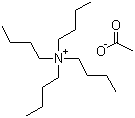
Tetrabutylammonium acetate is a quaternary ammonium salt with the chemical formula C16H35NO2. It is composed of a tetrabutylammonium cation (C4H9)4N+ and an acetate anion (CH3COO−). This compound is commonly synthesized by reacting tetrabutylammonium hydroxide with acetic acid. It is a colorless, hygroscopic solid that is typically used in organic synthesis and as a phase transfer catalyst.
The primary application of tetrabutylammonium acetate is in organic synthesis, where it is employed as a phase transfer catalyst. Phase transfer catalysis is a process that facilitates the transfer of ions or molecules between immiscible phases, such as between aqueous and organic solvents. Tetrabutylammonium acetate, like other quaternary ammonium salts, is effective in this role because the cation can interact with both aqueous and organic solvents, aiding the transport of reactive species from one phase to another.
In addition to its role as a phase transfer catalyst, tetrabutylammonium acetate is also used in the preparation of various other quaternary ammonium compounds, which are important in a wide range of applications, including surfactants, detergents, and disinfectants. These compounds are widely used in industries such as cosmetics, pharmaceuticals, and water treatment due to their surfactant and antimicrobial properties.
Tetrabutylammonium acetate is also known to be involved in the synthesis of ionic liquids. Ionic liquids are salts that remain in a liquid state at relatively low temperatures and are considered valuable for their ability to dissolve a wide range of materials, as well as their non-volatile and thermally stable nature. Ionic liquids are being researched for use in chemical processes such as catalysis, extraction, and electrochemical applications.
Beyond these industrial applications, tetrabutylammonium acetate also plays a role in laboratory research, particularly in studies involving organic reactions and the development of new catalysts. Its ability to solvate both organic and inorganic ions makes it useful for various synthetic pathways where the solubility of reactants is a limiting factor.
Overall, tetrabutylammonium acetate is a versatile compound primarily used as a phase transfer catalyst in organic synthesis and the preparation of other quaternary ammonium salts. It also contributes to the development of ionic liquids and has applications in various industrial processes, including surfactant production and water treatment.
References
2024. Free carbenes from complementarily paired alkynes. Nature Chemistry, 16(6).
DOI: 10.1038/s41557-024-01550-9
2024. Controlling reversible complexation-mediated polymerization (RCMP) via deep eutectic solvents: fast kinetics, narrow molecular weight distribution and mechanistic insights. Science China Chemistry.
DOI: 10.1007/s11426-024-2103-7
2024. Thermophysical Properties of Clathrate Hydrates with Various Guests for Novel Technologies: A Review. International Journal of Thermophysics, 45(9).
DOI: 10.1007/s10765-024-03429-w
|




 GHS07 Warning Details
 Discovery and Applications