
Online Database of Chemicals from Around the World
| Luminescence Technology Corp. | Taiwan | |||
|---|---|---|---|---|
 | www.lumtec.com.tw | |||
 | +886 (2) 2697-5600 | |||
 | +886 (2) 2697-5601 | |||
 | sales@lumtec.com.tw | |||
| Chemical manufacturer since 1999 | ||||
| chemBlink Standard supplier since 2024 | ||||
| Classification | Pharmaceutical intermediate >> Heterocyclic compound intermediate >> Thiophene compound |
|---|---|
| Name | 3-Hexyl-2,5-dimethylthiophene amine |
| Molecular Structure | 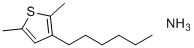 |
| Molecular Formula | C12H23NS |
| Molecular Weight | 213.38 |
| CAS Registry Number | 110134-47-9 |
| SMILES | CCCCCCC1=C(SC(=C1)C)C.N |
| SDS | Available |
|---|---|
 chemBlink Chemical Story
|
3-Hexyl-2,5-dimethylthiophene amine is a notable organosulfur compound that has gained attention in recent years due to its unique structural properties and potential applications in organic electronics and materials science. This compound belongs to the thiophene family, characterized by a five-membered aromatic ring containing sulfur. The presence of both a hexyl chain and a primary amine group provides versatility for chemical modification and enhances its potential for use in various functional materials. The discovery of 3-hexyl-2,5-dimethylthiophene amine can be traced back to efforts to synthesize thiophene-based molecules with tailored electronic and structural properties. Thiophene derivatives are widely known for their stability, conductivity, and suitability in conjugated polymer systems. The introduction of a hexyl chain at the 3-position improves the solubility of the compound in organic solvents, making it easier to process in solution-based applications. The dimethyl groups at the 2- and 5-positions of the thiophene ring help to stabilize the aromatic system, while the amine group allows for subsequent functionalization, such as forming linkages with other molecules or surfaces. The synthesis of 3-hexyl-2,5-dimethylthiophene amine typically involves multi-step reactions starting with thiophene derivatives. In a common approach, 2,5-dimethylthiophene is functionalized at the 3-position through a Friedel-Crafts alkylation using hexyl halides. The resulting 3-hexyl-2,5-dimethylthiophene can then be subjected to nitration followed by a reduction step to introduce the amine group at the appropriate position. Purification is achieved through column chromatography or recrystallization to ensure the compound is obtained in high purity. One of the most promising applications of 3-hexyl-2,5-dimethylthiophene amine is in the field of organic electronics, particularly in the development of organic light-emitting diodes (OLEDs) and organic field-effect transistors (OFETs). The thiophene core provides excellent charge transport properties, while the hexyl chain enhances solubility, allowing for the fabrication of devices using solution-processing techniques. The amine group can be used to modify electrodes or to link the molecule to other functional groups, enabling the creation of complex molecular architectures. Additionally, this compound shows potential in the synthesis of conjugated polymers. When polymerized, 3-hexyl-2,5-dimethylthiophene amine contributes to polymers that exhibit favorable electronic and mechanical properties. These polymers are useful in applications such as flexible electronics, photovoltaic cells, and sensors. The ability to fine-tune the electronic properties of the polymer by modifying the thiophene monomer makes this compound valuable for materials research. In the context of sensor development, 3-hexyl-2,5-dimethylthiophene amine can be employed to create chemosensors for detecting various analytes. The amine functionality allows for interactions with acidic or electrophilic species, making it suitable for sensing applications where the detection of specific chemicals is required. Thiophene-based sensors benefit from the inherent conductivity and stability of the thiophene ring system, providing reliable performance in different environments. Research is ongoing to explore additional functionalizations and applications of 3-hexyl-2,5-dimethylthiophene amine. Its versatility and combination of solubility, functional group reactivity, and electronic properties make it a valuable compound in the design and synthesis of advanced organic materials for electronic and sensor applications. |
| Market Analysis Reports |