
Online Database of Chemicals from Around the World
| Antimex Pharmaceuticals & Chemicals Ltd. | China | |||
|---|---|---|---|---|
 | www.antimex.com | |||
 | +86 (21) 5056-3169 | |||
 | +86 (21) 5156-1690 | |||
 | info@antimex.com | |||
| Chemical manufacturer | ||||
| chemBlink Standard supplier since 2007 | ||||
| Simagchem Corporation | China | |||
|---|---|---|---|---|
| www.simagchem.com | |||
| +86 13806087780 | |||
| +86 (592) 268-0237 | |||
| sale@simagchem.com | |||
| Chemical manufacturer since 2002 | ||||
| chemBlink Standard supplier since 2008 | ||||
| Oceanchem Group-Globalsources Asia Limited | China | |||
|---|---|---|---|---|
| www.oceanchem-group.com | |||
| +86 (536) 859-6048 | |||
| +86 (536) 859-6047 | |||
| oceanchem@126.com sales@oceanchem-group.com | |||
| Chemical manufacturer since 1950 | ||||
| chemBlink Standard supplier since 2009 | ||||
| Tianjin Zhongxin Chem-tech Co., Ltd. | China | |||
|---|---|---|---|---|
| www.tjzxchem.com | |||
| +86 (22) 6688-0623 | |||
| +86 (22) 8988-0739 ex 8030 | |||
| sales@tjzxchem.com | |||
| Chemical manufacturer since 2007 | ||||
| chemBlink Standard supplier since 2009 | ||||
| Hefei TNJ Chemical Industry Co., Ltd. | China | |||
|---|---|---|---|---|
| www.tnjchem.com | |||
| +86 (551) 6541-8684 | |||
| +86 (551) 6541-8697 | |||
| sales@tnjchem.com | |||
| Chemical manufacturer since 2001 | ||||
| chemBlink Standard supplier since 2010 | ||||
| Ring Specialty Chemicals Inc. | Canada | |||
|---|---|---|---|---|
| www.ringchemicals.com | |||
| +1 (416) 493-6870 | |||
| info@ringchemicals.com | |||
| Chemical distributor | ||||
| chemBlink Standard supplier since 2010 | ||||
| BOC Sciences | USA | |||
|---|---|---|---|---|
| www.bocsci.com | |||
| +1 (631) 485-4226 | |||
| +1 (631) 614-7828 | |||
| info@bocsci.com | |||
| Chemical manufacturer | ||||
| chemBlink Standard supplier since 2010 | ||||
| Chembridge International Corp. Taipei / Dongguan / Nanjing | China | |||
|---|---|---|---|---|
| www.chembridge.com.tw | |||
| +886 (2) 2649-6320 +86 (769) 2250-4087 +86 (25) 8471-2192 | |||
| +886 (2) 2704-3915 / +86 (769) 2246-8225 / +86 (25) 8471-2052 | |||
| cnservice@chembridge.net | |||
| Chemical manufacturer | ||||
| chemBlink Standard supplier since 2011 | ||||
| Beckmann-Kenko GmbH | Germany | |||
|---|---|---|---|---|
| www.beckmann-kenko.com | |||
| +49 (4241) 930-888 | |||
| +49 (4241) 930-889 | |||
| info@beckmann-kenko.com | |||
| Chemical distributor | ||||
| chemBlink Standard supplier since 2011 | ||||
| Qingdao Xuxin Chemical Industry Co., Ltd. | China | |||
|---|---|---|---|---|
| www.xuxinhg.com | |||
| +86 (532) 8281-0358 | |||
| +86 (532) 8281-1359 | |||
| xuxinhg@yahoo.cn | |||
| Chemical manufacturer since 2001 | ||||
| chemBlink Standard supplier since 2012 | ||||
| Synchemer Co., Limited | China | |||
|---|---|---|---|---|
| www.synchemer.com | |||
| +86 (20) 3668-5350 +86 13556109416 | |||
| +86 (20) 3668-6430 | |||
| info@synchemer.com | |||
| Chemical manufacturer since 2013 | ||||
| chemBlink Standard supplier since 2013 | ||||
| Zhang Jia Gang YaRui Chemical Co., Ltd. | China | |||
|---|---|---|---|---|
| www.zjgyrchemical.com | |||
| +86 (512) 5896-1066 +86 18921980669 | |||
| +86 (512) 5896-1120 | |||
| sales@yaruichem.com | |||
 | QQ Chat | |||
 | Skype Chat | |||
| Chemical manufacturer since 2013 | ||||
| chemBlink Standard supplier since 2020 | ||||
| Riverland Trading LLC. | USA | |||
|---|---|---|---|---|
| www.riverlandtrading.com | |||
| +1 (336).944-2293 | |||
| bens@riverlandtrading.com | |||
| Chemical distributor | ||||
| chemBlink Standard supplier since 2023 | ||||
| Strem Chemicals, Inc. | USA | |||
|---|---|---|---|---|
| www.strem.com | |||
| +1 (978) 499-1600 | |||
| +1 (978) 465-3104 | |||
| info@strem.com | |||
| Chemical manufacturer | ||||
| Crescent Chemical Co. Inc. | USA | |||
|---|---|---|---|---|
| www.crescentchemical.com | |||
| +1 (631) 348-0333 | |||
| +1 (631) 348-0913 | |||
| crescent@creschem.com | |||
| Chemical distributor | ||||
| Angchen Co., Ltd. | China | |||
|---|---|---|---|---|
| www.angchenchem.com | |||
| +86 (510) 8375-1665 8232-757 | |||
| +86 (510) 8232-8226 | |||
| sales@angchenchem.com | |||
| Chemical distributor | ||||
| Classification | Organic raw materials >> Inorganic acid ester |
|---|---|
| Name | Tris(2-chloroethyl) phosphate |
| Synonyms | Phosphoric acid tris(2-chloroethyl)ester; TCEP |
| Molecular Structure | 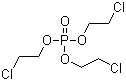 |
| Molecular Formula | C6H12Cl3O4P |
| Molecular Weight | 285.49 |
| CAS Registry Number | 115-96-8 |
| EC Number | 204-118-5 |
| SMILES | C(CCl)OP(=O)(OCCCl)OCCCl |
| Density | 1.1±0.1 g/cm3, Calc.*, 1.39 g/mL |
|---|---|
| Melting point | -51 °C |
| Index of Refraction | 1.539, Calc.*, 1.471-1.473 |
| Boiling Point | 341.1±15.0 °C (760 mmHg), Calc.*, 330 °C |
| Flash Point | 132.3±13.2 °C, Calc.*, 232 °C |
| Water solubility | 7 g/L (20 °C) |
| * | Calculated using Advanced Chemistry Development (ACD/Labs) Software. |
| Hazard Symbols |    GHS08;GHS07;GHS09 Danger Details GHS08;GHS07;GHS09 Danger Details | ||||||||||||||||||||||||||||||||
|---|---|---|---|---|---|---|---|---|---|---|---|---|---|---|---|---|---|---|---|---|---|---|---|---|---|---|---|---|---|---|---|---|---|
| Risk Statements | H351-H360F-H302-H411 Details | ||||||||||||||||||||||||||||||||
| Safety Statements | P203-P264-P270-P273-P280-P301+P317-P318-P330-P391-P405-P501 Details | ||||||||||||||||||||||||||||||||
| Hazard Classification | |||||||||||||||||||||||||||||||||
| |||||||||||||||||||||||||||||||||
| Transport Information | UN 2810 | ||||||||||||||||||||||||||||||||
| SDS | Available | ||||||||||||||||||||||||||||||||
 chemBlink Chemical Story
|
Tris(2-chloroethyl) phosphate (TCEP) is an organophosphate compound that has garnered attention for its diverse applications, particularly as a flame retardant and plasticizer. Its chemical formula is C6H12Cl3O4P, and it is characterized by the presence of three 2-chloroethyl groups esterified to a phosphate backbone. The discovery of TCEP dates back to the mid-20th century when researchers were exploring the potential of organophosphates for various industrial applications. As the demand for materials with enhanced fire resistance increased, TCEP emerged as a valuable compound in this regard. One of the primary applications of TCEP is as a flame retardant in a variety of materials, including textiles, plastics, and rubber. Its effectiveness lies in its ability to inhibit the ignition and spread of flames, thus improving the safety of consumer products. TCEP works by promoting the formation of a char layer on the surface of materials when exposed to heat, which acts as a barrier to oxygen and heat transfer. This property has made TCEP a popular choice in the manufacturing of products that require stringent fire safety standards, such as electronics, automotive components, and building materials. In addition to its role as a flame retardant, TCEP is utilized as a plasticizer in the production of flexible PVC and other polymer formulations. By incorporating TCEP into these materials, manufacturers can enhance their flexibility, durability, and resistance to environmental degradation. This application is particularly important in the construction, automotive, and consumer goods sectors, where long-lasting and resilient materials are essential. Despite its useful properties, the use of TCEP has raised environmental and health concerns. Studies have indicated that TCEP can be persistent in the environment and may pose risks to aquatic organisms. Moreover, there is evidence suggesting potential human health effects associated with exposure to organophosphates, including endocrine disruption and developmental toxicity. Consequently, regulatory agencies have implemented guidelines to manage the use of TCEP and limit its exposure in various applications. As a response to the growing concerns surrounding TCEP and similar compounds, research is ongoing to identify safer alternatives that can provide comparable flame retardant and plasticizing properties without the associated risks. The search for sustainable and environmentally friendly materials is increasingly important in the context of global efforts to reduce harmful chemicals in consumer products. In conclusion, tris(2-chloroethyl) phosphate is a significant chemical compound with a range of applications in flame retardancy and plasticization. Its discovery during the mid-20th century has led to its widespread use in various industries, enhancing the safety and performance of many products. However, the potential environmental and health impacts of TCEP necessitate careful management and ongoing research into safer alternatives to ensure the continued safety and efficacy of materials in the market. References 2024. Unveiling the mechanisms of reproductive toxicity induced by full life-cycle exposure to environmentally relevant concentrations of tris(2-chloroethyl) phosphate in male zebrafish. Aquatic toxicology (Amsterdam, Netherlands). DOI: 10.1016/j.aquatox.2024.107079 2024. Exploring the effects of environmentally relevant concentrations of tris(2-chloroethyl) phosphate on tadpole health: A comprehensive analysis of intestinal microbiota and hepatic transcriptome. The Science of the total environment. DOI: 10.1016/j.scitotenv.2024.174428 1957. Vapor Pressures of Some Phosphate and Phosphonate Esters. The Journal of Physical Chemistry. DOI: 10.1021/j150556a052 |
| Market Analysis Reports |