
Online Database of Chemicals from Around the World
| Hangzhou Verychem Science And Technology Co., Ltd. | China | |||
|---|---|---|---|---|
 | www.verychem.com | |||
 | +86 (571) 8816-2785 +86 13606544505 | |||
 | +86 (571) 8816-2787 | |||
 | lucy@verychem.com | |||
| Chemical manufacturer since 2004 | ||||
| chemBlink Massive supplier since 2021 | ||||
| Classification | Organic raw materials >> Carboxylic compounds and derivatives >> Carboxylic esters and their derivatives |
|---|---|
| Name | 4-(Oxiran-2-ylmethoxy)butyl acrylate |
| Molecular Structure | 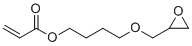 |
| Molecular Formula | C10H16O4 |
| Molecular Weight | 200.23 |
| CAS Registry Number | 119692-59-0 |
| SMILES | C=CC(=O)OCCCCOCC1CO1 |
| Density | 1.1±0.1 g/cm3, Calc.* |
|---|---|
| Index of Refraction | 1.463, Calc.* |
| Boiling Point | 287.5±20.0 °C (760 mmHg), Calc.* |
| Flash Point | 123.3±21.8 °C, Calc.* |
| * | Calculated using Advanced Chemistry Development (ACD/Labs) Software. |
| Hazard Symbols |    GHS07;GHS08;GHS09 Danger Details GHS07;GHS08;GHS09 Danger Details |
|---|---|
| Risk Statements | H315-H319-H410-H227-H372 Details |
| Safety Statements | P501-P273-P210-P264-P280-P302+P352-P370+P378-P391-P337+P313-P305+P351+P338-P362+P364-P332+P313-P403+P235 Details |
 chemBlink Chemical Story
|
4-(Oxiran-2-ylmethoxy)butyl acrylate is an organic compound that belongs to the class of acrylate esters with a unique structure featuring an oxirane (epoxide) ring and a flexible butyl spacer. The molecular formula of this compound is C10H16O4, and it is characterized by the reactive acrylate and oxirane functional groups, which contribute to its reactivity and versatility in industrial applications. Initially synthesized in studies focused on acrylate derivatives with crosslinking potential, 4-(oxiran-2-ylmethoxy)butyl acrylate was soon identified as a valuable intermediate in the development of advanced polymers and coatings. One of the key applications of 4-(oxiran-2-ylmethoxy)butyl acrylate is in the field of polymer chemistry, where it is utilized as a monomer for producing polymers with enhanced durability and chemical resistance. The presence of both an acrylate group and an oxirane ring allows it to participate in two types of reactions: polymerization and crosslinking. During polymerization, the acrylate group can undergo radical polymerization, creating a strong polymer backbone, while the oxirane group can react with other components to form crosslinked networks. These properties make it suitable for producing high-performance coatings, adhesives, and sealants that require strength, flexibility, and resistance to environmental degradation. In addition to its use in high-strength polymers, 4-(oxiran-2-ylmethoxy)butyl acrylate finds applications in electronics, particularly in protective coatings for circuit boards and microelectronic components. Due to its stability and crosslinking capability, it helps enhance the durability and insulation of sensitive electronics, protecting them from moisture, chemicals, and physical wear. The compound is also gaining attention in biomedical engineering as a component in hydrogels and other biocompatible materials. Its oxirane ring allows it to bond with bioactive molecules or drugs, making it a promising candidate for controlled drug release systems and tissue engineering scaffolds. Researchers continue to explore its biocompatibility and potential for creating new materials that can safely interact with biological environments. Overall, 4-(oxiran-2-ylmethoxy)butyl acrylate stands out as a multifunctional acrylate ester with diverse applications in polymer science, electronics, and biomedical engineering. Its unique chemical structure and reactivity make it a valuable component in developing advanced materials across multiple industries, with ongoing research likely to further expand its applications. References n.d. https://www.epa.gov/tsca-inventory. EPA TSCA Inventory. URL: https://www.epa.gov/tsca-inventory |
| Market Analysis Reports |