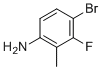
4-Bromo-3-fluoro-2-methylaniline is an organic compound belonging to the class of aniline derivatives, which are widely used in the synthesis of a variety of chemicals, including dyes, pharmaceuticals, and agrochemicals. The structure of 4-bromo-3-fluoro-2-methylaniline consists of an aniline backbone, where the amino group (-NH2) is attached to a benzene ring that is substituted with a bromo group at the 4-position, a fluoro group at the 3-position, and a methyl group at the 2-position. This specific substitution pattern gives the compound its unique properties, making it valuable for various synthetic applications.
The discovery of 4-bromo-3-fluoro-2-methylaniline is part of the broader development of halogenated aniline derivatives, which have attracted significant interest due to their ability to serve as building blocks for more complex molecules. Halogenation, particularly the introduction of bromine and fluorine atoms, can greatly influence the reactivity, polarity, and stability of organic molecules. The discovery and study of these compounds have advanced with the goal of exploring their potential applications in materials science, drug development, and catalysis.
One of the primary applications of 4-bromo-3-fluoro-2-methylaniline lies in the synthesis of pharmaceuticals. Aniline derivatives, particularly those with halogen substitutions, are important intermediates in the pharmaceutical industry. The presence of the fluorine and bromine atoms can influence the biological activity of the compounds, making them more effective or selective in targeting specific biological pathways. 4-bromo-3-fluoro-2-methylaniline serves as an essential building block for the development of biologically active molecules, including those with antibacterial, antiviral, and anticancer properties. By modifying the structure of this compound, researchers can design molecules with improved pharmacological profiles.
In addition to pharmaceutical applications, 4-bromo-3-fluoro-2-methylaniline is valuable in the development of agrochemicals. The selective properties of halogenated compounds make them useful in the design of herbicides, fungicides, and insecticides. The compound can be further modified to optimize its efficacy in controlling pests and diseases that affect crops, offering a sustainable and targeted approach to agricultural chemical development. The introduction of the methyl group on the aromatic ring can also enhance the compound’s solubility and stability, which are important properties in the formulation of effective agrochemicals.
Moreover, the compound is also used as an intermediate in the synthesis of dyes and pigments. The electron-withdrawing effects of the bromine and fluorine atoms can alter the electronic properties of the aromatic ring, leading to distinctive color properties when incorporated into various dye formulations. This property has applications in industries such as textiles, printing, and coatings, where high-performance dyes are required.
In materials science, 4-bromo-3-fluoro-2-methylaniline can be employed as a precursor in the synthesis of functional materials, such as conductive polymers or liquid crystal compounds. The fluorine atom, in particular, enhances the compound's stability and performance in various electronic applications, making it suitable for use in optoelectronic devices, displays, and sensors. Furthermore, the compound's ability to form stable complexes with metals or other ligands may offer opportunities for its use in advanced catalytic processes or as a precursor to novel materials with specific optical, electrical, or magnetic properties.
In conclusion, 4-bromo-3-fluoro-2-methylaniline is a versatile compound with significant applications across several fields, including pharmaceuticals, agrochemicals, dye manufacturing, and materials science. Its unique combination of halogen and methyl substitutions makes it a valuable intermediate for the synthesis of biologically active molecules and functional materials, providing key advantages in terms of reactivity, selectivity, and stability.
|




 GHS07 Warning Details
 chemBlink Chemical Story