
Online Database of Chemicals from Around the World
| Hangzhou Brown Bio-Pharm Co., Ltd. | China | |||
|---|---|---|---|---|
 | www.chinaelion.com | |||
 | +86 (571) 8538-1539 +86 13588363288 | |||
 | +86 (571) 8538-1539 / 8502-2151 | |||
 | elionchem@chinaelion.com sales@chinaelion.com | |||
 | QQ Chat | |||
| Chemical manufacturer since 2013 | ||||
| chemBlink Standard supplier since 2008 | ||||
| BOC Sciences | USA | |||
|---|---|---|---|---|
| www.bocsci.com | |||
| +1 (631) 485-4226 | |||
| +1 (631) 614-7828 | |||
| info@bocsci.com | |||
| Chemical manufacturer | ||||
| chemBlink Standard supplier since 2010 | ||||
| KS Laboratories Co., Ltd. | South Korea | |||
|---|---|---|---|---|
| www.kslabo.co.kr | |||
| +82 (61) 753-9717 | |||
| +82 (61) 753-9718 | |||
| semiyong@kslabo.co.kr | |||
| Chemical manufacturer | ||||
| chemBlink Standard supplier since 2012 | ||||
| Anhui Royal Chemical Co., Ltd. | China | |||
|---|---|---|---|---|
| www.royal-chem.com | |||
| +86 (25) 8663-9253 | |||
| +86 (25) 5227-9193 | |||
| zoey.zhao@royal-chem.com | |||
| Chemical manufacturer since 2008 | ||||
| chemBlink Standard supplier since 2019 | ||||
| Achemica | Switzerland | |||
|---|---|---|---|---|
| www.achemica.com | |||
| +41 (24) 466-2929 | |||
| +41 (24) 466-2800 | |||
| contact@achemica.com | |||
| Chemical manufacturer since 2010 | ||||
| Sinocure Chemical Group | China | |||
|---|---|---|---|---|
| www.sinocurechem.com | |||
| +86 15550440621 | |||
| info@sinocurechem.com | |||
| Chemical manufacturer since 2020 | ||||
| Classification | Chemical reagent >> Organic reagent >> Thiol/thiophenol |
|---|---|
| Name | 4-(Mercaptomethyl)-3,6-dithia-1,8-octanedithiol |
| Synonyms | 1,2-Bis[(2-mercaptoethyl)thio]-3-mercaptopropane; 2,3-Bis[(2-mercaptoethyl)thio]-1-propanethiol; 4-(Mercaptomethyl)-1,8-dimercapto-3,6-dithiaoctane |
| Molecular Structure | 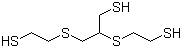 |
| Molecular Formula | C7H16S5 |
| Molecular Weight | 260.53 |
| CAS Registry Number | 131538-00-6 |
| EC Number | 411-290-7 |
| SMILES | C(CSCC(CS)SCCS)S |
| Density | 1.2±0.1 g/cm3, Calc.* |
|---|---|
| Index of Refraction | 1.607, Calc.* |
| Boiling Point | 395.6±42.0 °C (760 mmHg), Calc.* |
| Flash Point | 193.0±27.9 °C, Calc.* |
| * | Calculated using Advanced Chemistry Development (ACD/Labs) Software. |
| Hazard Symbols |    GHS08;GHS07;GHS09 Warning Details GHS08;GHS07;GHS09 Warning Details | ||||||||||||||||||||||||||||||||
|---|---|---|---|---|---|---|---|---|---|---|---|---|---|---|---|---|---|---|---|---|---|---|---|---|---|---|---|---|---|---|---|---|---|
| Risk Statements | H302-H373-H400-H410 Details | ||||||||||||||||||||||||||||||||
| Safety Statements | P203-P260-P261-P264-P270-P272-P273-P280-P301+P317-P302+P352-P308+P316-P318-P319-P321-P330-P333+P317-P362+P364-P391-P405-P501 Details | ||||||||||||||||||||||||||||||||
| Hazard Classification | |||||||||||||||||||||||||||||||||
| |||||||||||||||||||||||||||||||||
| Transport Information | UN 3335 | ||||||||||||||||||||||||||||||||
 chemBlink Chemical Story
|
4-(Mercaptomethyl)-3,6-dithia-1,8-octanedithiol, commonly known as a specialized dithiol compound, is an organosulfur chemical with notable applications in various industrial and chemical processes. This compound features a unique structure with multiple thiol (sulfhydryl) groups, which impart it with significant reactivity and functionality. The discovery of 4-(Mercaptomethyl)-3,6-dithia-1,8-octanedithiol arose from the study of organosulfur compounds and their potential applications in materials science and catalysis. The compound's synthesis typically involves the reaction of appropriate thiol and disulfide precursors under controlled conditions to form the dithiol structure. The presence of multiple thiol groups enhances its ability to interact with other chemical species, making it a valuable component in several specialized applications. One of the primary applications of 4-(Mercaptomethyl)-3,6-dithia-1,8-octanedithiol is in the field of polymer chemistry. The compound is used as a crosslinking agent in the synthesis of polymers and elastomers. Its multiple thiol groups facilitate the formation of strong crosslinks between polymer chains, which improves the mechanical properties and stability of the resulting materials. This property is particularly useful in the production of high-performance rubber and elastomeric compounds used in various industrial applications. In addition to its role in polymer chemistry, 4-(Mercaptomethyl)-3,6-dithia-1,8-octanedithiol is utilized as a stabilizer in the formulation of certain metal and semiconductor materials. The compound’s thiol groups can form strong bonds with metal surfaces, providing protective layers that prevent oxidation and degradation. This application is crucial in maintaining the performance and longevity of electronic components and metal-based products. The compound also finds use in the field of catalysis, where it serves as a ligand in metal-catalyzed reactions. The thiol groups in 4-(Mercaptomethyl)-3,6-dithia-1,8-octanedithiol can coordinate with metal centers, influencing the reactivity and selectivity of catalytic processes. This makes it a valuable tool in the development of novel catalytic systems for various chemical transformations. Despite its advantageous properties, the handling of 4-(Mercaptomethyl)-3,6-dithia-1,8-octanedithiol requires careful attention to safety due to the reactivity of its thiol groups. Proper safety protocols must be followed during its synthesis and application to mitigate any potential risks associated with its use. Overall, 4-(Mercaptomethyl)-3,6-dithia-1,8-octanedithiol is a versatile compound with significant applications in polymer chemistry, material stabilization, and catalysis. Its unique chemical structure and reactivity make it an important component in various industrial and research settings. References 1999. Preparation, characterization, and optical properties of disulfide-comprising oligo[2,5-bis(thiomethyl)-1,4-dithiane] and its poly[S-alkylcarbamate]. Journal of Materials Science, 34(1). DOI: 10.1023/a:1004417908638 2019. Cure-Reaction Kinetics of Crosslinked Polythiourethane Network for Optical Applications Using FTIR Spectroscopy. Polymer Science, Series B, 61(3). DOI: 10.1134/s156009041903094 2023. Polythiourethane composite film with high transparency, high refractive index and low dispersion containing ZnS nanoparticle via thiol-ene click chemistry. Macromolecular Research, 31(5). DOI: 10.1007/s13233-023-00144-7 |
| Market Analysis Reports |