
Online Database of Chemicals from Around the World
| BOC Sciences | USA | Inquire | ||
|---|---|---|---|---|
 |
+1 (631) 485-4226 | |||
 |
info@bocsci.com | |||
| Chemical manufacturer | ||||
| chemBlink standard supplier since 2010 | ||||
| Jiangsu Evergreen New Material Technology Incorporated | China | Inquire | ||
|---|---|---|---|---|
|
+86 (025) 8491-1160 | |||
|
flora.wang@cqsgfz.cn | |||
 |
Skype Chat | |||
 |
QQ chat | |||
 |
WeChat: 13605178468 | |||
 |
WhatsApp: +8613605178468 | |||
| Chemical manufacturer since 2010 | ||||
| chemBlink standard supplier since 2024 | ||||
| Chiron AS | Norway | Inquire | ||
|---|---|---|---|---|
|
+47 (73) 874-490 | |||
|
chiron@chiron.no | |||
| Chemical manufacturer | ||||
| ChemSampCo, Inc. | USA | Inquire | ||
|---|---|---|---|---|
|
+1 (609) 656-2440 | |||
|
sales@chemsampco.com | |||
| Chemical manufacturer since 1960 | ||||
| Classification | Organic raw materials >> Hydrocarbon compounds and their derivatives >> Aromatic hydrocarbon |
|---|---|
| Name | 1,3-Diethylbenzene |
| Synonyms | m-Diethylbenzene |
| Molecular Structure | 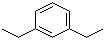 |
| Molecular Formula | C10H14 |
| Molecular Weight | 134.22 |
| CAS Registry Number | 141-93-5 |
| EC Number | 205-511-4 |
| SMILES | CCC1=CC(=CC=C1)CC |
| Density | 0.9±0.1 g/cm3, Calc.*, 0.864 g/mL (Expl.) |
|---|---|
| Index of Refraction | 1.497, Calc.*, 1.496 (Expl.) |
| Melting point | -83.9 ºC (Expl.) |
| Boiling Point | 181.7±10.0 ºC (760 mmHg), Calc.*, 182 ºC (Expl.) |
| Hazard Symbols |


 GHS02;GHS07;GHS08;GHS09 Danger Details
 | ||||||||||||||||||||||||||||||||
|---|---|---|---|---|---|---|---|---|---|---|---|---|---|---|---|---|---|---|---|---|---|---|---|---|---|---|---|---|---|---|---|---|---|
| Hazard Statements | H226-H304-H315-H319-H335-H411 Details | ||||||||||||||||||||||||||||||||
| Precautionary Statements | P210-P233-P240-P241-P242-P243-P261-P264-P264+P265-P271-P273-P280-P301+P316-P302+P352-P303+P361+P353-P304+P340-P305+P351+P338-P319-P321-P331-P332+P317-P337+P317-P362+P364-P370+P378-P391-P403+P233-P403+P235-P405-P501 Details | ||||||||||||||||||||||||||||||||
| Hazard Classification | |||||||||||||||||||||||||||||||||
| |||||||||||||||||||||||||||||||||
| Transport Information | UN 2049 | ||||||||||||||||||||||||||||||||
| SDS | Available | ||||||||||||||||||||||||||||||||
 Discovory and Applicatios
|
1,3-Diethylbenzene, also known as meta-diethylbenzene, is an aromatic hydrocarbon with the molecular formula C₁₀H₁₄. It consists of a benzene ring substituted with two ethyl groups at the 1 and 3 positions. As one of the three isomeric forms of diethylbenzene, it appears as a colorless liquid with a characteristic aromatic odor and is relatively insoluble in water but soluble in organic solvents. The compound is typically produced through the ethylation of benzene using ethylene in the presence of a catalyst such as aluminum chloride or zeolite. The reaction yields a mixture of ortho-, meta-, and para-diethylbenzene isomers, which are then separated by fractional distillation or other purification methods. The meta-isomer, 1,3-diethylbenzene, is isolated based on its distinct boiling point and other physical properties. 1,3-Diethylbenzene finds use primarily as a chemical intermediate in organic synthesis. Its aromatic ring, substituted with two ethyl groups, serves as a stable framework for further functionalization. The compound is used in the development of substituted benzenes, where electrophilic aromatic substitution reactions are commonly employed. It is also involved in the production of specialty chemicals, including certain dyes, polymers, and additives. In the petrochemical industry, diethylbenzenes serve as precursors in the synthesis of styrenic and other polymeric materials. While 1,3-diethylbenzene itself is not as widely used as some related compounds, it contributes to the formulation of high-boiling solvents and heat transfer fluids. Its thermal stability and favorable physical characteristics make it a suitable component in such systems. From an analytical perspective, 1,3-diethylbenzene is utilized as a reference standard in chromatographic techniques, particularly in gas chromatography, to help identify and quantify alkylbenzene components in complex mixtures. It can also appear as a constituent in fuel and lubricant formulations, and its presence is monitored in environmental testing related to petroleum product contamination. 1,3-Diethylbenzene is a well-characterized compound within the class of alkylbenzenes, offering value in both synthetic chemistry and industrial applications due to its structural simplicity, reactivity, and physicochemical properties. References 2024. Health Risk Assessment of Exposure to BTEX and PAH Compounds in Workers of Burnt Oil Recycling Factory: Simulation Using Monte Carlo Method. Environmental Processes, 11(3). DOI: 10.1007/s40710-024-00703-9 2023. Process-specific volatile organic compounds emission characteristics, environmental impact and health risk assessments of the petrochemical industry in the Beijing-Tianjin-Hebei region. Environmental science and pollution research international, 30(60). DOI: 10.1007/s11356-023-31351-5 2023. Fuelling phytoremediation: gasoline degradation by green wall systems-a case study. Environmental science and pollution research international, 30(55). DOI: 10.1007/s11356-023-30634-1 |
| Market Analysis Reports |
| List of Reports Available for 1,3-Diethylbenzene |