
Online Database of Chemicals from Around the World
| Shaanxi Sciphar Biotechnology Co., Ltd. | China | |||
|---|---|---|---|---|
 | www.sciphar.com | |||
 | +86 (29) 8835-3228 8838-9752 8300-6195 | |||
 | +86 (29) 8838-9961 / 6221-6857 | |||
 | sales@sciphar.com | |||
| Chemical manufacturer | ||||
| chemBlink Standard supplier since 2007 | ||||
| Simagchem Corporation | China | |||
|---|---|---|---|---|
| www.simagchem.com | |||
| +86 13806087780 | |||
| +86 (592) 268-0237 | |||
| sale@simagchem.com | |||
| Chemical manufacturer since 2002 | ||||
| chemBlink Standard supplier since 2008 | ||||
| Extrasynthese Chemical S.A.S. | France | |||
|---|---|---|---|---|
| www.extrasynthese.com | |||
| +33 (47) 898-2034 | |||
| +33 (47) 898-1945 | |||
| info@extrasynthese.com | |||
| Chemical manufacturer | ||||
| chemBlink Standard supplier since 2009 | ||||
| WJF Chemicals Co., Ltd., Quzhou | China | |||
|---|---|---|---|---|
| www.wjfchemicals.com | |||
| +86 (570) 386-5831 | |||
| +86 (570) 389-1534 | |||
| info@wjfchemicals.com | |||
| Chemical manufacturer since 2007 | ||||
| chemBlink Standard supplier since 2009 | ||||
| Hefei TNJ Chemical Industry Co., Ltd. | China | |||
|---|---|---|---|---|
| www.tnjchem.com | |||
| +86 (551) 6541-8684 | |||
| +86 (551) 6541-8697 | |||
| sales@tnjchem.com | |||
| Chemical manufacturer since 2001 | ||||
| chemBlink Standard supplier since 2010 | ||||
| Wilshire Technologies, Inc. | USA | |||
|---|---|---|---|---|
| www.wilshiretechnologies.com | |||
| +1 (609) 683-1117 | |||
| +1 (732) 274-0049 | |||
| Wilshire-info@evonik.com | |||
| Chemical manufacturer since 1997 | ||||
| chemBlink Standard supplier since 2010 | ||||
| Shaanxi Green Bio-Engineering Co., Ltd. | China | |||
|---|---|---|---|---|
| www.sxgreenfine.com | |||
| +86 (29) 8621-5910 8621-5920 8621-5930 | |||
| +86 (29) 8621-5580 | |||
| sxgreenfine@gmail.com rql1107@hotmail.com | |||
| Chemical manufacturer | ||||
| chemBlink Standard supplier since 2010 | ||||
| BOC Sciences | USA | |||
|---|---|---|---|---|
| www.bocsci.com | |||
| +1 (631) 485-4226 | |||
| +1 (631) 614-7828 | |||
| info@bocsci.com | |||
| Chemical manufacturer | ||||
| chemBlink Standard supplier since 2010 | ||||
| Aktin Chemicals Inc | China | |||
|---|---|---|---|---|
| www.aktinchem.com | |||
| +86 400-028-7725 | |||
| +86 (28) 8515-2372 | |||
| info@aktinchem.com | |||
 | QQ Chat | |||
| Chemical manufacturer | ||||
| chemBlink Standard supplier since 2011 | ||||
| Labseeker Inc | USA | |||
|---|---|---|---|---|
| www.labseeker.com | |||
| +1 (858) 750-1632 | |||
| +1 (858) 412-1220 | |||
| marketing@labseeker.com | |||
| Chemical manufacturer since 2002 | ||||
| chemBlink Standard supplier since 2015 | ||||
| Hangzhou Leap Chem Co., Ltd. | China | |||
|---|---|---|---|---|
| www.leapchem.com | |||
| +86 (571) 8771-1850 | |||
| market19@leapchem.com | |||
| QQ Chat | |||
| Chemical manufacturer since 2006 | ||||
| chemBlink Standard supplier since 2015 | ||||
| Chengdu Biopurify Phytochemicals Ltd. | China | |||
|---|---|---|---|---|
| www.phytopurify.com | |||
| +86 (28) 8263-3860 8263-3987 | |||
| +86 (28) 8263-3165 | |||
| sales@biopurify.com biopurify@gmail.com | |||
| QQ Chat | |||
 | Skype Chat | |||
| Chemical manufacturer | ||||
| chemBlink Standard supplier since 2017 | ||||
| Neostar United (Changzhou) Industrial Co., Ltd. | China | |||
|---|---|---|---|---|
| www.neostarunited.com | |||
| +86 (519) 8555-7386 +86 18015025600 | |||
| +86 (519) 8555-7389 | |||
| marketing1@neostarunited.com | |||
| Chemical distributor since 2014 | ||||
| chemBlink Standard supplier since 2020 | ||||
| Cfm Oskar Tropitzsch GmbH | Germany | |||
|---|---|---|---|---|
| www.cfmot.de | |||
| +49 (9231) 9619-0 | |||
| +49 (9231) 9619-60 | |||
| info@cfmot.de | |||
| Chemical distributor since 1985 | ||||
| chemBlink Standard supplier since 2022 | ||||
| Weiyel Inc | China | |||
|---|---|---|---|---|
| www.weiyel.com | |||
| +44 7421898692 | |||
| ivy@weiyelbncc.com | |||
| QQ Chat | |||
 | WeChat: +8615672728568 | |||
 | WhatsApp:+44 7421898692 | |||
| Chemical manufacturer since 2007 | ||||
| chemBlink Standard supplier since 2024 | ||||
| Sinova Corporation | USA | |||
|---|---|---|---|---|
| www.sinovainc.com | |||
| +1 (301) 961-1525 | |||
| +1 (240) 235-4288 | |||
| sales@sinovainc.com | |||
| Chemical manufacturer | ||||
| City Chemical LLC | USA | |||
|---|---|---|---|---|
| www.citychemical.com | |||
| +1 (203) 932-2489 | |||
| +1 (203) 937-8400 | |||
| sales@citychemical.com | |||
| Chemical distributor | ||||
| Ivy Fine Chemicals | USA | |||
|---|---|---|---|---|
| www.ivychem.com | |||
| +1 (856) 465-8550 | |||
| +1 (856) 616-1161 | |||
| sales@ivychem.com | |||
| Chemical manufacturer | ||||
| Classification | API >> Digestive system medication >> Laxative antidiarrheal |
|---|---|
| Name | Aloin |
| Synonyms | Barbaloin; 1,8-Dihydroxy-10-(beta-D-glucopyranosyl)-3-(hydroxymethyl)-9(10H)-anthracenone; 10-beta-D-Glucopyranosyl-1,8-dihydroxy-3-(hydroxymethyl)-9(10H)-anthracenone |
| Molecular Structure | 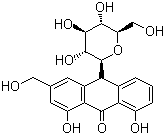 |
| Molecular Formula | C21H22O9 |
| Molecular Weight | 418.40 |
| CAS Registry Number | 1415-73-2 |
| EC Number | 215-808-0 |
| SMILES | C1=CC2=C(C(=C1)O)C(=O)C3=C([C@H]2[C@H]4[C@@H]([C@H]([C@@H]([C@H](O4)CO)O)O)O)C=C(C=C3O)CO |
| Solubility | 10 mM (DMSO) |
|---|---|
| Density | 1.6±0.1 g/cm3, Calc.* |
| Melting point | 188-148 °C |
| Index of Refraction | 1.741, Calc.* |
| Boiling Point | 752.6±60.0 °C (760 mmHg), Calc.* |
| Flash Point | 268.0±26.4 °C, Calc.* |
| * | Calculated using Advanced Chemistry Development (ACD/Labs) Software. |
| Hazard Symbols |  GHS07 Warning Details GHS07 Warning Details | ||||||||||||||||||||||||||||||||
|---|---|---|---|---|---|---|---|---|---|---|---|---|---|---|---|---|---|---|---|---|---|---|---|---|---|---|---|---|---|---|---|---|---|
| Risk Statements | H302-H315-H319-H332-H335 Details | ||||||||||||||||||||||||||||||||
| Safety Statements | P261-P264-P264+P265-P270-P271-P280-P301+P317-P302+P352-P304+P340-P305+P351+P338-P317-P319-P321-P330-P332+P317-P337+P317-P362+P364-P403+P233-P405-P501 Details | ||||||||||||||||||||||||||||||||
| Hazard Classification | |||||||||||||||||||||||||||||||||
| |||||||||||||||||||||||||||||||||
| SDS | Available | ||||||||||||||||||||||||||||||||
 Discovery and Applications
|
Aloin is a naturally occurring compound derived from the aloe vera plant, specifically from its leaves. This chemical substance belongs to a class of compounds known as anthraquinones, which are characterized by their distinct aromatic structure and biological properties. The discovery of aloin can be traced back to the traditional use of aloe vera in various cultures for its medicinal and therapeutic benefits. Historically, aloe vera has been utilized for centuries in herbal medicine, primarily for its soothing and healing properties. The extraction of aloin from aloe vera involves the isolation of the yellowish-brown, bitter compound found in the sap of the plant. The primary sources of aloin are the inner leaf gel and the outer leaf skin, where it is present as a glycosylated compound. The extraction process typically includes crushing the leaves to obtain the sap, followed by filtration and purification to isolate aloin in its active form. The interest in aloin surged with the growing popularity of herbal remedies and natural products in modern medicine. Aloin has garnered attention for its diverse applications in the fields of medicine, cosmetics, and food products. In traditional medicine, aloin is recognized for its laxative properties, acting as a natural stimulant for bowel movements. This effect is attributed to its ability to irritate the intestinal lining, thereby promoting peristalsis. As a result, aloin is commonly found in over-the-counter laxatives and digestive health products, although its use is regulated in some regions due to concerns about safety and potential side effects with prolonged use. In addition to its laxative effects, aloin has been studied for its potential anti-inflammatory and antioxidant properties. Research indicates that aloin may possess protective effects against oxidative stress, which is linked to various chronic diseases. These attributes make aloin a valuable ingredient in dietary supplements aimed at promoting overall health and wellness. Aloin is also utilized in the cosmetics industry for its moisturizing and skin-soothing benefits. It is commonly incorporated into skincare formulations, including lotions, creams, and gels, to provide hydration and relief for dry or irritated skin. The presence of aloin in these products enhances their efficacy and appeal, aligning with the growing consumer demand for natural and plant-based ingredients. Furthermore, aloin has been explored for its potential role in cancer prevention and treatment. Preliminary studies suggest that it may exhibit cytotoxic effects against certain cancer cell lines, prompting further investigation into its mechanisms of action and therapeutic applications. Although more research is needed, these findings open avenues for developing novel cancer therapies based on naturally derived compounds like aloin. Despite its numerous benefits, it is important to approach the use of aloin with caution. Prolonged consumption or high doses of aloin can lead to adverse effects, including abdominal cramps and diarrhea. As such, regulatory agencies in some countries have imposed restrictions on its use in food and dietary supplements. In summary, aloin is a significant compound derived from aloe vera with a rich history of use in traditional medicine and various applications in modern industries. Its discovery and ongoing research continue to highlight its potential health benefits, particularly in digestive health, skin care, and possibly even cancer therapy. References 2022. Barbaloin Promotes Osteogenic Differentiation of Human Bone Marrow Mesenchymal Stem Cells: Involvement of Wnt/b-catenin Signaling Pathway. Current Medicinal Chemistry, 29(25). DOI: 10.2174/0929867329666220629150656 2019. Mucoadhesive Polymeric Films to Enhance Barbaloin Penetration Into Buccal Mucosa: a Novel Approach to Chemoprevention. AAPS PharmSciTech, 20(1). DOI: 10.1208/s12249-018-1202-1 1963. The Quantitative Conversion of Barbaloin to Aloe-Emodin and its Application to the Evaluation of Aloes. The Journal of pharmacy and pharmacology, 15(9). DOI: 10.1111/j.2042-7158.1963.tb12789.x |
| Market Analysis Reports |