
Online Database of Chemicals from Around the World
| Simagchem Corporation | China | |||
|---|---|---|---|---|
 | www.simagchem.com | |||
 | +86 13806087780 | |||
 | +86 (592) 268-0237 | |||
 | sale@simagchem.com | |||
| Chemical manufacturer since 2002 | ||||
| chemBlink Standard supplier since 2008 | ||||
| Taizhou Crene Biotechnology Co., Ltd. | China | |||
|---|---|---|---|---|
| www.pharm-intermediates.com | |||
| +86 (576) 8881-3233 8820-5808 +86 13396860566 | |||
| +86 (576) 8822-9589 | |||
| sales@pharm-intermediates.com | |||
 | QQ Chat | |||
| Chemical manufacturer since 2011 | ||||
| chemBlink Standard supplier since 2009 | ||||
| BOC Sciences | USA | |||
|---|---|---|---|---|
| www.bocsci.com | |||
| +1 (631) 485-4226 | |||
| +1 (631) 614-7828 | |||
| info@bocsci.com | |||
| Chemical manufacturer | ||||
| chemBlink Standard supplier since 2010 | ||||
| Suzhou Myland Pharm & Nutrition Inc. | China | |||
|---|---|---|---|---|
| www.mylandpharm.com | |||
| +86 (512) 6615-0687 | |||
| +86 (512) 6615-7101 | |||
| info@mylandpharm.com | |||
| QQ Chat | |||
| Chemical manufacturer since 2013 | ||||
| chemBlink Standard supplier since 2014 | ||||
| Hangzhou Leap Chem Co., Ltd. | China | |||
|---|---|---|---|---|
| www.leapchem.com | |||
| +86 (571) 8771-1850 | |||
| market19@leapchem.com | |||
| QQ Chat | |||
| Chemical manufacturer since 2006 | ||||
| chemBlink Standard supplier since 2015 | ||||
| Shanghai Zehan Biopharma Technology Co., Ltd. | China | |||
|---|---|---|---|---|
| www.zehanbiopharma.com | |||
| +86 (21) 6135-0663 +86 13052117465 | |||
| +86 (21) 6135-0662 | |||
| sales@zehanbiopharma.com | |||
| QQ Chat | |||
| Chemical manufacturer since 2015 | ||||
| chemBlink Standard supplier since 2015 | ||||
| Amadis Chemical Co., Ltd. | China | |||
|---|---|---|---|---|
| www.amadischem.com | |||
| +86 (571) 8992-5085 | |||
| +86 (571) 8992-5065 | |||
| sales@amadischem.com | |||
| Chemical manufacturer since 2010 | ||||
| chemBlink Standard supplier since 2015 | ||||
| Shanghai Angewchem Co., Ltd. | China | |||
|---|---|---|---|---|
| www.angewchem.com | |||
| +86 18917157435 | |||
| dylan@angewchem.com | |||
| Chemical manufacturer since 2015 | ||||
| chemBlink Standard supplier since 2016 | ||||
| Viwit Pharmaceuticals Limited | China | |||
|---|---|---|---|---|
| www.viwit.com.cn | |||
| +86 (21) 3777-5618 | |||
| +86 (21) 3777-5619 | |||
| service@viwit.com | |||
| Chemical manufacturer since 2006 | ||||
| chemBlink Standard supplier since 2016 | ||||
| Jinlan Pharm-drugs Technology Co., Ltd. | China | |||
|---|---|---|---|---|
| www.royalpharms.com | |||
| +86 (571) 8582-9152 | |||
| sales02@royalpharms.com | |||
| Chemical distributor since 2012 | ||||
| chemBlink Standard supplier since 2016 | ||||
| Wuhan Demeikai Biotechnology Co., Ltd | China | |||
|---|---|---|---|---|
| www.dxhgnb.com | |||
| +86 +86 (027) 5045-8986 +86 17192727886 | |||
| sare@dmksw.xin wzh@dmksw.xin | |||
| QQ Chat | |||
| Chemical manufacturer since 2016 | ||||
| chemBlink Standard supplier since 2017 | ||||
| Pure Synmr Ingredients Limited | China | |||
|---|---|---|---|---|
| www.synmr.com | |||
| +86 (21) 6045-7587 ex 806 | |||
| sven@puresynmr.com | |||
| Chemical manufacturer since 2014 | ||||
| chemBlink Standard supplier since 2017 | ||||
| Xi'an Yinherb Bio-tech Co., Ltd | China | |||
|---|---|---|---|---|
| yinherb.ecer.com | |||
| +86 (29) 6333-2330 | |||
| sales@yinherb-nutraceuticals.com | |||
| QQ Chat | |||
| Chemical manufacturer since 2009 | ||||
| chemBlink Standard supplier since 2021 | ||||
| Demeikai (hongkong) biotechnology Co., Ltd. | China | |||
|---|---|---|---|---|
| www.hkdmk.com | |||
| +86 18942921723 | |||
| wzh@dmksw.xin | |||
 | Skype Chat | |||
| Chemical distributor since 2017 | ||||
| chemBlink Standard supplier since 2021 | ||||
| Xinlian Rui Biomedical Technology (shandong) Co., Ltd. | China | |||
|---|---|---|---|---|
| www.xlrchem.com | |||
| +86 15153173989 | |||
| 3865799121@qq.com | |||
| QQ Chat | |||
 | WeChat: 15153173989 | |||
| Chemical manufacturer since 2024 | ||||
| chemBlink Standard supplier since 2025 | ||||
| VDM Biochemicals | USA | |||
|---|---|---|---|---|
| www.vdmbio.com | |||
| +1 (330) 252-8181 | |||
| +1 (330) 252-8171 | |||
| sales@vdmbio.com info@vdmbio.com | |||
| Chemical manufacturer | ||||
| Axon MedChem BV | Netherlands | |||
|---|---|---|---|---|
| www.axonmedchem.com | |||
| +31 (50) 311-8007 | |||
| +31 (50) 360-0390 | |||
| order@axonmedchem.com | |||
| Chemical manufacturer | ||||
| Key Organics Ltd. | UK | |||
|---|---|---|---|---|
| www.keyorganics.net | |||
| +44 (1840) 212-137 | |||
| +44 (1840) 213-712 | |||
| info@keyorganics.net | |||
| Chemical manufacturer | ||||
| Classification | API >> Hormone and endocrine-regulating drugs >> Pituitary hormone |
|---|---|
| Name | Ibutamoren mesylate |
| Synonyms | MK-677; 2-Amino-N-[(1R)-2-[1,2-dihydro-1-(methylsulfonyl)spiro[3H-indole-3,4'-piperidin]-1'-yl]-2-oxo-1-[(phenylmethoxy)methyl]ethyl]-2-methylpropanamide methanesulfonate |
| Molecular Structure | 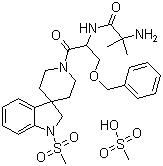 |
| Molecular Formula | C27H36N4O5S.CH4O3S |
| Molecular Weight | 624.77 |
| CAS Registry Number | 159752-10-0 |
| SMILES | CC(C)(C(=O)N[C@H](COCC1=CC=CC=C1)C(=O)N2CCC3(CC2)CN(C4=CC=CC=C34)S(=O)(=O)C)N.CS(=O)(=O)O |
| Solubility | DMSO 12 mg/mL, Water $lessThan$1 mg/mL (Expl.) |
|---|---|
| Hazard Symbols |  GHS07 Warning Details GHS07 Warning Details |
|---|---|
| Risk Statements | H302-H315-H319-H335 Details |
| Safety Statements | P261-P305+P351+P338 Details |
| SDS | Available |
 Discovery and Applications
|
Ibutamoren mesylate is a synthetic compound developed in the 1990s during research into growth hormone secretagogues, a class of molecules designed to stimulate the body’s natural production of growth hormone. It is the mesylate salt form of ibutamoren, which is also known by the research code MK-677. The discovery of ibutamoren was part of a larger pharmaceutical effort to find small-molecule alternatives to peptide-based growth hormone releasing agents, with the goal of developing an orally active drug that could mimic the effects of the natural ligand ghrelin. Ghrelin, identified in 1999 as a peptide hormone that binds to the growth hormone secretagogue receptor (GHSR), regulates appetite and growth hormone release. Prior to this discovery, ibutamoren had already been identified as a potent agonist of the same receptor, and its mesylate form was developed to improve stability, handling, and formulation. The main application of ibutamoren mesylate has been in clinical research related to disorders involving growth hormone deficiency and muscle wasting. By binding to the GHSR, it stimulates the secretion of growth hormone and subsequently increases circulating levels of insulin-like growth factor 1 (IGF-1). Both of these hormones play crucial roles in growth, metabolism, and tissue repair. Clinical studies have demonstrated that ibutamoren mesylate can increase growth hormone and IGF-1 levels in both young and elderly subjects, leading to interest in its potential use for treating growth hormone deficiencies, frailty in older populations, and conditions such as osteoporosis. Another area of research application has been in the treatment of muscle wasting and cachexia, which are common in chronic illnesses such as cancer and HIV/AIDS. The ability of ibutamoren mesylate to stimulate appetite through ghrelin receptor activation has been of particular interest in this context, since loss of appetite contributes significantly to weight loss in such conditions. Its oral bioavailability distinguishes it from peptide-based therapies, which typically require injection, making it more convenient for long-term administration in clinical settings. In addition to its applications in endocrinology and metabolic research, ibutamoren mesylate has also been studied in the context of sleep and cognitive function. Activation of the ghrelin receptor has been linked to improvements in sleep quality and architecture, and preliminary studies suggested possible benefits in cognitive performance through indirect mechanisms involving growth hormone and IGF-1. These findings contributed to broader investigations into its potential as a therapeutic tool beyond growth disorders. Despite the promising results from early studies, ibutamoren mesylate has not been approved for clinical use by regulatory agencies. Research has continued in the form of clinical trials, but its development as a marketed drug has remained limited. Concerns about long-term safety, particularly regarding insulin sensitivity and other metabolic effects, have influenced the pace of its progress. Nonetheless, the compound remains a widely studied example of a non-peptidic, orally active growth hormone secretagogue, and its discovery represented a significant milestone in the search for practical growth hormone modulators. References 2018. MK-0677, a Ghrelin Agonist, Alleviates Amyloid Beta-Related Pathology in 5XFAD Mice, an Animal Model of Alzheimer’s Disease. International Journal of Molecular Sciences, 19(6). DOI: 10.3390/ijms19061800 2011. MK-0677 (ibutamoren mesylate) for the treatment of patients recovering from hip fracture: A multicenter, randomized, placebo-controlled phase IIb study. Archives of Gerontology and Geriatrics, 53(2). DOI: 10.1016/j.archger.2010.10.004 2008. Effects of an oral ghrelin mimetic on body composition and clinical outcomes in healthy older adults: a randomized trial. Annals of Internal Medicine, 149(9). DOI: 10.7326/0003-4819-149-9-200811040-00003 |
| Market Analysis Reports |