
Online Database of Chemicals from Around the World
| Hangzhou Chuan Shuo Technology Co., Ltd. | China | |||
|---|---|---|---|---|
 | www.transol.cn | |||
 | +86 (571) 8760-9021 | |||
 | qian@transol.cn | |||
| Chemical manufacturer since 2017 | ||||
| chemBlink Standard supplier since 2025 | ||||
| Classification | Organic raw materials >> Organic derivative of hydrazine or hydrazine |
|---|---|
| Name | N'-tert-butyl-3-methoxy-2-methylbenzohydrazide |
| Synonyms | 3-Methoxy-2-methyl-N'-(2-methyl-2-propanyl)benzohydrazide |
| Molecular Structure | 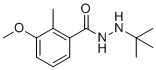 |
| Molecular Formula | C13H20N2O2 |
| Molecular Weight | 236.31 |
| CAS Registry Number | 163336-50-3 |
| SMILES | CC1=C(C=CC=C1OC)C(=O)NNC(C)(C)C |
| Density | 1.0 g/cm3 Calc.* |
|---|---|
| Boiling point | 331.9 °C 760 mmHg (Calc.)* |
| Flash point | 154.5 °C (Calc.)* |
| Index of refraction | 1.514 (Calc.)* |
| * | Calculated using Advanced Chemistry Development (ACD/Labs) Software. |
| Hazard Symbols |  GHS07 Warning Details GHS07 Warning Details |
|---|---|
| Risk Statements | H302-H315-H319-H335 Details |
| Safety Statements | P280-P305+P351+P338 Details |
| SDS | Available |
 chemBlink Chemical Story
|
N'-tert-butyl-3-methoxy-2-methylbenzohydrazide is a hydrazide derivative of substituted benzoic acid, featuring a tert-butyl-substituted hydrazide functional group. Its molecular structure consists of a benzene ring substituted with a methoxy group at the 3-position and a methyl group at the 2-position, while the carboxylic acid group at the 1-position is converted into a hydrazide, further substituted at the terminal nitrogen with a tert-butyl group. The compound belongs to the broader family of aromatic hydrazides, which are known for their role in medicinal chemistry and coordination chemistry. Benzohydrazide derivatives have historically been important for their applications as intermediates in the synthesis of pharmaceuticals, agrochemicals, and heterocyclic compounds. The hydrazide group is particularly versatile and reactive, allowing for condensation with aldehydes and ketones to form hydrazones, or cyclization to form a wide range of nitrogen-containing heterocycles. The synthesis of N'-tert-butyl-3-methoxy-2-methylbenzohydrazide is typically carried out by first preparing the corresponding 3-methoxy-2-methylbenzoic acid or ester, followed by conversion to the acyl hydrazide using hydrazine hydrate. The resulting hydrazide intermediate is then alkylated with tert-butyl bromide or a similar reagent to introduce the tert-butyl group at the terminal nitrogen of the hydrazide. The use of mild reaction conditions ensures selective substitution and avoids over-alkylation or side reactions. This compound has been explored in the context of medicinal chemistry, particularly for its potential to inhibit specific enzyme targets or act as a ligand in metal coordination complexes. The tert-butyl substituent adds steric bulk, which can influence the compound’s reactivity, binding affinity, and pharmacokinetic properties. The methoxy and methyl substituents on the aromatic ring affect the electron density and can modulate the chemical behavior during further transformations. Physicochemically, N'-tert-butyl-3-methoxy-2-methylbenzohydrazide is typically a solid at room temperature with moderate solubility in polar organic solvents such as ethanol, methanol, and dimethylformamide. It exhibits characteristic spectroscopic features, such as N–H stretching vibrations in infrared spectroscopy, and signals for aromatic protons, methoxy, and methyl groups in nuclear magnetic resonance spectroscopy. Mass spectrometry provides confirmation of its molecular weight and fragmentation pattern, while elemental analysis or high-performance liquid chromatography (HPLC) may be used for purity determination. Potential applications for this compound include its use as a building block in drug discovery, particularly in the synthesis of hydrazone-based bioactive molecules or nitrogen-containing heterocycles with antibacterial, antitumor, or anti-inflammatory properties. In some studies, similar hydrazide derivatives have demonstrated biological activity through their interaction with metal ions, serving as ligands for transition metals in catalysis or as antimicrobial agents due to their chelating ability. The hydrazide functionality in N'-tert-butyl-3-methoxy-2-methylbenzohydrazide also lends itself to use in analytical chemistry, particularly in derivatization reactions to enhance detectability or stability of analytes. In coordination chemistry, the compound may act as a bidentate or tridentate ligand, coordinating through the carbonyl oxygen and the nitrogen atoms, forming stable complexes with metal centers such as copper, nickel, or cobalt. Safety data specific to this compound are limited, but general precautions for hydrazides should be observed, as many related compounds are known to be irritants or sensitizers. Proper handling with gloves, eye protection, and fume hoods is recommended during laboratory use. In summary, N'-tert-butyl-3-methoxy-2-methylbenzohydrazide is a substituted aromatic hydrazide with potential utility in synthetic organic and medicinal chemistry. Its combination of functional groups provides both reactivity and versatility, making it a useful intermediate or ligand in various chemical applications. |
| Market Analysis Reports |