Dicyclohexylchlorophosphine is an important organophosphorus compound widely utilized in the field of synthetic chemistry. This chemical is notable for its unique properties, which make it a valuable reagent in various chemical transformations, particularly in the realm of organometallic chemistry and catalysis.
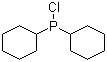
The discovery of dicyclohexylchlorophosphine dates back to the mid-20th century when chemists began exploring new phosphorus-containing ligands for use in catalytic processes. The compound is characterized by its phosphorus atom bonded to two cyclohexyl groups and one chlorine atom, giving it a distinct steric and electronic profile compared to other phosphines. The steric bulk provided by the two cyclohexyl rings imparts stability and prevents unwanted side reactions, while the chlorine atom enhances its reactivity in various chemical processes.
In synthetic chemistry, dicyclohexylchlorophosphine serves as a key ligand in the formation of coordination complexes, particularly with transition metals. Its application is most notable in the preparation of organometallic compounds where it plays a crucial role as a phosphine ligand. These complexes are often used in catalytic reactions, such as hydroformylation and olefin polymerization. The bulky nature of the dicyclohexyl groups makes this ligand particularly useful for stabilizing metal centers in these reactions, allowing for enhanced selectivity and activity.
One significant application of dicyclohexylchlorophosphine is in the synthesis of palladium and platinum complexes. These complexes are employed as catalysts in various organic transformations, including cross-coupling reactions. In Suzuki-Miyaura, Heck, and Negishi coupling reactions, for instance, palladium catalysts containing dicyclohexylchlorophosphine are known to provide high yields and selectivity, making them invaluable in the synthesis of complex organic molecules.
Moreover, dicyclohexylchlorophosphine is used in the development of new catalysts for asymmetric synthesis. Its ability to form stable complexes with metal centers allows chemists to design and optimize catalysts that can facilitate highly selective reactions. This is particularly important in the pharmaceutical industry, where asymmetric synthesis is crucial for producing enantiomerically pure compounds.
The reactivity of dicyclohexylchlorophosphine is also leveraged in the formation of phosphine oxides and other derivatives. These derivatives can be used in a variety of applications, including as stabilizers for organometallic complexes and as intermediates in the synthesis of more complex phosphorus-containing compounds.
In summary, dicyclohexylchlorophosphine is a versatile compound with significant implications for synthetic chemistry and catalysis. Its discovery and development have provided chemists with a valuable tool for enhancing the efficiency and selectivity of various chemical processes. As research in this area continues, it is likely that new applications and derivatives of dicyclohexylchlorophosphine will emerge, further expanding its role in the advancement of chemical synthesis.
References
Mechanochemistry-Directed Ligand Design: Development of a High-Performance Phosphine Ligand for Palladium-Catalyzed Mechanochemical Organoboron Cross-Coupling. Palladium-Catalyzed Mechanochemical Cross-Coupling Reactions.
DOI: 10.1007/978-981-97-1991-4_6
2019. Synthesis of ionic liquid-based Ru(II)-phosphinite complexes and evaluation of their antioxidant, antibacterial, DNA-binding, and DNA cleavage activities. Chemical Papers, 73(6), 1351-1362.
DOI: 10.1007/s11696-018-00670-0
1967. Preparation of tetracyclohexyl(methylenediphosphine) dioxide. Bulletin of the Academy of Sciences of the USSR, Division of chemical science, 16(4), 693-695.
DOI: 10.1007/bf00915696
|




 GHS05 Danger Details
 Discovery and Applications