
Online Database of Chemicals from Around the World
| Relybo Pharmachemical Co., Ltd. | China | |||
|---|---|---|---|---|
 | www.relybopharma.com | |||
 | +86 (25) 8771-6566 | |||
 | susanchen@relybopharma.com | |||
| Chemical distributor since 2011 | ||||
| chemBlink Standard supplier since 2014 | ||||
| Classification | Organic raw materials >> Amino compound >> Amide compound |
|---|---|
| Name | N-(2,2-dimethoxyethyl)-1H-imidazole-1-carboxamide |
| Molecular Structure | 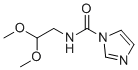 |
| Molecular Formula | C8H13N3O3 |
| Molecular Weight | 199.21 |
| CAS Registry Number | 183660-46-0 |
| SMILES | COC(CNC(=O)N1C=CN=C1)OC |
| Hazard Symbols |  GHS07 Warning Details GHS07 Warning Details |
|---|---|
| Risk Statements | H315-H319-H335 Details |
| Safety Statements | P261-P305+P351+P351-P302+P352 Details |
| SDS | Available |
 Discovery and Applications
|
N-(2,2-Dimethoxyethyl)-1H-imidazole-1-carboxamide is an organic compound that belongs to the class of imidazole derivatives, characterized by the presence of a carboxamide group and a dimethoxyethyl substituent. The compound has attracted attention due to its unique structural features, which include both a heterocyclic imidazole ring and a functionalized alkyl group. These attributes provide opportunities for its use in various chemical and pharmaceutical applications, making it an important molecule in the field of medicinal chemistry and material science. The discovery of N-(2,2-dimethoxyethyl)-1H-imidazole-1-carboxamide emerged from the broader exploration of imidazole-based compounds, which have long been recognized for their diverse biological activities. Imidazole derivatives, in particular, have been widely studied for their antimicrobial, anticancer, and anti-inflammatory properties, owing to the versatile reactivity and stability of the imidazole ring. The introduction of a carboxamide group further enhances the compound’s ability to engage in hydrogen bonding and other interactions with biological macromolecules, improving its potential as a bioactive agent. One of the most significant applications of N-(2,2-dimethoxyethyl)-1H-imidazole-1-carboxamide lies in the pharmaceutical industry. The imidazole core structure is an important scaffold in drug design, and the presence of the carboxamide group can influence the compound’s solubility and bioavailability. The dimethoxyethyl group serves to modulate the lipophilicity and pharmacokinetic properties of the compound, making it more favorable for oral administration and enhancing its stability in biological systems. This combination of structural features makes N-(2,2-dimethoxyethyl)-1H-imidazole-1-carboxamide a valuable intermediate for the development of new therapeutic agents targeting diseases such as cancer, fungal infections, and metabolic disorders. In addition to its pharmaceutical applications, N-(2,2-dimethoxyethyl)-1H-imidazole-1-carboxamide has potential uses in materials science. The imidazole ring, known for its electron-rich nature, can participate in various coordination chemistry processes, making the compound suitable for use in the design of metal-organic frameworks (MOFs) or as a ligand in catalysis. The dimethoxyethyl group can also play a role in tuning the solubility and interaction properties of the compound, which is essential for its incorporation into complex materials for applications in electronics, sensors, or drug delivery systems. Such functionalization can lead to the development of advanced materials with enhanced performance and stability. Another application of N-(2,2-dimethoxyethyl)-1H-imidazole-1-carboxamide is in the field of agrochemicals. The imidazole structure has been widely studied for its antifungal properties, and the modification of the compound with a carboxamide group could enhance its activity as a fungicide. This makes it a potential candidate for the development of crop protection agents, particularly those aimed at combating fungal pathogens that affect agriculture. Furthermore, the incorporation of the dimethoxyethyl group could improve the compound's ability to penetrate plant tissues, increasing its efficacy as a pesticide. The compound’s ability to interact with biological macromolecules also makes it a promising candidate for use in diagnostic applications. The imidazole ring can engage in specific binding interactions with proteins, enzymes, or nucleic acids, which is useful in the development of biosensors or diagnostic assays. By attaching the compound to a sensing platform, it could potentially be employed in the detection of disease biomarkers or environmental contaminants. In conclusion, N-(2,2-dimethoxyethyl)-1H-imidazole-1-carboxamide is a multifunctional compound with a wide range of applications in pharmaceuticals, materials science, agrochemicals, and diagnostics. Its structural features, including the imidazole ring and carboxamide group, contribute to its versatile reactivity, making it a valuable intermediate for drug discovery and material design. The unique combination of properties in this compound highlights its potential as a key component in future therapeutic and industrial developments. References none |
| Market Analysis Reports |