
Online Database of Chemicals from Around the World
| Shanghai Zhuyao Pharmaceutical Technology Co., Ltd. | China | |||
|---|---|---|---|---|
 | cn.pharmalego.com | |||
 | +86 (021) 5859-6383 | |||
 | marketing@pharmalego.com | |||
 | QQ Chat | |||
| Chemical manufacturer since 2023 | ||||
| chemBlink Standard supplier since 2024 | ||||
| Classification | Organic raw materials >> Amino compound >> Amide compound |
|---|---|
| Name | 2-((4-Chloropyrimidin-5-yl)oxy)-5-fluoro-N,N-diisopropylbenzamide |
| Molecular Structure | 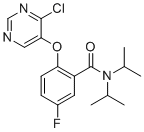 |
| Molecular Formula | C17H19ClFN3O2 |
| Molecular Weight | 351.80 |
| CAS Registry Number | 2169919-97-3 |
| SMILES | CC(C)N(C(C)C)C(=O)C1=C(C=CC(=C1)F)OC2=CN=CN=C2Cl |
| Density | 1.2±0.1 g/cm3, Calc.* |
|---|---|
| Index of Refraction | 1.549, Calc.* |
| Boiling Point | 453.3±45.0 °C (760 mmHg), Calc.* |
| Flash Point | 228.0±28.7 °C, Calc.* |
| * | Calculated using Advanced Chemistry Development (ACD/Labs) Software. |
| Hazard Symbols |  GHS07 Warning Details GHS07 Warning Details |
|---|---|
| Risk Statements | H302-H315-H319 Details |
| Safety Statements | P501-P270-P264-P280-P302+P352-P337+P313-P305+P351+P338-P362+P364-P332+P313-P301+P312+P330 Details |
| SDS | Available |
 chemBlink Chemical Story
|
2-((4-Chloropyrimidin-5-yl)oxy)-5-fluoro-N,N-diisopropylbenzamide is a chemical compound with a distinctive structure that has attracted attention in pharmaceutical and materials chemistry. This compound contains a pyrimidine ring, a benzamide group, and various substituents, making it a versatile molecule with the potential for a variety of applications. The combination of functional groups in its structure gives it both chemical reactivity and biological activity, which are essential in the development of new chemical agents. The discovery of 2-((4-chloropyrimidin-5-yl)oxy)-5-fluoro-N,N-diisopropylbenzamide lies in the broader field of pyrimidine-based compounds, which are known for their diverse biological and pharmacological properties. Pyrimidines are heterocyclic compounds that have been extensively studied due to their presence in many biologically relevant molecules such as nucleic acids, coenzymes, and other important metabolites. Substituted pyrimidines, such as 4-chloropyrimidine, have been explored for their ability to interact with biological systems, making them ideal candidates for drug discovery. The incorporation of a fluorine atom at the 5-position of the pyrimidine ring and a chloropyrimidine substituent on the benzamide group is a design strategy intended to enhance the compound's biological activity and stability. Fluorine atoms are often introduced into pharmaceutical compounds due to their electron-withdrawing effects, which can influence the compound’s pharmacokinetic properties, such as lipophilicity and metabolic stability. In this case, the combination of a fluorine atom and a chloro group in the molecular structure could improve the binding affinity of the compound to its biological targets, making it a promising candidate for therapeutic use. One of the major applications of 2-((4-chloropyrimidin-5-yl)oxy)-5-fluoro-N,N-diisopropylbenzamide is in the field of medicinal chemistry. The compound’s structure suggests that it may act as an inhibitor or modulator of specific enzymes or receptors, which could lead to the development of novel drugs. The presence of the benzamide group is particularly relevant because benzamide derivatives are known for their diverse biological activities, including anti-inflammatory, anticancer, and antimicrobial effects. The additional functional groups in this molecule may enable it to target specific diseases more effectively, making it an attractive lead compound for drug development. In particular, this compound may have potential in the treatment of cancer or other diseases driven by abnormal cell signaling. Pyrimidine derivatives are often designed to target enzymes involved in cell division and growth, such as kinases or other regulatory proteins. The fluorine and chlorine substitutions on the pyrimidine ring could enhance the molecule’s ability to interact with these targets, potentially leading to more potent anticancer agents or drugs with other therapeutic effects. In addition to its use in pharmaceuticals, 2-((4-chloropyrimidin-5-yl)oxy)-5-fluoro-N,N-diisopropylbenzamide may also find applications in materials science. The unique combination of a pyrimidine ring with the benzamide and isopropyl groups may give rise to interesting electronic or optical properties, making it a potential candidate for use in organic electronics, such as organic light-emitting diodes (OLEDs) or organic solar cells. The introduction of fluorine, in particular, is known to affect the electronic properties of organic compounds, which could lead to improved performance in optoelectronic devices. Furthermore, the compound could be a valuable intermediate in the synthesis of more complex organic molecules. Its structure allows for easy modification, enabling the creation of derivatives with enhanced properties for specific applications. Whether in drug discovery or materials chemistry, the synthetic versatility of 2-((4-chloropyrimidin-5-yl)oxy)-5-fluoro-N,N-diisopropylbenzamide makes it a molecule of interest for future research. In summary, 2-((4-chloropyrimidin-5-yl)oxy)-5-fluoro-N,N-diisopropylbenzamide is a promising chemical compound with applications in both medicinal chemistry and materials science. Its structure, which includes a pyrimidine core, a benzamide group, and functional substitutions, makes it an attractive candidate for the development of new therapeutic agents and advanced materials. As research into its properties and applications continues, it is likely to play a significant role in the creation of new drugs and cutting-edge technologies. |
| Market Analysis Reports |