
Online Database of Chemicals from Around the World
| Simagchem Corporation | China | |||
|---|---|---|---|---|
 | www.simagchem.com | |||
 | +86 13806087780 | |||
 | +86 (592) 268-0237 | |||
 | sale@simagchem.com | |||
| Chemical manufacturer since 2002 | ||||
| chemBlink Standard supplier since 2008 | ||||
| Hefei TNJ Chemical Industry Co., Ltd. | China | |||
|---|---|---|---|---|
| www.tnjchem.com | |||
| +86 (551) 6541-8684 | |||
| +86 (551) 6541-8697 | |||
| sales@tnjchem.com | |||
| Chemical manufacturer since 2001 | ||||
| chemBlink Standard supplier since 2010 | ||||
| Hangzhou Leap Chem Co., Ltd. | China | |||
|---|---|---|---|---|
| www.leapchem.com | |||
| +86 (571) 8771-1850 | |||
| market19@leapchem.com | |||
 | QQ Chat | |||
| Chemical manufacturer since 2006 | ||||
| chemBlink Standard supplier since 2015 | ||||
| Hangzhou Hairui Chemical Co., Ltd. | China | |||
|---|---|---|---|---|
| www.hairuichem.com | |||
| +86 (571) 8669-1155 | |||
| +86 (571) 8669-1154 | |||
| sales@hairuichem.com | |||
| Chemical distributor since 2005 | ||||
| chemBlink Standard supplier since 2017 | ||||
| Riverland Trading LLC. | USA | |||
|---|---|---|---|---|
| www.riverlandtrading.com | |||
| +1 (336).944-2293 | |||
| bens@riverlandtrading.com | |||
| Chemical distributor | ||||
| chemBlink Standard supplier since 2023 | ||||
| Ningbo Dongbo New Energy Co., Ltd. | China | |||
|---|---|---|---|---|
| www.dobonewenergy.com | |||
| +86 (0574) 6329-6893 | |||
| +86 (0574) 5801-0392 | |||
| alice@dobonewenergy.com | |||
| QQ Chat | |||
 | WeChat: 18668281331 | |||
 | WhatsApp:15824288686 | |||
| Chemical distributor since 2020 | ||||
| chemBlink Standard supplier since 2025 | ||||
| Scientific Polymer Products, Inc. | USA | |||
|---|---|---|---|---|
| www.scientificpolymer.com | |||
| +1 (585) 265-0413 | |||
| +1 (585) 265-1390 | |||
| custserv@scipoly.com | |||
| Chemical manufacturer | ||||
| Whyte Chemicals | UK | |||
|---|---|---|---|---|
| www.whytechemicals.co.uk | |||
| +44 (20) 8346-5946 | |||
| +44 (20) 8349-4589 | |||
| sales@whytechemicals.co.uk | |||
| Chemical distributor | ||||
| Classification | Catalysts and additives >> Polymer |
|---|---|
| Name | Poly(tetrahydrofuran) |
| Synonyms | (2S)-2-butoxybutan-1-ol |
| Molecular Structure | 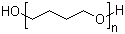 |
| Molecular Formula | H.(C4H8O)n.OH |
| CAS Registry Number | 25190-06-1 |
| EC Number | 607-637-9 |
| SMILES | CCCCO[C@@H](CC)CO |
| Density | 0.9 g/cm3 Calc.* |
|---|---|
| Boiling point | 195.7 °C 760 mmHg (Calc.)* |
| Flash point | 58.1 °C (Calc.)* |
| Index of refraction | 1.427 (Calc.)* |
| * | Calculated using Advanced Chemistry Development (ACD/Labs) Software. |
| Hazard Symbols |  GHS07 Warning Details GHS07 Warning Details | ||||||||||||||||||||
|---|---|---|---|---|---|---|---|---|---|---|---|---|---|---|---|---|---|---|---|---|---|
| Risk Statements | H319-H412 Details | ||||||||||||||||||||
| Safety Statements | P264+P265-P273-P280-P305+P351+P338-P337+P317-P501 Details | ||||||||||||||||||||
| Hazard Classification | |||||||||||||||||||||
| |||||||||||||||||||||
| SDS | Available | ||||||||||||||||||||
 Discovery and Applications
|
Poly(tetrahydrofuran), commonly abbreviated as PTHF or sometimes referred to as polytetramethylene ether glycol (PTMEG), is a linear polyether diol obtained by the cationic ring-opening polymerization of tetrahydrofuran (THF). This polymer is characterized by repeating oxybutylene units, with the general structure HO–(CH2)4–O–)n–H. Its molecular weight typically ranges from 250 to several thousand Daltons, depending on the degree of polymerization. PTHF is known for its flexibility, hydrolytic stability, and good compatibility with isocyanates, which has made it an essential raw material in the manufacture of polyurethane elastomers. The discovery of poly(tetrahydrofuran) dates back to the early research on polymerizing cyclic ethers. Significant development occurred during the mid-20th century when reliable catalysts for the ring-opening polymerization of THF were introduced. These included acid catalysts such as fluorosulfonic acid and later, more controllable systems based on boron trifluoride complexes or triflic acid. The production process involves initiation by a proton source or other electrophilic catalyst, leading to a chain-growth mechanism with minimal branching. The ability to control molecular weight and maintain narrow molecular weight distributions improved with the introduction of living polymerization techniques. PTHF has been most prominently applied in the field of polyurethanes, especially in thermoplastic polyurethane (TPU) elastomers. These materials are valued for their high elasticity, abrasion resistance, and stability over a broad temperature range. PTHF acts as the soft segment in these block copolymers, contributing to elasticity and resistance to hydrolysis. TPU based on PTHF is widely used in applications such as sporting goods, automotive components, cable jacketing, medical devices, and textile coatings. In the elastomer sector, PTHF-based polyurethanes are favored over other polyether diols like polyethylene glycol due to their superior mechanical strength and resilience under dynamic conditions. The hydrophobic character of PTHF also confers better hydrolysis resistance compared to polyester-based polyurethanes, making it suitable for use in humid or aqueous environments. This property is particularly advantageous in marine applications or for protective coatings. Beyond polyurethane elastomers, PTHF is used in the synthesis of spandex fibers. In this context, it serves as a central component in segmented polyurethanes where it imparts the stretchability and recovery characteristics essential to elastic textiles. Spandex fibers containing PTHF offer durability and comfort, and are extensively used in activewear and performance clothing. PTHF has also been studied for use in advanced materials such as ion-conductive polymers, where its ether oxygen atoms provide coordination sites for lithium ions. In this role, it has been explored as part of the polymer matrix in solid polymer electrolytes for lithium batteries. Its combination of flexibility, low glass transition temperature, and coordination ability makes it a promising candidate, though conductivity enhancements and thermal stability improvements remain areas of ongoing research. In surface coatings and adhesives, PTHF serves as a reactive intermediate, especially where a balance of flexibility and chemical resistance is required. It can be end-functionalized to react with various other monomers, enabling the formation of block copolymers or crosslinked networks. Such versatility has made it a valuable component in developing advanced coatings for electronics, packaging, and consumer products. Environmental and toxicological evaluations have shown that PTHF exhibits low toxicity and limited bioaccumulation. As a synthetic polymer, it is not biodegradable in conventional environments, though research has explored enzymatic degradation under specific conditions. Recycling and reuse of PTHF-based products remain industrial challenges, especially in mixed-material systems. Overall, poly(tetrahydrofuran) continues to play an important role in polymer science and industrial chemistry. Its balance of flexibility, chemical resistance, and reactivity has ensured its relevance across a wide array of applications, from elastomers to high-performance coatings and beyond. References 2016. Artificial extracellular matrix for biomedical applications: biocompatible and biodegradable poly (tetramethylene ether) glycol/poly (ε-caprolactone diol)-based polyurethanes. Journal of Biomaterials Science, Polymer Edition, 27(14). DOI: 10.1080/09205063.2016.1231436 2002. Hydrogels based on poly(ethylene oxide) and poly(tetramethylene oxide) or poly(dimethyl siloxane): synthesis, characterization, in vitro protein adsorption and platelet adhesion. Biomaterials, 23(8). DOI: 10.1016/s0142-9612(01)00306-4 2002. Hydrogels based on poly(ethylene oxide) and poly(tetramethylene oxide) or poly(dimethyl siloxane). III. In vivo biocompatibility and biostability. Journal of biomedical materials research. Part A, 66(1). DOI: 10.1002/jbm.a.10424 |
| Market Analysis Reports |