
Online Database of Chemicals from Around the World
| Wuhan Kemi-works Chemical Co., Ltd. | China | |||
|---|---|---|---|---|
 | www.kemiworks.net | |||
 | +86 (27) 8573-6489 | |||
 | +86 (27) 8573-6485 | |||
 | info@kemiworks.net sales@kemiworks.com | |||
| Chemical manufacturer | ||||
| chemBlink Premium supplier since 2011 | ||||
| Earlier HK Company Limited | China | |||
|---|---|---|---|---|
| www.earlierchem.com | |||
| +86 (10) 6142-6769 +86 18616907430 | |||
| +86 (10) 6142-6769 | |||
| info@earlierchem.com | |||
 | QQ Chat | |||
| Chemical manufacturer since 2011 | ||||
| chemBlink Premium supplier since 2014 | ||||
| Classification | Chemical reagent >> Organic reagent >> Siloxane |
|---|---|
| Name | 3-Glycidoxypropyltrimethoxysilane |
| Synonyms | [3-(2,3-Epoxypropoxy)propyl]trimethoxysilane; Glycidyl 3-(trimethoxysilyl)propyl ether; Glymo |
| Molecular Structure | 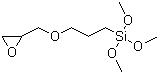 |
| Molecular Formula | C9H20O5Si |
| Molecular Weight | 236.34 |
| CAS Registry Number | 2530-83-8 |
| EC Number | 219-784-2 |
| SMILES | CO[Si](CCCOCC1CO1)(OC)OC |
| Density | 1.07 |
|---|---|
| Boiling point | 120 °C (2 mmHg) |
| Refractive index | 1.428-1.43 |
| Flash point | 122 °C |
| Hazard Symbols |   GHS05;GHS08 Danger Details GHS05;GHS08 Danger Details | ||||||||||||||||||||||||||||||||||||||||||||||||||||||||||||||||
|---|---|---|---|---|---|---|---|---|---|---|---|---|---|---|---|---|---|---|---|---|---|---|---|---|---|---|---|---|---|---|---|---|---|---|---|---|---|---|---|---|---|---|---|---|---|---|---|---|---|---|---|---|---|---|---|---|---|---|---|---|---|---|---|---|---|
| Risk Statements | H318-H3421-H412 Details | ||||||||||||||||||||||||||||||||||||||||||||||||||||||||||||||||
| Safety Statements | P203-P264+P265-P273-P280-P305+P354+P338-P317-P318-P405-P501 Details | ||||||||||||||||||||||||||||||||||||||||||||||||||||||||||||||||
| Hazard Classification | |||||||||||||||||||||||||||||||||||||||||||||||||||||||||||||||||
| |||||||||||||||||||||||||||||||||||||||||||||||||||||||||||||||||
| SDS | Available | ||||||||||||||||||||||||||||||||||||||||||||||||||||||||||||||||
 chemBlink Chemical Story
|
3-Glycidoxypropyltrimethoxysilane is an organosilane compound that has gained widespread use in various industries due to its unique chemical structure and versatility. The discovery of organosilanes, including 3-glycidoxypropyltrimethoxysilane, emerged from early 20th-century studies on the interaction between organic and inorganic materials, particularly focusing on enhancing adhesion between these distinct material types. Organosilanes were found to be key intermediates, allowing for better bonding between organic polymers and inorganic surfaces like glass, metal, and ceramics. 3-Glycidoxypropyltrimethoxysilane features an epoxy-functional group and a trimethoxysilyl group, making it a hybrid molecule with dual reactivity. The trimethoxysilane portion can hydrolyze and form silanol groups, which readily react with hydroxyl groups on surfaces like glass and metal oxides, forming strong covalent bonds. On the other hand, the glycidoxypropyl group contains an epoxy ring, capable of reacting with various organic materials such as polymers, making it highly suitable as a coupling agent. The primary application of 3-glycidoxypropyltrimethoxysilane is in the production of composite materials, where it functions as a coupling agent. By chemically bonding organic polymers to inorganic substrates, this compound significantly enhances the mechanical properties of the resulting composites. For example, it is commonly used in fiberglass-reinforced plastics, where it improves the adhesion between the glass fibers and the polymer matrix, increasing the material's strength and durability. This has made it indispensable in the automotive, aerospace, and construction industries, where strong, lightweight materials are essential. Additionally, 3-glycidoxypropyltrimethoxysilane is utilized in adhesives and sealants to improve bonding between different surfaces, especially when bonding organic materials to glass or metal. Its ability to form durable bonds under a wide range of conditions makes it valuable in applications requiring long-lasting performance, such as in electronics and automotive assembly. Another significant application is in coatings, where 3-glycidoxypropyltrimethoxysilane acts as a surface modifier. When used in coatings for glass or metal, it improves the adhesion and protective properties of the coating, enhancing resistance to moisture, chemicals, and mechanical wear. In addition to industrial uses, this silane is also employed in paints and sealants, where it contributes to improved weather resistance and durability. Beyond industrial and commercial applications, 3-glycidoxypropyltrimethoxysilane has found uses in biomedical fields, particularly in surface treatments of biomaterials. By modifying the surfaces of materials used in medical devices or implants, it enhances biocompatibility and integration with biological tissues. As research in material science progresses, new applications for 3-glycidoxypropyltrimethoxysilane continue to emerge, particularly in advanced composite technologies and functional coatings. Its ability to bridge the gap between organic and inorganic materials, improving adhesion and enhancing performance characteristics, ensures that it will remain a critical component in various technological advancements. References 2024. Structurally tunable conductive wood sponge incorporated with PEDOT: PSS for enhanced piezoresistive sensor applications. *Cellulose*, 31(17). DOI: 10.1007/s10570-024-06224-w 2005. Label-free characterisation of oligonucleotide hybridisation using reflectometric interference spectroscopy. *Analytical and Bioanalytical Chemistry*, 383(1). DOI: 10.1007/s00216-005-3301-6 2012. Epoxy-based monoliths for capillary liquid chromatography of small and large molecules. *Analytical and Bioanalytical Chemistry*, 404(8). DOI: 10.1007/s00216-012-6486-5 |
| Market Analysis Reports |