
Online Database of Chemicals from Around the World
| Capot Chemical Co., Ltd. | China | |||
|---|---|---|---|---|
 | www.capotchem.com | |||
 | +86 (571) 8558-6718 +86 13336195806 | |||
 | +86 (571) 8586-4795 | |||
 | capotchem@gmail.com sales@capotchem.com | |||
 | QQ Chat | |||
| Chemical manufacturer | ||||
| chemBlink Standard supplier since 2006 | ||||
| Enki Biopharmaceuticals (Shanghai) Limited | China | |||
|---|---|---|---|---|
| www.enkibiopharma.com | |||
| +86 (21) 5768-0965 +86 13916707528 | |||
| +86 (21) 5768-0922 | |||
| info@enkibiopharma.com | |||
| QQ Chat | |||
| Chemical distributor since 2014 | ||||
| chemBlink Standard supplier since 2015 | ||||
| Shanghai Fuxin Pharmaceutical Co., Ltd. | China | |||
|---|---|---|---|---|
| www.fuxinpharm.com | |||
| +86 (21) 3130-0828 +86 18645121291 | |||
| +86 (21) 3130-0828 | |||
| contact@fuxinpharm.com | |||
| Chemical manufacturer since 2016 | ||||
| chemBlink Standard supplier since 2018 | ||||
| Classification | Organic raw materials >> Carboxylic compounds and derivatives |
|---|---|
| Name | 2-Methyl-4-(2-methylbenzoylamino)benzoic acid |
| Synonyms | 4-(2-Methylbenzoylamino)-2-methylbenzoic acid |
| Molecular Structure | 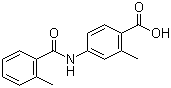 |
| Molecular Formula | C16H15NO3 |
| Molecular Weight | 269.30 |
| CAS Registry Number | 317374-08-6 |
| EC Number | 811-203-6 |
| SMILES | CC1=CC=CC=C1C(=O)NC2=CC(=C(C=C2)C(=O)O)C |
| Density | 1.262 |
|---|---|
| Hazard Symbols |  GHS07 Warning Details GHS07 Warning Details |
|---|---|
| Risk Statements | H302-H315-H319-H335 Details |
| Safety Statements | P261-P305+P351+P338 Details |
| SDS | Available |
 Discovery and Applications
|
2-Methyl-4-(2-methylbenzoylamino)benzoic acid was discovered during investigations into benzoylbenzoic acid derivatives with potential therapeutic properties. Researchers aimed to create compounds with enhanced stability and activity by modifying benzoic acid structures. The synthesis involved the condensation of 2-methylbenzoic acid with 4-amino-2-methylbenzoic acid to form a stable amide linkage. This modification aimed to explore the compound's chemical properties and biological activities. Initially synthesized in the laboratory as part of structure-activity relationship (SAR) studies, 2-Methyl-4-(2-methylbenzoylamino)benzoic acid emerged as a versatile intermediate with potential applications in drug development and material science. The compound shows promise as a candidate for active pharmaceutical ingredients. Its structural features, including the amide linkage and methyl groups, allow for interaction with biological targets, making it a potential therapeutic agent. Researchers are exploring its efficacy in treating inflammatory conditions, pain management, and possibly certain types of cancer due to its ability to interact with specific biological pathways. In drug development, 2-Methyl-4-(2-methylbenzoylamino)benzoic acid serves as a scaffold for designing new drugs. The compound's structure can be modified to enhance its pharmacokinetic and pharmacodynamic properties, leading to the creation of novel drugs with improved efficacy and safety profiles. This makes it a valuable starting point in the development of new therapeutic agents for various diseases. The chemical is used in creating functional materials, particularly in the design of polymers and resins. Its ability to form stable amide linkages and its aromatic structure contribute to the mechanical strength and thermal stability of materials. This makes it useful in developing high-performance materials for industrial applications, such as coatings, adhesives, and composites. In organic electronics, 2-Methyl-4-(2-methylbenzoylamino)benzoic acid can be employed as a building block for organic semiconductors and conductive polymers. Its structural properties allow for efficient charge transport, making it suitable for use in electronic devices such as organic light-emitting diodes (OLEDs), organic field-effect transistors (OFETs), and photovoltaic cells. In organic synthesis, 2-Methyl-4-(2-methylbenzoylamino)benzoic acid acts as a versatile intermediate for creating complex molecules. Its amide and aromatic functionalities allow it to undergo various chemical reactions, such as substitution, coupling, and cyclization, leading to the synthesis of diverse organic compounds. This versatility makes it a valuable reagent in constructing complex molecular architectures in medicinal chemistry and material science. It is used as a starting material in the synthesis of advanced organic compounds, including heterocycles and other aromatic derivatives. The ability to modify its structure enables the development of compounds with specific properties tailored for particular applications, such as pharmaceuticals and specialty chemicals. The compound is used as a biochemical probe to study the interactions between small molecules and biological targets. Its structure allows for binding studies with proteins, enzymes, and receptors, providing insights into its mechanism of action and potential therapeutic applications. This research is valuable for understanding how small molecules can modulate biological functions and for developing new drugs. Researchers use 2-Methyl-4-(2-methylbenzoylamino)benzoic acid in structure-activity relationship studies to understand how changes in molecular structure affect biological activity. By modifying different parts of the molecule, scientists can explore its effects on binding affinity, selectivity, and efficacy, leading to the optimization of drug candidates. References 2011. 2-Methyl-4-(2-methyl-benzamido)-benzoic acid. Acta Crystallographica Section E: Structure Reports Online, 67(4). DOI: 10.1107/s160053681101110x 2011. CCDC 825373: Experimental Crystal Structure Determination. DOI: 10.5517/ccwpvyb |
| Market Analysis Reports |