
Online Database of Chemicals from Around the World
| Suzhou Biosyntech Co., Ltd. | China | |||
|---|---|---|---|---|
 | www.biosyntech-suzhou.com | |||
 | +86 13921151340 +86 (512) 6300-1269 | |||
 | sales2@biosyntech-suzhou.com sales@biosyntech-suzhou.com | |||
 | QQ Chat | |||
| Chemical distributor since 2019 | ||||
| chemBlink Standard supplier since 2020 | ||||
| Hubei Innerse Biotechnology Co., Ltd. | China | |||
|---|---|---|---|---|
| www.innersebio.com | |||
| +86 (027) 8818-9299 | |||
| sales@innersebio.com | |||
| QQ Chat | |||
| Chemical manufacturer since 2020 | ||||
| chemBlink Standard supplier since 2025 | ||||
| Shanghai Worldyang Chemical Co., Ltd. | China | |||
|---|---|---|---|---|
| www.worldyachem.com | |||
| +86 13651600618 +86 (21) 5679-5779 | |||
 | +86 (21) 5679-5266 | |||
| sales7777@worldyachem.com | |||
| QQ Chat | |||
 | WeChat: 13651600618 | |||
 | WhatsApp:+86 13651600618 | |||
| Chemical manufacturer since 2012 | ||||
| Classification | Pharmaceutical intermediate >> Heterocyclic compound intermediate >> Pyrimidine compound >> Alcohol |
|---|---|
| Name | (4-Isopropyl-3,5-dimethoxyphenyl)methanol |
| Molecular Structure | 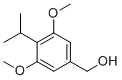 |
| Molecular Formula | C12H18O3 |
| Molecular Weight | 210.27 |
| CAS Registry Number | 344396-18-5 |
| SMILES | CC(C)C1=C(C=C(C=C1OC)CO)OC |
| Density | 1.0±0.1 g/cm3, Calc.* |
|---|---|
| Index of Refraction | 1.510, Calc.* |
| Boiling Point | 340.1±42.0 °C (760 mmHg), Calc.* |
| Flash Point | 159.5±27.9 °C, Calc.* |
| * | Calculated using Advanced Chemistry Development (ACD/Labs) Software. |
 chemBlink Chemical Story
|
(4-isopropyl-3,5-dimethoxyphenyl)methanol, commonly abbreviated as DIMPM, is a unique compound with a wide range of applications in organic synthesis and medicine. Its molecular composition includes an aromatic ring substituted with isopropyl and methoxy groups, with the methanol functional group increasing its chemical reactivity. The discovery of DIMPM stems from the exploration of phenol derivatives for potential applications in medicine and materials science. Phenols substituted with various functional groups, including methoxy and isopropyl, exhibit different biological and chemical properties. Researchers synthesize DIMPMs with specific functional group combinations to create compounds with enhanced reactivity and stability. The synthesis of DIMPM is typically a multistep process starting from commercially available precursors. The initial step involves methylation of the hydroxyl group on the phenolic compound to introduce the methoxy group. This is followed by a Friedel-Crafts alkylation to attach the isopropyl group to the aromatic ring. Finally, a reduction step is used to convert the aldehyde or ketone precursor into a methanol derivative, completing the formation of DIMPM. In organic synthesis, DIMPM is valued for its role in building intermediates for more complex molecules. Its structure features reactive hydroxymethyl and electron-donating methoxy substituents, making it a versatile building block for creating a wide range of compounds. One notable application is in the synthesis of bioactive molecules, where the methoxy and isopropyl groups can influence the pharmacological properties of the compound. The hydroxymethyl groups of DIMPM enable it to undergo a variety of chemical reactions, including oxidation to form aldehydes or carboxylic acids, or conversion to esters and ethers. This reactivity makes DIMPM a useful starting material for the synthesis of a variety of derivatives, with potential applications in pharmaceuticals and agrochemicals. In medicinal chemistry, DIMPM can be used as a precursor for the development of drugs with specific bioactive properties. Its methoxy group is known to enhance the lipophilicity of drug molecules, thereby increasing their ability to cross biological membranes and improving their bioavailability. This property makes DIMPM a starting material for the synthesis of drug candidates for central nervous system disorders and other diseases where enhanced membrane permeability is beneficial. The compound's structure also enables it to form complexes with metals as a ligand, which can be used to design metallodrugs. Metallodrugs contain metal ions and are an emerging class of drugs that can be used to treat diseases such as cancer and infections. DIMPM's ability to form stable complexes with metal ions highlights its potential in the development of new therapeutic agents. In addition to pharmaceuticals, DIMPM can also be used in materials science, particularly in the synthesis of polymers and resins. Its hydroxymethyl groups can participate in polymerization reactions to form polymers with customized properties. These materials can be used in a variety of industrial applications, including coatings, adhesives, and specialty polymers with specific mechanical or chemical properties. The electron-donating nature of the methoxy groups in DIMPM can also affect the electronic properties of the resulting polymer, making it useful in applications that require electronic conductivity or specific optical properties. This versatility in modifying material properties highlights the importance of DIMPM in materials science research. |
| Market Analysis Reports |