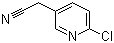
2-Chloro-5-pyridineacetonitrile is a chlorinated heteroaromatic nitrile composed of a pyridine ring bearing a chlorine atom at position 2 and a cyanomethyl substituent at position 5. Its molecular formula is C6H5ClN2, with a molecular weight of approximately 144.57 g/mol. The compound features a combination of electron-withdrawing substituents on an aromatic nitrogen heterocycle, leading to pronounced electronic polarization across the ring. The chlorine atom is positioned ortho to the ring nitrogen, influencing both steric and electronic properties, while the nitrile side chain introduces a reactive functional group capable of further chemical elaboration.
Synthesis of 2-chloro-5-pyridineacetonitrile is commonly achieved through selective chlorination of pyridineacetonitrile precursors or via stepwise substitution on a 2-chloropyridine framework. Introduction of the cyanomethyl group can be accomplished through alkylation of pyridyl carbanion equivalents or through nucleophilic substitution on haloacetonitrile derivatives. Reaction conditions are optimized to ensure regioselective formation of the 5-substituted product and to minimize rearrangement or oligomerization of reactive intermediates. In some synthetic routes, catalyst systems or phase-transfer strategies are used to enhance yields and improve purification outcomes.
Chemically, the chlorine atom at position 2 provides a site for nucleophilic aromatic substitution under suitable activation conditions, permitting substitution by amines, alkoxides, thiolates, or other nucleophiles. The nitrile group is more inert but remains a valuable synthetic handle, capable of undergoing hydrolysis to yield amides or carboxylic acids, or conversion to amidines and tetrazoles under controlled conditions. The presence of both chloro and cyano substituents contributes to an electron-poor aromatic ring, which can influence reaction pathways and selectivity. The cyanomethyl side chain may also undergo deprotonation, allowing further functionalization through alkylation or condensation reactions.
In terms of physical characteristics, 2-chloro-5-pyridineacetonitrile is typically obtained as a crystalline solid or low-melting solid. It is soluble in a variety of organic solvents including acetone, dimethyl sulfoxide, dichloromethane, and acetonitrile, while showing limited solubility in water. The compound shows adequate stability when stored under normal laboratory conditions, though exposure to strong bases or nucleophilic media should be avoided to prevent substitution at the chlorine atom or decomposition of the nitrile group. Handling under dry and oxygen-free conditions is recommended when long-term stability is required.
This compound is used primarily as a synthetic intermediate in heterocyclic and medicinal chemistry. Its particular substitution pattern allows modular elaboration of the pyridine core, supporting the preparation of diverse derivatives through selective substitution, coupling, and functional group interconversion. The nitrile group enables chain extension and derivatization, while the chlorine atom allows controlled introduction of additional substituents, making the molecule well suited for applications in the design and optimization of bioactive compounds, agrochemical candidates, and functional materials.
Overall, 2-chloro-5-pyridineacetonitrile serves as a versatile heteroaromatic building block whose combination of a reactive chloro substituent, a transformable nitrile group, and an electron-deficient pyridine ring supports its broad use in chemical synthesis and the preparation of structurally diverse heterocyclic compounds.
References
none
|






 GHS05;GHS06;GHS07 Danger Details
 Discovery and Applications