
Online Database of Chemicals from Around the World
| Mascot I.E. CO.,Ltd. | China | |||
|---|---|---|---|---|
 | www.mascotchem.com | |||
 | +86 (519) 8501-0339 +86 13584504415 | |||
 | +86 (519) 8501-0366 | |||
 | info@mascotchem.com | |||
 | QQ Chat | |||
| Chemical distributor since 2006 | ||||
| chemBlink Standard supplier since 2006 | ||||
| Simagchem Corporation | China | |||
|---|---|---|---|---|
| www.simagchem.com | |||
| +86 13806087780 | |||
| +86 (592) 268-0237 | |||
| sale@simagchem.com | |||
| Chemical manufacturer since 2002 | ||||
| chemBlink Standard supplier since 2008 | ||||
| HBCChem, Inc. | USA | |||
|---|---|---|---|---|
| www.hbcchem-inc.com | |||
| +1 (510) 219-6317 | |||
| +1 (510) 675-0318 | |||
| sales@hbcchem-inc.com | |||
| Chemical manufacturer | ||||
| chemBlink Standard supplier since 2008 | ||||
| Santai Labs, Inc. | China | |||
|---|---|---|---|---|
| www.santailabs.com | |||
| +86 (519) 8560-1385 | |||
| +86 (519) 8560-1389 | |||
| marketing@santailabs.com | |||
| Chemical manufacturer since 2009 | ||||
| chemBlink Standard supplier since 2011 | ||||
| Suzhou Chemwe, Inc. | China | |||
|---|---|---|---|---|
| www.chemwe.com | |||
| +86 (512) 6270-6911 +86 13812802656 | |||
| +86 (512) 6270-6910 | |||
| sales@chemwe.com | |||
| QQ Chat | |||
| Chemical manufacturer since 2007 | ||||
| chemBlink Standard supplier since 2012 | ||||
| Hangzhou Loop Biotech Co., Ltd. | China | |||
|---|---|---|---|---|
| www.looppharm.com | |||
| +86 (0571) 8526-0761 | |||
| sales01@looppharm.com | |||
| QQ Chat | |||
| Chemical manufacturer since 2015 | ||||
| chemBlink Standard supplier since 2023 | ||||
| Hangzhou Zentra Bio-Chemical Co., Ltd. | China | |||
|---|---|---|---|---|
| www.zentrachem.com | |||
| 18321999949 | |||
| steven@zentrachem.com | |||
| QQ Chat | |||
 | WeChat: Hangzhou Zentra Bio-Chemical Co., Ltd. | |||
| Chemical distributor since 2025 | ||||
| chemBlink Standard supplier since 2025 | ||||
| Xiantao Chutian Fine Chemical Factory | China | |||
|---|---|---|---|---|
| www.chutianchem.com | |||
| +86 (728) 261-8727 +86 13908638941 | |||
| sales@chutianchem.com | |||
| Chemical manufacturer | ||||
| Shandong Xingshun New Material Co., Ltd. | China | |||
|---|---|---|---|---|
| www.sd-xingshun.com | |||
| +86 (519) 8646-1196 +86 (519) 8646-4994 +86 13809078067 | |||
| +86 (519) 8646-3703 | |||
| gxx@xingshengtech.com gxy@xingshengtech.com xp@xingshengtech.com | |||
| QQ Chat | |||
| Chemical manufacturer since 1996 | ||||
| Classification | Pharmaceutical intermediate >> Heterocyclic compound intermediate >> Pyrimidine compound >> Ketones |
|---|---|
| Name | 2,7-Dihydroxy-9-fluorenone |
| Synonyms | 2,7-Dihydroxy-9H-fluoren-9-on |
| Molecular Structure | 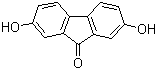 |
| Molecular Formula | C13H8O3 |
| Molecular Weight | 212.20 |
| CAS Registry Number | 42523-29-5 |
| EC Number | 610-035-9 |
| SMILES | C1=CC2=C(C=C1O)C(=O)C3=C2C=CC(=C3)O |
| Density | 1.5±0.1 g/cm3 Calc.* |
|---|---|
| Boiling point | 444.5±20.0 °C 760 mmHg (Calc.)* |
| Flash point | 236.7±18.3 °C (Calc.)* |
| Index of refraction | 1.749 (Calc.)* |
| * | Calculated using Advanced Chemistry Development (ACD/Labs) Software. |
| Hazard Symbols |   GHS06;GHS07 Danger Details GHS06;GHS07 Danger Details | ||||||||||||||||||||||||||||||||
|---|---|---|---|---|---|---|---|---|---|---|---|---|---|---|---|---|---|---|---|---|---|---|---|---|---|---|---|---|---|---|---|---|---|
| Risk Statements | H301-H302-H312-H315-H319-H332-H335 Details | ||||||||||||||||||||||||||||||||
| Safety Statements | P261-P264-P264+P265-P270-P271-P280-P301+P316-P301+P317-P302+P352-P304+P340-P305+P351+P338-P317-P319-P321-P330-P332+P317-P337+P317-P362+P364-P403+P233-P405-P501 Details | ||||||||||||||||||||||||||||||||
| Hazard Classification | |||||||||||||||||||||||||||||||||
| |||||||||||||||||||||||||||||||||
| SDS | Available | ||||||||||||||||||||||||||||||||
 Discovery and Applications
|
2,7-Dihydroxy-9-fluorenone is an organic compound belonging to the class of fluorenones, which are characterized by a fluorene backbone bearing a ketone functional group at the 9-position. In this compound, hydroxyl groups are substituted at the 2 and 7 positions of the fluorene ring system, creating a dihydroxy-substituted fluorenone structure. The presence of hydroxyl substituents introduces additional sites for hydrogen bonding and chemical reactivity, influencing the molecule’s physical and chemical properties. The fluorene core consists of two benzene rings fused to a central five-membered ring, with the 9-position referring to the bridging carbon atom that typically carries the ketone group in fluorenones. The dihydroxy substitution pattern at the 2 and 7 positions is located on the aromatic rings adjacent to the ketone moiety, allowing for potential intramolecular hydrogen bonding interactions between the hydroxyl groups and the ketone oxygen. Synthesis of 2,7-dihydroxy-9-fluorenone typically involves the oxidation of corresponding dihydroxyfluorene precursors or selective hydroxylation of 9-fluorenone derivatives. Various oxidative agents or catalytic methods can facilitate the introduction of hydroxyl groups at the desired positions. The compound’s synthesis requires careful control of reaction conditions to achieve regioselectivity and prevent overoxidation or polymerization. Chemically, the compound exhibits properties characteristic of hydroxy-substituted aromatic ketones. The hydroxyl groups can participate in electrophilic substitution reactions, form hydrogen bonds, and influence the acidity of adjacent protons. The ketone group at the 9-position provides a reactive site for nucleophilic addition and condensation reactions. The presence of hydroxyl groups can also affect the compound’s photophysical properties, such as fluorescence and UV-visible absorption spectra. Applications of 2,7-dihydroxy-9-fluorenone include its use as an intermediate in organic synthesis and materials science. It can serve as a building block for the preparation of more complex polycyclic compounds, dyes, and pharmaceuticals. Its hydroxyl and ketone functionalities enable chemical modifications such as esterification, etherification, and condensation, expanding its utility in designing functional materials and bioactive molecules. Analytical characterization involves nuclear magnetic resonance (¹H and ¹³C NMR) spectroscopy to identify aromatic proton and carbon environments, confirming the substitution pattern. Infrared (IR) spectroscopy reveals characteristic absorption bands for hydroxyl groups (around 3400 cm–1) and carbonyl groups (near 1650–1700 cm–1). Mass spectrometry provides molecular weight verification and fragmentation data consistent with the dihydroxyfluorenone structure. Physically, 2,7-dihydroxy-9-fluorenone is typically obtained as a crystalline solid. It shows moderate solubility in polar organic solvents such as methanol, ethanol, and dimethyl sulfoxide (DMSO), while exhibiting limited solubility in nonpolar solvents. Its melting point and crystalline properties depend on purity and crystallization conditions. In summary, 2,7-dihydroxy-9-fluorenone is a dihydroxy-substituted fluorenone with important chemical functionalities, enabling diverse reactivity and applications in organic synthesis and material development. Its structural features influence both its chemical behavior and physical properties, making it a valuable compound in multiple fields. References 2015. An efficient synthesis of highly functionalized fluorenes and fluorenothiazines. Journal of the Iranian Chemical Society, 12(10). DOI: 10.1007/s13738-015-0745-2 2005. Synthesis and Luminescence Spectral Properties of New 2,7-Dihydroxy-9H-fluoren-9-one Derivatives. Russian Journal of General Chemistry, 75(2). DOI: 10.1007/s11176-005-0212-3 2004. DNA-Binding Properties of Nonsymmetric Fluorenone Derivatives. Pharmaceutical Chemistry Journal, 38(3). DOI: 10.1023/b:phac.0000034300.89484.b1 |
| Market Analysis Reports |