
Online Database of Chemicals from Around the World
| Luminescence Technology Corp. | Taiwan | |||
|---|---|---|---|---|
 | www.lumtec.com.tw | |||
 | +886 (2) 2697-5600 | |||
 | +886 (2) 2697-5601 | |||
 | sales@lumtec.com.tw | |||
| Chemical manufacturer since 1999 | ||||
| chemBlink Standard supplier since 2024 | ||||
| Classification | Organic raw materials >> Heterocyclic compound >> Carbazoles |
|---|---|
| Name | 9-(4-(4,6-Diphenyl-1,3,5-triazin-2-yl)phenyl)-9H-carbazole |
| Molecular Structure | 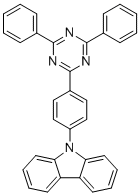 |
| Molecular Formula | C33H22N4 |
| Molecular Weight | 474.55 |
| CAS Registry Number | 440354-93-8 |
| EC Number | 891-330-1 |
| SMILES | C1=CC=C(C=C1)C2=NC(=NC(=N2)C3=CC=C(C=C3)N4C5=CC=CC=C5C6=CC=CC=C64)C7=CC=CC=C7 |
| Hazard Symbols |  GHS07 Warning Details GHS07 Warning Details | ||||||||||||||||
|---|---|---|---|---|---|---|---|---|---|---|---|---|---|---|---|---|---|
| Risk Statements | H315-H319-H335 Details | ||||||||||||||||
| Safety Statements | P261-P264-P264+P265-P271-P280-P302+P352-P304+P340-P305+P351+P338-P319-P321-P332+P317-P337+P317-P362+P364-P403+P233-P405-P501 Details | ||||||||||||||||
| Hazard Classification | |||||||||||||||||
| |||||||||||||||||
| SDS | Available | ||||||||||||||||
 chemBlink Chemical Story
|
9-(4-(4,6-Diphenyl-1,3,5-triazin-2-yl)phenyl)-9H-carbazole is a highly specialized compound that has found significant relevance in the field of organic electronics, particularly in the development of materials for organic light-emitting diodes (OLEDs). This compound is a hybrid molecule combining a carbazole core and a triazine functional group, each contributing unique properties that make it useful in advanced applications. The discovery of this compound can be traced back to research on high-performance hole-transport and electron-transport materials in the context of OLED technology. Carbazole derivatives have been known since the mid-20th century for their high thermal stability, strong electron-donating ability, and favorable hole-transport properties. The triazine moiety, on the other hand, is well-known for its electron-deficient character, providing efficient electron-transport capabilities. By integrating these two moieties, researchers achieved a compound that possesses a balance of hole-transport and electron-transport characteristics, crucial for efficient OLED performance. The molecular structure of 9-(4-(4,6-diphenyl-1,3,5-triazin-2-yl)phenyl)-9H-carbazole features a carbazole core linked via a phenyl bridge to a diphenyltriazine unit. This design allows the molecule to exhibit both electron-donating and electron-withdrawing properties. Such dual-function behavior is important in the development of ambipolar materials, which can transport both holes and electrons. The phenyl bridge further enhances the molecule’s rigidity and stability, essential factors for longevity in electronic applications. One of the primary applications of this compound is in the field of OLEDs as a host material in phosphorescent devices. OLEDs rely on the efficient transport of both holes and electrons to emit light when a voltage is applied. Materials like 9-(4-(4,6-diphenyl-1,3,5-triazin-2-yl)phenyl)-9H-carbazole provide an ideal environment for the recombination of charge carriers, thereby enhancing light emission efficiency. The balanced transport properties minimize energy losses, leading to OLEDs with high brightness, low power consumption, and long operational life. In addition to OLEDs, this compound is used in organic photovoltaic (OPV) devices. The electron-transport properties of the triazine moiety combined with the hole-transport properties of the carbazole core make it an effective material for charge separation and transport in OPV cells. This ability to manage charge carriers efficiently is critical in improving the power conversion efficiency of solar cells. Another notable application of 9-(4-(4,6-diphenyl-1,3,5-triazin-2-yl)phenyl)-9H-carbazole is in the fabrication of thermally activated delayed fluorescence (TADF) materials. TADF materials are an emerging class of emitters that enable the harvesting of both singlet and triplet excitons, thereby achieving high quantum efficiency without the use of expensive rare metals like iridium. The combination of carbazole and triazine units facilitates the separation of highest occupied molecular orbital (HOMO) and lowest unoccupied molecular orbital (LUMO), which is essential for achieving efficient TADF. The synthesis of 9-(4-(4,6-diphenyl-1,3,5-triazin-2-yl)phenyl)-9H-carbazole involves coupling reactions, typically using Suzuki or Buchwald-Hartwig protocols. The process begins with the preparation of the triazine component, followed by its attachment to the carbazole moiety through a phenyl linker. Advances in synthetic techniques have allowed for the scalable production of this compound with high purity, making it more accessible for industrial applications. Research continues to explore modifications to the structure of 9-(4-(4,6-diphenyl-1,3,5-triazin-2-yl)phenyl)-9H-carbazole to optimize its performance in electronic devices. Variations in substituents on the carbazole or triazine groups can fine-tune the electronic properties, enhancing stability, efficiency, or processability. As a result, this compound remains a focus of investigation in the quest for next-generation OLED materials and other electronic applications. The combination of structural versatility, balanced charge-transport properties, and high thermal stability ensures that 9-(4-(4,6-diphenyl-1,3,5-triazin-2-yl)phenyl)-9H-carbazole will continue to play a vital role in the development of advanced electronic materials. References 2019. Turn on of sky-blue thermally activated delayed fluorescence and circularly polarized luminescence (CPL) via increased torsion by a bulky carbazolophane donor. Chemical Science, 10(28). DOI: 10.1039/c9sc01821b 2020. Fast spin-flip enables efficient and stable organic electroluminescence from charge-transfer states. Nature Photonics, 14(9). DOI: 10.1038/s41566-020-0668-z |
| Market Analysis Reports |