
Online Database of Chemicals from Around the World
| Sichuan Tongsheng Amino Acids Co., Ltd. | China | |||
|---|---|---|---|---|
 | www.aminoacid.cc | |||
 | +86 (838) 227-4206 250-8248 | |||
 | +86 (838) 227-4207 | |||
 | amino@vip.sina.com sales@biots.cn | |||
 | QQ Chat | |||
| Chemical manufacturer since 2003 | ||||
| chemBlink Standard supplier since 2007 | ||||
| Simagchem Corporation | China | |||
|---|---|---|---|---|
| www.simagchem.com | |||
| +86 13806087780 | |||
| +86 (592) 268-0237 | |||
| sale@simagchem.com | |||
| Chemical manufacturer since 2002 | ||||
| chemBlink Standard supplier since 2008 | ||||
| Genchem & Genpharm (Changzhou) Co., Ltd. | China | |||
|---|---|---|---|---|
| www.genchem.cn | |||
| +86(519)8572-0003 +86 18861157602 | |||
| +86 (519) 8572-0007 | |||
| sales03@genchem.cn | |||
| Chemical manufacturer | ||||
| chemBlink Standard supplier since 2008 | ||||
| BOC Sciences | USA | |||
|---|---|---|---|---|
| www.bocsci.com | |||
| +1 (631) 485-4226 | |||
| +1 (631) 614-7828 | |||
| info@bocsci.com | |||
| Chemical manufacturer | ||||
| chemBlink Standard supplier since 2010 | ||||
| Creative Peptides | USA | |||
|---|---|---|---|---|
| www.creative-peptides.com | |||
| +1 (631) 624-4882 | |||
| +1 (631) 614-7828 | |||
| info@creative-peptides.com | |||
| Chemical manufacturer | ||||
| chemBlink Standard supplier since 2010 | ||||
| Chengdu Chuangkecheng Biological Technology Co., Ltd. | China | |||
|---|---|---|---|---|
| www.ckcbiotech.com | |||
| +86 (28) 6503-9985 | |||
| +86 (28) 6503-9985 | |||
| sales@ckcbiotech.com | |||
| Chemical manufacturer | ||||
| chemBlink Standard supplier since 2013 | ||||
| Hangzhou Leap Chem Co., Ltd. | China | |||
|---|---|---|---|---|
| www.leapchem.com | |||
| +86 (571) 8771-1850 | |||
| market19@leapchem.com | |||
| QQ Chat | |||
| Chemical manufacturer since 2006 | ||||
| chemBlink Standard supplier since 2015 | ||||
| Amadis Chemical Co., Ltd. | China | |||
|---|---|---|---|---|
| www.amadischem.com | |||
| +86 (571) 8992-5085 | |||
| +86 (571) 8992-5065 | |||
| sales@amadischem.com | |||
| Chemical manufacturer since 2010 | ||||
| chemBlink Standard supplier since 2015 | ||||
| Zhejiang Zetian Fine Chemicals Co., Ltd. | China | |||
|---|---|---|---|---|
| www.zetchem.com | |||
| +86 (571) 8732-2520 | |||
| sales@zetchem.com | |||
| Chemical manufacturer since 2009 | ||||
| chemBlink Standard supplier since 2018 | ||||
| R&D Scientific Inc. | Canada | |||
|---|---|---|---|---|
| www.rdscientific.com | |||
| +1 (226) 600-0236 | |||
| sales@rdscientific.com | |||
| Chemical manufacturer since 2016 | ||||
| chemBlink Standard supplier since 2023 | ||||
| Shandong Juntai Pharmaceutical Co., Ltd. | China | |||
|---|---|---|---|---|
| www.h2opharm.com | |||
| +86 15106953682 | |||
| sales01@h2opharm.com | |||
| QQ Chat | |||
| Chemical manufacturer since 2020 | ||||
| chemBlink Standard supplier since 2024 | ||||
| IRIS Biotech GmbH | Germany | |||
|---|---|---|---|---|
| www.iris-biotech.de | |||
| +49 (9231) 961-973 | |||
| +49 (9231) 961-999 | |||
| info@iris-biotech.de | |||
| Chemical manufacturer since 1788 | ||||
| Aroz Technologies, LLC | USA | |||
|---|---|---|---|---|
| www.aroztech.com | |||
| +1 (877) 818-2125 | |||
| +1 (877) 818-2129 | |||
| sales@aroztech.com | |||
| Chemical manufacturer | ||||
| Watanabe Chemical Ind., Ltd. | Japan | |||
|---|---|---|---|---|
| www.watanabechem.co.jp | |||
| +81 (82) 231-0540 | |||
| +81 (82) 231-1451 | |||
| inquiry@watanabechem.co.jp | |||
| Chemical manufacturer | ||||
| Hamari Chemicals, Ltd. | Japan | |||
|---|---|---|---|---|
| www.hamarichemicals.com | |||
| +81 (6) 6322-0191 | |||
| +81 (6) 6323-2115 | |||
| sales2@hamari.co.jp | |||
| Chemical manufacturer since 1948 | ||||
| Classification | Biochemical >> Amino acids and their derivatives >> Glutamic acid derivative |
|---|---|
| Name | L-Glutamic acid 1-tert-butyl ester |
| Synonyms | (4S)-4-amino-5-[(2-methylpropan-2-yl)oxy]-5-oxopentanoic acid |
| Molecular Structure | 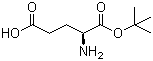 |
| Molecular Formula | C9H17NO4 |
| Molecular Weight | 203.11 |
| Protein Sequence | E |
| CAS Registry Number | 45120-30-7 |
| EC Number | 801-523-4 |
| SMILES | CC(C)(C)OC(=O)[C@H](CCC(=O)O)N |
| Density | 1.1±0.1 g/cm3, Calc.* |
|---|---|
| Melting point | 139-145 °C |
| alpha | 13 |
| Index of Refraction | 1.476, Calc.* |
| Boiling Point | 326.8±32.0 °C (760 mmHg), Calc.* |
| Flash Point | 151.5±25.1 °C, Calc.* |
| * | Calculated using Advanced Chemistry Development (ACD/Labs) Software. |
| Hazard Symbols |  GHS07 Warning Details GHS07 Warning Details | ||||||||||||||||
|---|---|---|---|---|---|---|---|---|---|---|---|---|---|---|---|---|---|
| Risk Statements | H315-H319-H335 Details | ||||||||||||||||
| Safety Statements | P261-P264-P264+P265-P271-P280-P302+P352-P304+P340-P305+P351+P338-P319-P321-P332+P317-P337+P317-P362+P364-P403+P233-P405-P501 Details | ||||||||||||||||
| Hazard Classification | |||||||||||||||||
| |||||||||||||||||
| SDS | Available | ||||||||||||||||
 chemBlink Chemical Story
|
L-Glutamic acid 1-tert-butyl ester is an important compound in the fields of organic chemistry and biochemistry, primarily recognized for its role as an amino acid derivative. The discovery of this compound can be traced back to the growing interest in amino acid derivatives in the mid-20th century, coinciding with advancements in peptide synthesis and the development of pharmaceuticals. The synthesis of L-glutamic acid 1-tert-butyl ester involves the reaction of L-glutamic acid with tert-butanol in the presence of an acid catalyst. This reaction results in the formation of the tert-butyl ester, which enhances the lipophilicity and stability of the amino acid. The introduction of the tert-butyl group at the carboxyl position provides a protective strategy, facilitating further modifications and synthesis of more complex molecules. L-Glutamic acid 1-tert-butyl ester has a range of applications in synthetic organic chemistry. One of its primary uses is as a protected form of glutamic acid in peptide synthesis. The tert-butyl ester group effectively shields the carboxyl group, preventing unwanted reactions during the coupling of amino acids to form peptides. This protective strategy is crucial for maintaining the integrity of the peptide bond formation process, ultimately leading to higher yields and purities of the final peptide products. In addition to its role in peptide synthesis, L-glutamic acid 1-tert-butyl ester is utilized in the development of various pharmaceutical compounds. The enhanced stability and solubility provided by the tert-butyl ester group make this compound an attractive intermediate for synthesizing bioactive molecules, including neuroprotective agents and pharmaceuticals targeting the central nervous system. Glutamic acid itself plays a critical role as a neurotransmitter, and derivatives like the tert-butyl ester are being investigated for their potential therapeutic effects. Moreover, L-glutamic acid 1-tert-butyl ester is employed in the preparation of various derivatives that have been studied for their biological activity. Research indicates that modifications of glutamic acid can lead to compounds with enhanced efficacy and selectivity, making them suitable candidates for drug development. The versatility of this ester allows for the exploration of different pharmacophores, contributing to the discovery of novel therapeutic agents. Recent advancements in the synthesis and application of L-glutamic acid derivatives highlight the compound's significance in drug design and development. Ongoing research focuses on understanding the pharmacological properties of glutamic acid esters, including their mechanisms of action and potential uses in treating neurological disorders. In summary, L-glutamic acid 1-tert-butyl ester is a vital compound with a rich history and diverse applications in organic synthesis and pharmaceuticals. Its discovery has significantly impacted peptide synthesis methodologies, and its continued exploration underscores its importance in advancing research in medicinal chemistry and drug development. References 2000. Evaluation of novel dendrimer chiral stationary phases using HPLC. Chromatographia, 51(3-4). DOI: 10.1007/bf02491562 |
| Market Analysis Reports |