
Online Database of Chemicals from Around the World
| Simagchem Corporation | China | |||
|---|---|---|---|---|
 | www.simagchem.com | |||
 | +86 13806087780 | |||
 | +86 (592) 268-0237 | |||
 | sale@simagchem.com | |||
| Chemical manufacturer since 2002 | ||||
| chemBlink Standard supplier since 2008 | ||||
| Manus Aktteva | India | |||
|---|---|---|---|---|
| www.manusaktteva.in | |||
| +91 (79) 6512-3395 | |||
| +91 (79) 2646-3395 | |||
| products@manusakttevabiopharma.in | |||
| Chemical distributor | ||||
| chemBlink Standard supplier since 2008 | ||||
| Discovery Fine Chemicals Ltd. | UK | |||
|---|---|---|---|---|
| www.discofinechem.com | |||
| +44 (1202) 874-517 | |||
| +44 (845) 094-4385 | |||
| pjc@discofinechem.com | |||
| Chemical manufacturer | ||||
| chemBlink Standard supplier since 2009 | ||||
| Hefei TNJ Chemical Industry Co., Ltd. | China | |||
|---|---|---|---|---|
| www.tnjchem.com | |||
| +86 (551) 6541-8684 | |||
| +86 (551) 6541-8697 | |||
| sales@tnjchem.com | |||
| Chemical manufacturer since 2001 | ||||
| chemBlink Standard supplier since 2010 | ||||
| BOC Sciences | USA | |||
|---|---|---|---|---|
| www.bocsci.com | |||
| +1 (631) 485-4226 | |||
| +1 (631) 614-7828 | |||
| info@bocsci.com | |||
| Chemical manufacturer | ||||
| chemBlink Standard supplier since 2010 | ||||
| Hangzhou Leap Chem Co., Ltd. | China | |||
|---|---|---|---|---|
| www.leapchem.com | |||
| +86 (571) 8771-1850 | |||
| market19@leapchem.com | |||
 | QQ Chat | |||
| Chemical manufacturer since 2006 | ||||
| chemBlink Standard supplier since 2015 | ||||
| Xi'an Veda Chemical Co., Ltd. | China | |||
|---|---|---|---|---|
| www.vedachem.com | |||
| +86 13379235092 | |||
| +86 (29) 8866-5278 | |||
| sales@vedachem.com | |||
| QQ Chat | |||
 | WeChat: +86-13379235092 | |||
 | WhatsApp:+86-13379235092 | |||
| Chemical manufacturer since 2012 | ||||
| chemBlink Standard supplier since 2016 | ||||
| Hong Xin Rui Yu Finechemical Co., Ltd. | China | |||
|---|---|---|---|---|
| www.hbhxryfc.com | |||
| +86 13886177946 | |||
| +86 (27) 6552-6669 | |||
| 2545103399@qq.com | |||
| Chemical manufacturer since 2014 | ||||
| chemBlink Standard supplier since 2016 | ||||
| Panjin Jiahe Shengshi Pharmaceutical Technology Co., Ltd | China | |||
|---|---|---|---|---|
| www.jhssw.com | |||
| +86 13032431717 | |||
| sale@jhssw.com | |||
| QQ Chat | |||
| Chemical manufacturer since 2016 | ||||
| chemBlink Standard supplier since 2021 | ||||
| Shenzhen Nexconn Pharmatechs Ltd. | China | |||
|---|---|---|---|---|
| www.nexconn.com | |||
| +86 19068605196 | |||
| jason.deng@nexconn.com | |||
| Chemical manufacturer since 2009 | ||||
| chemBlink Standard supplier since 2025 | ||||
| Avonchem/Chromos Express Ltd. | UK | |||
|---|---|---|---|---|
| www.avonchem.co.uk | |||
| +44 (1625) 434-300 | |||
| +44 (1625) 869-777 | |||
| info@avonchem.co.uk | |||
| Chemical manufacturer | ||||
| Xi'an Huayao Pharm-Chem Institute | China | |||
|---|---|---|---|---|
| www.huayaochem.com | |||
| +86 (29) 8624-6986 | |||
| +86 (29) 8626-5661 | |||
| info@huayaochem.com | |||
| Chemical manufacturer since 1999 | ||||
| Carbone Scientific Co., Ltd. | UK | |||
|---|---|---|---|---|
| www.carbonesci.com | |||
| +44 (870) 486-8629 | |||
| +44 (870) 288-7399 | |||
| sales@carbonesci.com | |||
| Chemical distributor | ||||
| Shanghai Worldyang Chemical Co., Ltd. | China | |||
|---|---|---|---|---|
| www.worldyachem.com | |||
| +86 13651600618 +86 (21) 5679-5779 | |||
| +86 (21) 5679-5266 | |||
| sales7777@worldyachem.com | |||
| QQ Chat | |||
| WeChat: 13651600618 | |||
| WhatsApp:+86 13651600618 | |||
| Chemical manufacturer since 2012 | ||||
| Chemos GmbH & Co. KG | Germany | |||
|---|---|---|---|---|
| www.chemos.de | |||
| +49 871-966346-0 | |||
| +49 871-966346-13 | |||
| chemos@chemos.de | |||
| Chemical distributor | ||||
| Classification | API >> Synthetic anti-infective drugs >> Disinfectant antiseptic |
|---|---|
| Name | Chlorhexidine acetate |
| Synonyms | Chlorhexidine di(acetate); 1,6-Bis(N5-[p-chlorophenyl]-N1-biguanido)hexane; 1,1'-Hexamethylenebis(5-[p-chlorophenyl]biguanide) |
| Molecular Structure | 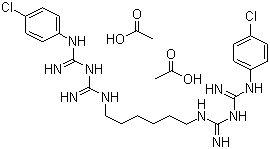 |
| Molecular Formula | C22H30Cl2N10.2(C2H4O2);C26H38Cl2N10O4 |
| Molecular Weight | 625.55 |
| CAS Registry Number | 56-95-1 |
| EC Number | 200-302-4 |
| SMILES | CC(=O)O.CC(=O)O.C1=CC(=CC=C1N/C(=N/C(=NCCCCCCN=C(/N=C(/NC2=CC=C(C=C2)Cl)N)N)N)/N)Cl |
| Melting point | 155 °C |
|---|---|
| Water solubility | 1.9 g/100 mL (20 °C) (Expl.) |
| Hazard Symbols |    GHS06;GHS07;GHS09 Danger Details GHS06;GHS07;GHS09 Danger Details | ||||||||||||||||||||||||||||||||
|---|---|---|---|---|---|---|---|---|---|---|---|---|---|---|---|---|---|---|---|---|---|---|---|---|---|---|---|---|---|---|---|---|---|
| Risk Statements | H301-H302-H319-H400-H410-H411 Details | ||||||||||||||||||||||||||||||||
| Safety Statements | P264-P264+P265-P270-P273-P280-P301+P316-P301+P317-P305+P351+P338-P321-P330-P337+P317-P391-P405-P501 Details | ||||||||||||||||||||||||||||||||
| Hazard Classification | |||||||||||||||||||||||||||||||||
| |||||||||||||||||||||||||||||||||
| SDS | Available | ||||||||||||||||||||||||||||||||
 Discovery and Applications
|
Chlorhexidine acetate is a chemical compound that belongs to the class of antiseptic agents, widely used in both medical and industrial applications. It is a salt formed from chlorhexidine, a broad-spectrum antimicrobial agent, and acetic acid. This compound is known for its effectiveness against a wide range of bacteria, fungi, and viruses, making it an essential component in various formulations, particularly in healthcare. The discovery of chlorhexidine dates back to the late 1940s, when it was first synthesized by chemists at the English company, ICI (Imperial Chemical Industries). Chlorhexidine acetate, as a salt form of chlorhexidine, was introduced to enhance its solubility and stability, particularly for use in aqueous solutions. This salt form of chlorhexidine became widely adopted in clinical practice and various industries for its antimicrobial properties. Chlorhexidine acetate has found significant applications in healthcare as a topical antiseptic. It is commonly used in surgical scrubs, hand sanitizers, mouthwashes, and disinfectant solutions for skin preparation. Its effectiveness in reducing bacterial load makes it a valuable tool in preventing infections during medical procedures. The compound is particularly effective against both Gram-positive and Gram-negative bacteria, with a mode of action that disrupts the bacterial cell membrane, leading to cell death. In dental care, chlorhexidine acetate is frequently used in mouthwashes and oral gels to help control plaque and reduce the risk of gingivitis and other oral infections. Its broad-spectrum antimicrobial action makes it highly effective for oral hygiene purposes, especially in individuals with conditions that increase their risk of oral infections. Chlorhexidine acetate is also used in the veterinary field for its antimicrobial properties, particularly in the treatment and prevention of infections in animals. It is applied topically for wound care and as a disinfectant for surgical instruments and equipment. Its use extends to the aquaculture industry, where it is employed as a disinfectant in water systems to control bacterial infections in fish. In addition to its medical applications, chlorhexidine acetate has industrial uses, including in the formulation of disinfectants for surface cleaning and sterilization processes in various sectors, such as food processing and biotechnology. Overall, chlorhexidine acetate is recognized for its reliable antimicrobial activity, which has been well-established through numerous studies and applications across multiple fields. Its discovery and subsequent development have made it a staple in both clinical and industrial hygiene practices. References 2024. Exploring microbial interactions with denture resin surface and implications for plant based plaque control strategies: a narrative review. Beni-Suef University Journal of Basic and Applied Sciences, 13(1). DOI: 10.1186/s43088-024-00574-x 2010. Synthesis and characterization of new copper(II) complex compounds with chlorhexidine. Central European Journal of Chemistry, 8(3). DOI: 10.2478/s11532-010-0028-9 1987. Periodic subgingival antimicrobial irrigation of periodontal pockets. II. Microbiological and radiographical observations. Journal of Clinical Periodontology, 14(10). DOI: 10.1111/j.1600-051x.1987.tb00997.x |
| Market Analysis Reports |