
Online Database of Chemicals from Around the World
| Fenhe Chemical Co., Ltd. | China | |||
|---|---|---|---|---|
 | www.fenhechem.com | |||
 | +86 (021) 3392-6068 | |||
 | julius.wei@fenhechem.com | |||
| Chemical manufacturer since 1997 | ||||
| chemBlink Standard supplier since 2024 | ||||
| SynChem, Inc. | USA | |||
|---|---|---|---|---|
| www.synchem.com | |||
| +1 (847) 298-2436 ex 230 | |||
 | +1 (847) 298-2439 | |||
| sales@synchem.com | |||
| Chemical manufacturer since 1997 | ||||
| Classification | API >> Synthetic anti-infective drugs >> Sulfonamides and synergists |
|---|---|
| Name | 3-Amino-N-(tert-butyl)benzenesulfonamide |
| Molecular Structure | 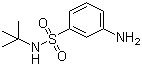 |
| Molecular Formula | C10H16N2O2S |
| Molecular Weight | 228.31 |
| CAS Registry Number | 608523-94-0 |
| EC Number | 692-504-8 |
| SMILES | CC(C)(C)NS(=O)(=O)C1=CC=CC(=C1)N |
| Solubility | 2501 mg/L (25 °C water) |
|---|---|
| Density | 1.2±0.1 g/cm3, Calc.* |
| Index of Refraction | 1.553, Calc.* |
| Melting point | 132.19 °C |
| Boiling Point | 387.3±44.0 °C (760 mmHg), Calc.*, 367.79 °C |
| Flash Point | 188.0±28.4 °C, Calc.* |
| * | Calculated using Advanced Chemistry Development (ACD/Labs) Software. |
| Hazard Symbols |  GHS07 Warning Details GHS07 Warning Details | ||||||||||||||||||||
|---|---|---|---|---|---|---|---|---|---|---|---|---|---|---|---|---|---|---|---|---|---|
| Risk Statements | H302-H315-H319-H335 Details | ||||||||||||||||||||
| Safety Statements | P261-P264-P270-P271-P280-P301+P312-P302+P352-P304+P340-P305+P351+P338-P330-P332+P313-P337+P313-P362-P403+P233-P405-P501 Details | ||||||||||||||||||||
| Hazard Classification | |||||||||||||||||||||
| |||||||||||||||||||||
| SDS | Available | ||||||||||||||||||||
 chemBlink Chemical Story
|
3-Amino-N-(tert-butyl)benzenesulfonamide is an organic compound with the molecular formula C10H16N2O2S. It features an aromatic ring substituted with an amino group (–NH2), a tert-butyl group (–C(CH3)3), and a sulfonamide group (–SO2NH2). This combination of functional groups makes the compound particularly interesting in organic synthesis and pharmaceutical research. The discovery of 3-Amino-N-(tert-butyl)benzenesulfonamide is tied to the broader exploration of sulfonamides, which are compounds containing the sulfonamide functional group attached to an aromatic ring. Sulfonamides were first discovered in the early 20th century and gained significant attention due to their antibacterial properties, leading to the development of sulfa drugs, some of the first antibiotics. Over time, chemists have modified the basic sulfonamide structure to explore different biological activities and chemical reactivities, leading to the synthesis of 3-Amino-N-(tert-butyl)benzenesulfonamide. One of the primary applications of 3-Amino-N-(tert-butyl)benzenesulfonamide is in the field of pharmaceuticals. The sulfonamide group is a well-known pharmacophore, meaning it is a part of a molecule responsible for its biological activity. The presence of the amino group adds further versatility to the molecule, allowing it to participate in hydrogen bonding and other interactions with biological targets such as enzymes or receptors. This makes 3-Amino-N-(tert-butyl)benzenesulfonamide a valuable intermediate in the synthesis of pharmaceutical compounds, especially those designed to interact with specific biological targets through hydrogen bonding or electrostatic interactions. In medicinal chemistry, this compound can serve as a building block for the development of new drugs. The tert-butyl group is a bulky alkyl group that can influence the molecule's pharmacokinetics, such as its absorption, distribution, metabolism, and excretion (ADME) properties. The introduction of a tert-butyl group can enhance the molecule's stability and reduce its susceptibility to metabolic degradation, thereby improving the drug's bioavailability. As a result, 3-Amino-N-(tert-butyl)benzenesulfonamide is often used as a starting material for the synthesis of drugs that require these properties. Additionally, 3-Amino-N-(tert-butyl)benzenesulfonamide has applications in the development of agrochemicals. The sulfonamide group is not only significant in pharmaceuticals but also plays a crucial role in the design of herbicides and pesticides. The compound can be used to develop active ingredients that target specific enzymes or pathways in plants or pests, helping to control their growth or survival. The tert-butyl group can contribute to the selectivity and potency of these agrochemicals, making them effective at low concentrations. In organic synthesis, 3-Amino-N-(tert-butyl)benzenesulfonamide is valuable due to its functional groups, which can undergo various chemical reactions. The amino group can participate in acylation, alkylation, and diazotization reactions, among others, allowing for the introduction of different functional groups into the molecule. The sulfonamide group is also reactive, particularly in nucleophilic substitution reactions, where it can be replaced or modified to create a wide range of derivatives. This makes 3-Amino-N-(tert-butyl)benzenesulfonamide a versatile intermediate in the synthesis of more complex organic molecules. In summary, 3-Amino-N-(tert-butyl)benzenesulfonamide is a multifunctional compound with significant applications in pharmaceuticals, agrochemicals, and organic synthesis. Its discovery and use as a derivative of sulfonamides have provided chemists with a valuable tool for developing new drugs and other chemical products, highlighting its importance in both research and industry. References 2021. Buchwald-Hartwig Reaction: An Update. *Monatshefte für Chemie - Chemical Monthly*, 152(9). DOI: 10.1007/s00706-021-02834-3 |
| Market Analysis Reports |