
Online Database of Chemicals from Around the World
| Fenhe Chemical Co., Ltd. | China | |||
|---|---|---|---|---|
 | www.fenhechem.com | |||
 | +86 (021) 3392-6068 | |||
 | julius.wei@fenhechem.com | |||
| Chemical manufacturer since 1997 | ||||
| chemBlink Standard supplier since 2024 | ||||
| Name | Tetrakis(4-bromophenyl)ethene |
|---|---|
| Synonyms | Tetrakis(4-bromophenyl)ethylene |
| Molecular Structure | 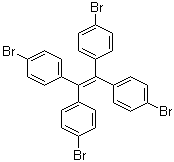 |
| Molecular Formula | C26H16Br4 |
| Molecular Weight | 648.02 |
| CAS Registry Number | 61326-44-1 |
| EC Number | 833-836-7 |
| SMILES | C1=CC(=CC=C1C(=C(C2=CC=C(C=C2)Br)C3=CC=C(C=C3)Br)C4=CC=C(C=C4)Br)Br |
| Solubility | Insoluble (5.8E-7 g/L) (25 °C), Calc.* |
|---|---|
| Density | 1.750±0.06 g/cm3 (20 °C 760 Torr), Calc.* |
| Melting point | 258-259 °C** |
| Index of Refraction | 1.683, Calc.* |
| Boiling Point | 575.1±45.0 °C (760 mmHg), Calc.* |
| Flash Point | 289.2±23.5 °C, Calc.* |
| * | Calculated using Advanced Chemistry Development (ACD/Labs) Software. |
| Hazard Symbols |  GHS07 Warning Details GHS07 Warning Details | ||||||||||||
|---|---|---|---|---|---|---|---|---|---|---|---|---|---|
| Risk Statements | H315-H319 Details | ||||||||||||
| Safety Statements | P264-P264+P265-P280-P302+P352-P305+P351+P338-P321-P332+P317-P337+P317-P362+P364 Details | ||||||||||||
| Hazard Classification | |||||||||||||
| |||||||||||||
| SDS | Available | ||||||||||||
 chemBlink Chemical Story
|
Tetrakis(4-bromophenyl)ethene is an organic compound that belongs to the class of polyphenyl ethylene derivatives. It is composed of a central ethene (ethylene) core bonded to four brominated phenyl groups at the para position, giving it the chemical formula C26H16Br4. This compound is particularly interesting due to its symmetrical structure and the presence of multiple bromine atoms, which endow it with unique chemical properties. These properties make it valuable in the fields of organic electronics, materials science, and synthetic chemistry. The discovery of Tetrakis(4-bromophenyl)ethene is linked to the broader study of polyphenyl ethylenes and their derivatives, which have been explored for various applications due to their structural rigidity and ability to participate in π-conjugation. Researchers initially focused on simpler diphenyl ethylenes, but as the field progressed, more complex derivatives like Tetrakis(4-bromophenyl)ethene were synthesized to investigate their potential in advanced materials and chemical processes. One of the primary applications of Tetrakis(4-bromophenyl)ethene is in the development of organic electronic materials. The compound's conjugated system, formed by the ethene core and the four phenyl rings, allows for electron delocalization across the molecule, a key feature in organic semiconductors. The bromine atoms increase the molecule's electron density and enhance its ability to participate in halogen bonding, making it suitable for use in organic light-emitting diodes (OLEDs), organic photovoltaic cells (OPVs), and other electronic devices. The symmetrical structure also contributes to the uniformity and predictability of its electronic properties, which is crucial for the consistent performance of these materials in electronic applications. In addition to its role in organic electronics, Tetrakis(4-bromophenyl)ethene is used in materials science for the synthesis of polymers and coordination compounds. The bromine atoms serve as reactive sites for further functionalization, allowing the compound to be incorporated into larger polymeric structures. These polymers can be designed to exhibit specific mechanical, thermal, or electronic properties, depending on the desired application. The ability to form cross-linked networks also makes Tetrakis(4-bromophenyl)ethene a valuable monomer in the production of durable and high-performance materials. In synthetic chemistry, Tetrakis(4-bromophenyl)ethene is utilized as a building block for constructing more complex molecules. The presence of multiple bromine atoms enables the compound to undergo a variety of coupling reactions, such as Suzuki or Stille coupling, where the bromine atoms are replaced by other functional groups. This makes the compound a versatile intermediate for the synthesis of multi-functionalized aromatic compounds, which are important in the development of pharmaceuticals, agrochemicals, and specialty chemicals. Furthermore, the compound's rigidity and bulkiness make it an interesting ligand in the formation of metal-organic frameworks (MOFs). These frameworks are porous materials that can be used for gas storage, separation, and catalysis. The brominated phenyl groups in Tetrakis(4-bromophenyl)ethene provide sites for metal coordination, allowing the formation of stable and structurally diverse MOFs. In summary, Tetrakis(4-bromophenyl)ethene is a significant compound with wide-ranging applications in organic electronics, materials science, and synthetic chemistry. Its discovery and development have opened up new possibilities for the design and fabrication of advanced materials and complex molecules, highlighting its importance in both research and industrial applications. References 2024. Tetraphenylethene-based hole transporting material for highly efficient and stable perovskite solar cells. *Science China Chemistry*, 67(5). DOI: 10.1007/s11426-023-1905-7 2024. Efficient and ultrafast organic scintillators by hot exciton manipulation. *Nature Photonics*, 18(3). DOI: 10.1038/s41566-023-01358-y 2000. Chiral inclusion crystallization of tetra(p-bromophenyl)ethylene by exposure to the vapor of achiral guest molecules: a novel racemic-to-chiral transformation through gas-solid reaction. *Chemical Communications*, (6). DOI: 10.1039/a909782a |
| Market Analysis Reports |