
Online Database of Chemicals from Around the World
| Shaanxi Jiahe Phytochem Co., Ltd. | China | |||
|---|---|---|---|---|
 | www.jiaherb.com | |||
 | +86 (29) 8832-6710 | |||
 | +86 (29) 8832-5519 | |||
 | jiaherb@vip.163.com | |||
| Chemical manufacturer | ||||
| chemBlink Standard supplier since 2007 | ||||
| Simagchem Corporation | China | |||
|---|---|---|---|---|
| www.simagchem.com | |||
| +86 13806087780 | |||
| +86 (592) 268-0237 | |||
| sale@simagchem.com | |||
| Chemical manufacturer since 2002 | ||||
| chemBlink Standard supplier since 2008 | ||||
| Manus Aktteva | India | |||
|---|---|---|---|---|
| www.manusaktteva.in | |||
| +91 (79) 6512-3395 | |||
| +91 (79) 2646-3395 | |||
| products@manusakttevabiopharma.in | |||
| Chemical distributor | ||||
| chemBlink Standard supplier since 2008 | ||||
| Extrasynthese Chemical S.A.S. | France | |||
|---|---|---|---|---|
| www.extrasynthese.com | |||
| +33 (47) 898-2034 | |||
| +33 (47) 898-1945 | |||
| info@extrasynthese.com | |||
| Chemical manufacturer | ||||
| chemBlink Standard supplier since 2009 | ||||
| Sichuan Sanherb Biotech. Co., Ltd. | China | |||
|---|---|---|---|---|
| www.sanherb.com | |||
| +86 (28) 8317-5585 | |||
| +86 (28) 6800-3670 | |||
| sophie@sanherb.com | |||
| Chemical manufacturer since 2012 | ||||
| chemBlink Standard supplier since 2010 | ||||
| Hefei TNJ Chemical Industry Co., Ltd. | China | |||
|---|---|---|---|---|
| www.tnjchem.com | |||
| +86 (551) 6541-8684 | |||
| +86 (551) 6541-8697 | |||
| sales@tnjchem.com | |||
| Chemical manufacturer since 2001 | ||||
| chemBlink Standard supplier since 2010 | ||||
| Shaanxi Yongyuan Bio-Tech Co., Ltd. | China | |||
|---|---|---|---|---|
| www.herbalextractcn.com | |||
| +86 (29) 8834-6470 | |||
| +86 (29) 8834-6470 | |||
| infoyy@herbalextractcn.com yysale2@herbalextractcn.com | |||
| Chemical manufacturer | ||||
| chemBlink Standard supplier since 2010 | ||||
| BOC Sciences | USA | |||
|---|---|---|---|---|
| www.bocsci.com | |||
| +1 (631) 485-4226 | |||
| +1 (631) 614-7828 | |||
| info@bocsci.com | |||
| Chemical manufacturer | ||||
| chemBlink Standard supplier since 2010 | ||||
| Alkaloids Corporation | India | |||
|---|---|---|---|---|
| www.alkaloidscorp.com | |||
| +91 (33) 2475-2952 | |||
| alkacorp@alkaloids.in | |||
| Chemical manufacturer since 1967 | ||||
| chemBlink Standard supplier since 2010 | ||||
| Aktin Chemicals Inc | China | |||
|---|---|---|---|---|
| www.aktinchem.com | |||
| +86 400-028-7725 | |||
| +86 (28) 8515-2372 | |||
| info@aktinchem.com | |||
 | QQ Chat | |||
| Chemical manufacturer | ||||
| chemBlink Standard supplier since 2011 | ||||
| Xi'an Union Pharmpro Co., Ltd. | China | |||
|---|---|---|---|---|
| www.unipharmpro.com | |||
| +86 (29) 8886-5676 | |||
| +86 (29) 8886-3915 | |||
| info@unipharmpro.com | |||
| Chemical manufacturer | ||||
| chemBlink Standard supplier since 2012 | ||||
| Suzhou Myland Pharm & Nutrition Inc. | China | |||
|---|---|---|---|---|
| www.mylandpharm.com | |||
| +86 (512) 6615-0687 | |||
| +86 (512) 6615-7101 | |||
| info@mylandpharm.com | |||
| QQ Chat | |||
| Chemical manufacturer since 2013 | ||||
| chemBlink Standard supplier since 2014 | ||||
| Hangzhou Leap Chem Co., Ltd. | China | |||
|---|---|---|---|---|
| www.leapchem.com | |||
| +86 (571) 8771-1850 | |||
| market19@leapchem.com | |||
| QQ Chat | |||
| Chemical manufacturer since 2006 | ||||
| chemBlink Standard supplier since 2015 | ||||
| Koffee Pharm Co., Ltd. | China | |||
|---|---|---|---|---|
| www.koffeepharm.com | |||
| +86 (21) 6172-9394 | |||
| +86 (21) 6172-9329 | |||
| sales01@koffeepharm.com | |||
| Chemical manufacturer since 1999 | ||||
| chemBlink Standard supplier since 2015 | ||||
| Chengdu Biopurify Phytochemicals Ltd. | China | |||
|---|---|---|---|---|
| www.phytopurify.com | |||
| +86 (28) 8263-3860 8263-3987 | |||
| +86 (28) 8263-3165 | |||
| sales@biopurify.com biopurify@gmail.com | |||
| QQ Chat | |||
 | Skype Chat | |||
| Chemical manufacturer | ||||
| chemBlink Standard supplier since 2017 | ||||
| Guangzhou Tongyi Biochemistry Technology Co., Ltd. | China | |||
|---|---|---|---|---|
| www.tongyibiochem.com | |||
| +86 13710861177 | |||
| tongyibiochem@163.com | |||
| Chemical distributor since 2017 | ||||
| chemBlink Standard supplier since 2017 | ||||
| Health Biochem Technology Co., Ltd. | China | |||
|---|---|---|---|---|
| www.health-biochem.com | |||
| +86 (29) 6259-9512 | |||
| sales@health-biochem.com | |||
| Chemical manufacturer since 2015 | ||||
| chemBlink Standard supplier since 2018 | ||||
| Neostar United (Changzhou) Industrial Co., Ltd. | China | |||
|---|---|---|---|---|
| www.neostarunited.com | |||
| +86 (519) 8555-7386 +86 18015025600 | |||
| +86 (519) 8555-7389 | |||
| marketing1@neostarunited.com | |||
| Chemical distributor since 2014 | ||||
| chemBlink Standard supplier since 2020 | ||||
| Ascent Scientific | UK | |||
|---|---|---|---|---|
| www.ascentscientific.com | |||
| +44 (117) 982-9988 | |||
| +44 (2030) 700-369 | |||
| customerservice@ascentscientific.co.uk | |||
| Chemical manufacturer | ||||
| Santa Cruz Biotechnology, Inc. | USA | |||
|---|---|---|---|---|
| www.scbt.com | |||
| +1 (831) 457-3800 | |||
| +1 (831) 457-3801 | |||
| scbt@scbt.com | |||
| Chemical manufacturer | ||||
| Indofine Chemical Company, Inc. | USA | |||
|---|---|---|---|---|
| www.indofinechemical.com | |||
| +1 (888) 463-6346 | |||
| +1 (908) 359-1179 | |||
| info@indofinechemical.com | |||
| Chemical manufacturer since 1981 | ||||
| Classification | API >> Nervous system medication >> Antidepressant, manic |
|---|---|
| Name | Yohimbine hydrochloride |
| Synonyms | 17-Hydroxy-yohimban-16-carboxylic acid methyl ester hydrochloride |
| Molecular Structure | 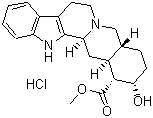 |
| Molecular Formula | C21H26N2O3.HCl |
| Molecular Weight | 390.91 |
| CAS Registry Number | 65-19-0 |
| EC Number | 200-600-4 |
| SMILES | COC(=O)[C@H]1[C@H](CC[C@@H]2[C@@H]1C[C@H]3C4=C(CCN3C2)C5=CC=CC=C5N4)O.Cl |
| Melting point | 288 - 290 °C (Decomposes) (Expl.) |
|---|---|
| Solubility | H2O: 10 mg/mL, DMSO: 20 mM (Expl.) |
| Alpha | 99 ° (c=1%, H2O, dry subst) (Expl.) |
| Hazard Symbols |  GHS06 Danger Details GHS06 Danger Details | ||||||||||||||||||||||||||||||||||||
|---|---|---|---|---|---|---|---|---|---|---|---|---|---|---|---|---|---|---|---|---|---|---|---|---|---|---|---|---|---|---|---|---|---|---|---|---|---|
| Risk Statements | H300-H301-H311-H331 Details | ||||||||||||||||||||||||||||||||||||
| Safety Statements | P261-P262-P264-P270-P271-P280-P301+P316-P302+P352-P304+P340-P316-P321-P330-P361+P364-P403+P233-P405-P501 Details | ||||||||||||||||||||||||||||||||||||
| Hazard Classification | |||||||||||||||||||||||||||||||||||||
| |||||||||||||||||||||||||||||||||||||
| SDS | Available | ||||||||||||||||||||||||||||||||||||
 Discovery and Applications
|
Yohimbine hydrochloride is the hydrochloride salt form of yohimbine, an indole alkaloid derived primarily from the bark of the Pausinystalia yohimbe tree, native to West Africa. Yohimbine has a long history of traditional use as an aphrodisiac and stimulant, and its hydrochloride form improves its solubility and stability for pharmaceutical use. The discovery of yohimbine dates back to the 19th century, when the compound was first isolated from the bark of the yohimbe tree. Subsequent research identified yohimbine as an alpha-2 adrenergic receptor antagonist, a property that underpins many of its pharmacological effects. Yohimbine hydrochloride acts primarily by blocking presynaptic alpha-2 adrenergic receptors, leading to increased release of norepinephrine and enhanced sympathetic nervous system activity. Clinically, yohimbine hydrochloride has been used to treat erectile dysfunction and other sexual disorders, due to its ability to increase blood flow and nerve impulses in genital tissues. It has also been studied for its potential to aid weight loss by promoting lipolysis and increasing energy expenditure. However, its therapeutic use is limited by side effects such as increased heart rate, elevated blood pressure, anxiety, and gastrointestinal disturbances. Beyond its sexual health applications, yohimbine hydrochloride has been explored in psychiatric and neurological research. It may influence mood and anxiety by modulating noradrenergic pathways. Some studies have investigated its use in managing orthostatic hypotension and in enhancing athletic performance, although evidence remains inconclusive. In pharmaceutical preparations, yohimbine hydrochloride is administered in oral tablet form or as an injectable solution. Dosage and safety profiles vary, requiring careful medical supervision due to the risk of adverse cardiovascular and neurological effects. The compound’s pharmacokinetics include rapid absorption, hepatic metabolism, and renal excretion. Yohimbine hydrochloride remains a compound of interest for its unique mechanism of action and diverse biological effects. Research continues into optimizing its clinical applications and minimizing side effects. Regulatory status varies by country, with some regions restricting its use to prescription-only medications, while others limit or ban its availability due to safety concerns. References 1990. Structure-activity relationship of yohimbine and its related analogs in blocking alpha-1 and alpha-2 adrenoceptors: A comparative study of cardiovascular activities. Chemical and Pharmaceutical Bulletin, 38(6). DOI: 10.1248/cpb.38.1702 1990. Identification of human platelet a2-adrenoceptors with a new antagonist [3H]-RX821002, a 2-methoxy derivative of idazoxan. British Journal of Pharmacology, 100(4). DOI: 10.1111/j.1476-5381.1990.tb14105.x 1979. Blockade of the sodium channels of the node of Ranvier membrane channels by the alkaloid yohimbine. Doklady Akademii nauk SSSR. URL: https://pubmed.ncbi.nlm.nih.gov/487935 |
| Market Analysis Reports |