
Online Database of Chemicals from Around the World
| Chizhou Dongsheng Pharmaceutical Co., Ltd. | China | |||
|---|---|---|---|---|
 | www.dspharmchem.com | |||
 | +86 (576) 8429-2571 | |||
 | +86 (576) 8429-2560 | |||
 | ksz@dspharmchem.com | |||
| Chemical manufacturer since 1995 | ||||
| chemBlink Premium supplier since 2011 | ||||
| Classification | Organic raw materials >> Hydrocarbon compounds and their derivatives >> Hydrocarbon halide |
|---|---|
| Name | Melatonine |
| Synonyms | N-(2-(5-methoxyindol-3-yl)ethyl)acetamide; N-Acetyl-5-methoxytryptamine; 3-(N-Acetyl-2-aminoethyl)-5-methoxyindole |
| Molecular Structure | 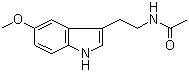 |
| Molecular Formula | C13H16N2O2 |
| Molecular Weight | 232.28 |
| CAS Registry Number | 73-31-4 |
| EC Number | 200-797-7 |
| SMILES | CC(=O)NCCC1=CNC2=C1C=C(C=C2)OC |
| Solubility | 10 mM (H2O), 47 mg/mL (DMSO) |
|---|---|
| Melting point | 116-120 °C |
| Hazard Symbols |  GHS07 Warning Details GHS07 Warning Details | ||||||||||||||||||||||||||||
|---|---|---|---|---|---|---|---|---|---|---|---|---|---|---|---|---|---|---|---|---|---|---|---|---|---|---|---|---|---|
| Risk Statements | H302-H315-H319 Details | ||||||||||||||||||||||||||||
| Safety Statements | P501-P270-P264-P280-P302+P352-P337+P313-P305+P351+P338-P362+P364-P332+P313-P301+P312+P330 Details | ||||||||||||||||||||||||||||
| Hazard Classification | |||||||||||||||||||||||||||||
| |||||||||||||||||||||||||||||
| SDS | Available | ||||||||||||||||||||||||||||
 chemBlink Chemical Story
|
Melatonin was first discovered in 1958 by Dr. Aaron B. Lerner and his team at Yale University. The discovery stemmed from research into the biological effects of serotonin. Melatonin has a chemical formula of C13H16N2O2 and has a complex structure derived from tryptophan. It is synthesized in the pineal gland and released into the bloodstream to regulate circadian rhythms. Melatonin's primary function is to regulate the sleep-wake cycle. It signals the body that it's time to sleep, thereby promoting rest and synchronizing with the natural day-night cycle. Melatonin production peaks at night and decreases during the day, helping to adapt to changes in ambient light. This regulatory effect has a profound impact on overall health, affecting not only sleep but also a variety of physiological processes, including immune function and mood regulation. Melatonin is widely used to treat sleep disorders such as insomnia and jet lag. It is able to normalize circadian rhythms and is helpful for people who have trouble falling and staying asleep. Melatonin supplements are usually available by prescription or over-the-counter and help improve the quality and duration of sleep. For travelers who travel across multiple time zones or work night shifts, melatonin helps reset the internal clock to new sleep-wake patterns. It can reduce the symptoms of jet lag and help shift workers adjust to unconventional schedules, which can improve overall well-being and productivity. For children who have trouble sleeping, especially those with developmental disorders such as autism, melatonin can help establish regular sleep patterns. It is often used as part of a comprehensive treatment plan to improve sleep hygiene and daily functioning. Emerging research suggests that melatonin has antioxidant and anti-inflammatory properties that may have protective effects against cell damage and inflammation. These effects are being explored for potential applications in neurodegenerative and other chronic diseases. Melatonin is also found in plants, where it plays a role in regulating growth and defense mechanisms. In agriculture, it is used to enhance plant resilience to stress and improve crop yields by influencing growth patterns and protecting against environmental stressors. In veterinary medicine, melatonin is used to treat sleep disorders in pets and treat conditions such as hair loss and anxiety in animals. It can regulate the reproductive cycle in livestock and pets, promoting reproduction and overall health. Melatonin is safe for short-term use with minimal side effects. However, its long-term safety requires further study, especially in special populations such as pregnant women, children, and people with underlying health conditions. As with any supplement, it is important to use melatonin under a physician's supervision to avoid interactions with other medications and to ensure appropriate dosing. Ongoing research continues to explore new therapeutic potential for melatonin. Its role in regulating circadian rhythms and its antioxidant properties suggest future applications in areas such as cancer treatment, cardiovascular health, and aging. References 1978. The Measurement of Melatonin in Mammalian Tissues and Body Fluids. The Pineal Gland. DOI: 10.1007/978-3-7091-4427-5_19 1978. Melatonin: Clinical Pharmacology. The Pineal Gland. DOI: 10.1007/978-3-7091-4427-5_25 1979. Melatonin- and serotonin-stimulated release of vasopressin from rat neurohypophysis in vitro. Molecular and Cellular Endocrinology, 14(3). DOI: 10.1016/0303-7207(79)90103-5 |
| Market Analysis Reports |