
Online Database of Chemicals from Around the World
| Jiangsu B-Win Chemical Co., Ltd. | China | |||
|---|---|---|---|---|
 | www.jsbschem.com | |||
 | +86 (510) 8584-0252 +86 18861806888 | |||
 | +86 (510) 8584-0253 | |||
 | huisongshu_2001@163.com | |||
 | QQ Chat | |||
| Chemical manufacturer | ||||
| chemBlink Standard supplier since 2008 | ||||
| Sinocompound Catalysts Co., Ltd. | China | |||
|---|---|---|---|---|
| www.sinocompound.com | |||
| +86 (512) 6721-6630 | |||
| +86 (512) 5631-6689 | |||
| sales@sinocompound.com | |||
| Chemical manufacturer since 2008 | ||||
| chemBlink Standard supplier since 2010 | ||||
| Hefei TNJ Chemical Industry Co., Ltd. | China | |||
|---|---|---|---|---|
| www.tnjchem.com | |||
| +86 (551) 6541-8684 | |||
| +86 (551) 6541-8697 | |||
| sales@tnjchem.com | |||
| Chemical manufacturer since 2001 | ||||
| chemBlink Standard supplier since 2010 | ||||
| Ereztech LLC | USA | |||
|---|---|---|---|---|
| www.ereztech.com | |||
| +1 (888) 658-1221 | |||
| sales@ereztech.com | |||
| Chemical distributor since 2010 | ||||
| chemBlink Standard supplier since 2011 | ||||
| Intatrade Chemicals GmbH | Germany | |||
|---|---|---|---|---|
| www.intatrade.de | |||
| +49 (3493) 605-465 | |||
| +49 (3493) 605-470 | |||
| sales@intatrade.de | |||
| Chemical distributor | ||||
| chemBlink Standard supplier since 2011 | ||||
| Eastar Chemical Corporation | USA | |||
|---|---|---|---|---|
| www.eastarchem.com | |||
| +1 800-898-2436 | |||
| +1 (877) 898-2436 | |||
| info@eastarchem.com | |||
| Chemical manufacturer since 1989 | ||||
| chemBlink Standard supplier since 2014 | ||||
| Forxine Pharmaceutical Co., Ltd. | China | |||
|---|---|---|---|---|
| www.forxine.com | |||
| +86 (21) 6496-1699 | |||
| +86 (21) 6496-1388 ex 8320 | |||
| reagent@forxine.com sales@forxine.com | |||
| QQ Chat | |||
| Chemical manufacturer since 2013 | ||||
| chemBlink Standard supplier since 2014 | ||||
| Hangzhou Leap Chem Co., Ltd. | China | |||
|---|---|---|---|---|
| www.leapchem.com | |||
| +86 (571) 8771-1850 | |||
| market19@leapchem.com | |||
| QQ Chat | |||
| Chemical manufacturer since 2006 | ||||
| chemBlink Standard supplier since 2015 | ||||
| Zhengzhou Kingorgchem Chemical Technology Co., Ltd. | China | |||
|---|---|---|---|---|
| www.kingorgchem.com | |||
| +86 (371) 6551-1006 | |||
| +86 (371) 6575-6965 | |||
| sales@kingorgchem.com | |||
| QQ Chat | |||
 | WeChat: 18625597674 | |||
| Chemical manufacturer since 2015 | ||||
| chemBlink Standard supplier since 2016 | ||||
| Carbosynth China Ltd. | China | |||
|---|---|---|---|---|
| www.carbosynth.cn | |||
| +86 (512) 6260-5585 | |||
| +86 (512) 6260-5576 | |||
| sales@carbosynth.com | |||
| QQ Chat | |||
| Chemical manufacturer since 2006 | ||||
| chemBlink Standard supplier since 2016 | ||||
| Beijing Guofang Dingsheng Technology Co., Ltd. | China | |||
|---|---|---|---|---|
| www.gfdschem.com | |||
| +86 (10) 8904-9254 5909-2859 +86 18610472091 +86 18031679351 | |||
| +86 (10) 5909-2859 | |||
| gfdskj@163.com | |||
| QQ Chat | |||
| Chemical manufacturer since 2012 | ||||
| chemBlink Standard supplier since 2016 | ||||
| Hangzhou Hairui Chemical Co., Ltd. | China | |||
|---|---|---|---|---|
| www.hairuichem.com | |||
| +86 (571) 8669-1155 | |||
| +86 (571) 8669-1154 | |||
| sales@hairuichem.com | |||
| Chemical distributor since 2005 | ||||
| chemBlink Standard supplier since 2017 | ||||
| Shanghai Fuxin Pharmaceutical Co., Ltd. | China | |||
|---|---|---|---|---|
| www.fuxinpharm.com | |||
| +86 (21) 3130-0828 +86 18645121291 | |||
| +86 (21) 3130-0828 | |||
| contact@fuxinpharm.com | |||
| Chemical manufacturer since 2016 | ||||
| chemBlink Standard supplier since 2018 | ||||
| Digital Specialty Chemicals, Inc. | USA | |||
|---|---|---|---|---|
| www.digitalchem.com | |||
| +1 (603) 563-5060 | |||
| +1 (603) 563-9288 | |||
| sales@digitalchem.com | |||
| Chemical manufacturer since 1987 | ||||
| Dalchem | Russia | |||
|---|---|---|---|---|
| www.dalchem.com | |||
| +7 (8312) 753-772 | |||
| +7 (8312) 750-799 | |||
| dregichy@dalchem.com | |||
| Chemical manufacturer since 1997 | ||||
| Kemprotec Limited | UK | |||
|---|---|---|---|---|
| www.kemprotec.com | |||
| +44 (1642) 591-764 | |||
| +44 (1845) 550-001 | |||
| sales@kemprotec.co.uk | |||
| Chemical distributor since 1998 | ||||
| Chemcia Scientific, LLC | USA | |||
|---|---|---|---|---|
| www.chemcia.com | |||
| +1 (858) 678-0337 | |||
| sales@chemcia.com | |||
| Chemical manufacturer | ||||
| Anvia Chemicals, LLC | USA | |||
|---|---|---|---|---|
| www.anviachem.com | |||
| +1 (414) 534-7845 | |||
| +1 (414) 762-5539 | |||
| sales@anviachem.com | |||
| Chemical manufacturer | ||||
| Molekula Ltd | UK | |||
|---|---|---|---|---|
| www.molekula.com | |||
| +44 (1747) 831-066 | |||
| +44 (1747) 831-199 | |||
| info@molekula.com | |||
| Chemical manufacturer | ||||
| Anisyn, Inc. | USA | |||
|---|---|---|---|---|
| www.anisyn.com | |||
| +1 (269) 372-8736 | |||
| +1 (269) 372-3397 | |||
| sales@anisyn.com | |||
| Chemical manufacturer | ||||
| Strem Chemicals, Inc. | USA | |||
|---|---|---|---|---|
| www.strem.com | |||
| +1 (978) 499-1600 | |||
| +1 (978) 465-3104 | |||
| info@strem.com | |||
| Chemical manufacturer | ||||
| Acros Organics | Belgium | |||
|---|---|---|---|---|
| www.acros.com | |||
| +86 (21) 5258-1100 | |||
| +86 (21) 5258-0119 | |||
| info@acros.com | |||
| Chemical manufacturer | ||||
| Classification | Organic raw materials >> Organic phosphine compound |
|---|---|
| Name | 1,4-Bis(diphenylphosphino)butane |
| Synonyms | Butane-1,4-diylbis[diphenylphosphine] |
| Molecular Structure | 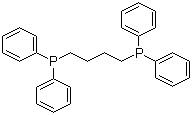 |
| Molecular Formula | C28H28P2 |
| Molecular Weight | 426.48 |
| CAS Registry Number | 7688-25-7 |
| EC Number | 231-698-7 |
| SMILES | C1=CC=C(C=C1)P(CCCCP(C2=CC=CC=C2)C3=CC=CC=C3)C4=CC=CC=C4 |
| Melting point | 130-137 °C |
|---|---|
| Hazard Symbols |   GHS07;GHS09 Warning Details GHS07;GHS09 Warning Details | ||||||||||||||||||||||||||||||||||||||||||||
|---|---|---|---|---|---|---|---|---|---|---|---|---|---|---|---|---|---|---|---|---|---|---|---|---|---|---|---|---|---|---|---|---|---|---|---|---|---|---|---|---|---|---|---|---|---|
| Risk Statements | H302-H315-H317-H319-H335-H400-H410-H413 Details | ||||||||||||||||||||||||||||||||||||||||||||
| Safety Statements | P261-P264-P264+P265-P270-P271-P272-P273-P280-P301+P317-P302+P352-P304+P340-P305+P351+P338-P319-P321-P330-P332+P317-P333+P317-P337+P317-P362+P364-P391-P403+P233-P405-P501 Details | ||||||||||||||||||||||||||||||||||||||||||||
| Hazard Classification | |||||||||||||||||||||||||||||||||||||||||||||
| |||||||||||||||||||||||||||||||||||||||||||||
| SDS | Available | ||||||||||||||||||||||||||||||||||||||||||||
 Discovery and Applications
|
1,4-Bis(diphenylphosphino)butane, often abbreviated as DPPB, is a significant bidentate ligand in the field of organometallic chemistry and catalysis. The compound, which features two diphenylphosphino groups linked by a butane chain, has become crucial in various catalytic processes due to its ability to stabilize metal centers and influence reaction outcomes through its chelating properties. The discovery of 1,4-Bis(diphenylphosphino)butane can be traced back to the early 1980s when chemists were seeking versatile ligands capable of forming stable complexes with transition metals. The ligand was developed as part of a broader effort to improve the efficiency and selectivity of catalytic reactions. The structure of DPPB, with its two phosphine groups connected by a four-carbon spacer, was designed to provide a rigid yet flexible framework that could coordinate effectively with metal centers, leading to enhanced catalytic performance. 1,4-Bis(diphenylphosphino)butane is particularly well-known for its application in palladium-catalyzed cross-coupling reactions. In these reactions, such as the Suzuki-Miyaura and Negishi couplings, DPPB acts as a bidentate ligand, forming stable palladium complexes that facilitate the coupling of aryl or vinyl halides with organometallic reagents. The presence of DPPB in these reactions often leads to increased reaction rates and improved selectivity, allowing for the efficient formation of biaryl and other complex structures. One of the notable applications of DPPB is in the field of pharmaceutical synthesis, where its role in palladium-catalyzed reactions enables the creation of complex, chiral molecules with high precision. The ability of DPPB to stabilize palladium intermediates and control reaction selectivity is particularly valuable in the synthesis of pharmaceuticals and other fine chemicals where enantioselectivity and yield are crucial. In addition to cross-coupling reactions, DPPB is used in various other catalytic processes, including hydrogenation and hydrosilylation. The ligand’s ability to form robust complexes with transition metals enhances the stability and reactivity of the catalysts, leading to more efficient and selective reactions. For instance, in hydrogenation reactions, DPPB-stabilized metal catalysts exhibit high activity and selectivity for the reduction of unsaturated compounds, making them useful for producing a range of valuable chemicals. The versatility of 1,4-Bis(diphenylphosphino)butane is attributed to its ability to chelate with metal centers through its two phosphine groups, which provides a strong and stable coordination environment. The butane spacer in the ligand allows for some flexibility in the metal-ligand interactions, which can be beneficial in optimizing catalytic performance for various reactions. Overall, 1,4-Bis(diphenylphosphino)butane has established itself as an essential ligand in modern organometallic chemistry. Its discovery has significantly advanced the field of catalysis, enabling more efficient and selective chemical transformations. The ligand’s applications in cross-coupling, hydrogenation, and other catalytic processes highlight its importance in both academic research and industrial applications. References 2023. Palladium-catalyzed 3,4-hydroaminocarbonylation of conjugated dienes for formation of β,γ-unsaturated amides. Science China Chemistry, 66(5). DOI: 10.1007/s11426-022-1538-8 2023. Functionalization of C,C-palladacycles: application in the synthesis of functional molecules. Science China Chemistry, 66(12). DOI: 10.1007/s11426-023-1758-1 2024. Synthesis of 11-vertex cobalt bis(diphenylphosphine) complexes based on medium-size non-icosahedral carborane 5,6-nido-C2B8H12. Molecular structure of complex [1,1-{κ2-1′,2′-Ph2P(CH2)2PPh2}-1-H-isonido-1,2,4-CoC2B8H10]. Russian Chemical Bulletin, 73(10). DOI: 10.1007/s11172-024-4406-4 |
| Market Analysis Reports |