
Online Database of Chemicals from Around the World
| Sinocompound Catalysts Co., Ltd. | China | |||
|---|---|---|---|---|
 | www.sinocompound.com | |||
 | +86 (512) 6721-6630 | |||
 | +86 (512) 5631-6689 | |||
 | sales@sinocompound.com | |||
| Chemical manufacturer since 2008 | ||||
| chemBlink Standard supplier since 2010 | ||||
| Shanghai Chang-Gen Chemical Technology Co., Ltd. | China | |||
|---|---|---|---|---|
| www.shcgchem.com | |||
| +86 (21) 6910-6824 | |||
| +86 (21) 6910-6814 | |||
| sales@shcgchem.com | |||
| Chemical manufacturer | ||||
| chemBlink Standard supplier since 2010 | ||||
| Rhodia (shanghai) International Trading Co., Ltd. | China | |||
|---|---|---|---|---|
| www.rhodia.com | |||
| +86 (21) 2408-9317 +86 13601753458 | |||
| +86 (21) 5483-0035 | |||
| hank.xue@ap.rhodia.com | |||
| Chemical manufacturer | ||||
| chemBlink Standard supplier since 2011 | ||||
| Zhengzhou Kingorgchem Chemical Technology Co., Ltd. | China | |||
|---|---|---|---|---|
| www.kingorgchem.com | |||
| +86 (371) 6551-1006 | |||
| +86 (371) 6575-6965 | |||
| sales@kingorgchem.com | |||
 | QQ Chat | |||
 | WeChat: 18625597674 | |||
| Chemical manufacturer since 2015 | ||||
| chemBlink Standard supplier since 2016 | ||||
| Beijing Guofang Dingsheng Technology Co., Ltd. | China | |||
|---|---|---|---|---|
| www.gfdschem.com | |||
| +86 (10) 8904-9254 5909-2859 +86 18610472091 +86 18031679351 | |||
| +86 (10) 5909-2859 | |||
| gfdskj@163.com | |||
| QQ Chat | |||
| Chemical manufacturer since 2012 | ||||
| chemBlink Standard supplier since 2016 | ||||
| Shanghai Fuxin Pharmaceutical Co., Ltd. | China | |||
|---|---|---|---|---|
| www.fuxinpharm.com | |||
| +86 (21) 3130-0828 +86 18645121291 | |||
| +86 (21) 3130-0828 | |||
| contact@fuxinpharm.com | |||
| Chemical manufacturer since 2016 | ||||
| chemBlink Standard supplier since 2018 | ||||
| Gelest, Inc. | USA | |||
|---|---|---|---|---|
| www.gelest.com | |||
| +1 (215) 547-1015 | |||
| +1 (215) 547-2484 | |||
| info@gelest.com | |||
| Chemical manufacturer | ||||
| Kemprotec Limited | UK | |||
|---|---|---|---|---|
| www.kemprotec.com | |||
| +44 (1642) 591-764 | |||
| +44 (1845) 550-001 | |||
| sales@kemprotec.co.uk | |||
| Chemical distributor since 1998 | ||||
| Strem Chemicals, Inc. | USA | |||
|---|---|---|---|---|
| www.strem.com | |||
| +1 (978) 499-1600 | |||
| +1 (978) 465-3104 | |||
| info@strem.com | |||
| Chemical manufacturer | ||||
| Digital Specialty Chemicals, Inc. | USA | |||
|---|---|---|---|---|
| www.digitalchem.com | |||
| +1 (603) 563-5060 | |||
| +1 (603) 563-9288 | |||
| sales@digitalchem.com | |||
| Chemical manufacturer since 1987 | ||||
| Classification | Organic raw materials >> Organic phosphine compound |
|---|---|
| Name | Dicyclohexylphosphine |
| Molecular Structure | 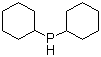 |
| Molecular Formula | C12H23P |
| Molecular Weight | 198.28 |
| CAS Registry Number | 829-84-5 |
| EC Number | 212-590-9 |
| SMILES | C1CCC(CC1)PC2CCCCC2 |
| Melting point | 129 °C (8mmHg) |
|---|---|
| Refractive index | 1.516 |
| Hazard Symbols |      GHS02;GHS05;GHS06;GHS07;GHS09 Danger Details GHS02;GHS05;GHS06;GHS07;GHS09 Danger Details | ||||||||||||||||||||||||||||||||||||||||||||||||||||
|---|---|---|---|---|---|---|---|---|---|---|---|---|---|---|---|---|---|---|---|---|---|---|---|---|---|---|---|---|---|---|---|---|---|---|---|---|---|---|---|---|---|---|---|---|---|---|---|---|---|---|---|---|---|
| Risk Statements | H225-H250-H301+H311+H331-H301-H311-H314-H319-H331-H411 Details | ||||||||||||||||||||||||||||||||||||||||||||||||||||
| Safety Statements | P210-P222-P231-P233-P240-P241-P242-P243-P260-P261-P262-P264-P264+P265-P270-P271-P273-P280-P301+P316-P301+P330+P331-P302+P335+P334-P302+P352-P302+P361+P354-P303+P361+P353-P304+P340-P305+P351+P338-P305+P354+P338-P316-P321-P330-P337+P317-P361+P364-P363-P370+P378-P391-P403+P233-P403+P235-P405-P501 Details | ||||||||||||||||||||||||||||||||||||||||||||||||||||
| Hazard Classification | |||||||||||||||||||||||||||||||||||||||||||||||||||||
| |||||||||||||||||||||||||||||||||||||||||||||||||||||
| SDS | Available | ||||||||||||||||||||||||||||||||||||||||||||||||||||
 Discovery and Applications
|
Dicyclohexylphosphine is a notable organophosphorus compound with significant applications in chemistry, particularly in catalysis and organic synthesis. This chemical substance is characterized by the presence of two cyclohexyl groups attached to a central phosphorus atom, forming a stable phosphine ligand. The synthesis of dicyclohexylphosphine involves the reaction of cyclohexylmagnesium bromide with a phosphorus trichloride precursor, resulting in the formation of the desired phosphine. The discovery of dicyclohexylphosphine can be traced back to efforts aimed at developing new ligands for transition metal complexes. Its structure, which incorporates bulky cyclohexyl groups, imparts steric hindrance around the phosphorus atom. This steric bulk is crucial in stabilizing metal complexes and influencing their reactivity. The presence of these bulky groups helps to reduce the likelihood of ligand dissociation, thereby enhancing the stability of the metal center. In terms of applications, dicyclohexylphosphine is widely used as a ligand in various catalytic processes. Its effectiveness as a ligand is particularly evident in transition metal catalysis, where it plays a crucial role in facilitating reactions such as hydrogenation, cross-coupling, and hydroformylation. The bulky cyclohexyl groups provide significant steric protection, making the ligand highly effective in stabilizing metal centers and promoting specific catalytic transformations. Additionally, dicyclohexylphosphine is employed in the synthesis of complex organic molecules. It is used to form organometallic compounds that serve as intermediates in the synthesis of pharmaceuticals, agrochemicals, and other fine chemicals. The ligand's ability to coordinate with various metals allows for the formation of a range of metal complexes, each with tailored reactivity suitable for different synthetic applications. The compound also finds use in material science, particularly in the development of advanced materials with specific properties. The phosphine's role in stabilizing metal centers can be exploited to create materials with desirable mechanical, electrical, or catalytic properties. Overall, dicyclohexylphosphine represents an important advancement in the field of organophosphorus chemistry. Its discovery and applications highlight the significance of phosphine ligands in enhancing the stability and reactivity of metal complexes, making it a valuable tool in both industrial and academic research. References 2020. Copper-catalyzed C-P cross-coupling of arylmethyl quaternary ammonium salts via C-N bond cleavage. Monatshefte für Chemie - Chemical Monthly, 151(1). DOI: 10.1007/s00706-019-02535-y 2017. Preparation of Aryl(dicyclohexyl)phosphines by C-P Bond-Forming Cross-Coupling in Water Catalyzed by an Amphiphilic-Resin-Supported Palladium Complex. Synlett, 28(16). DOI: 10.1055/s-0036-1590926 2008. Phosphorus derivatives of carboranes as ligands for Pd-catalyzed cross-coupling reactions. Russian Chemical Bulletin, 57(11). DOI: 10.1007/s11172-008-0326-y |
| Market Analysis Reports |