
Online Database of Chemicals from Around the World
| Beijing Eagle Sky Pharmatech Co., Ltd. | China | |||
|---|---|---|---|---|
 | www.eagleskypharmatech.com | |||
 | +86 (10) 5979-9429 8875-5821 | |||
 | +86 (10) 5804-3698 | |||
 | sophia_818@126.com contact@eagleskypharmatech.com | |||
 | QQ Chat | |||
| Chemical manufacturer since 2009 | ||||
| chemBlink Premium supplier since 2010 | ||||
| Classification | Biochemical >> Peptide |
|---|---|
| Name | Atosiban acetate |
| Synonyms | Acetic acid;(2S)-N-[(2S)-5-amino-1-[(2-amino-2-oxoethyl)amino]-1-oxopentan-2-yl]-1-[(4R,7S,10S,13S,16R)-7-(2-amino-2-oxoethyl)-13-[(2S)-butan-2-yl]-16-[(4-ethoxyphenyl)methyl]-10-[(1R)-1-hydroxyethyl]-6,9,12,15,18-pentaoxo-1,2-dithia-5,8,11,14,17-pentazacycloicosane-4-carbonyl]pyrrolidine-2-carboxamide |
| Molecular Structure | 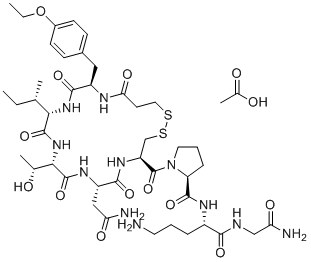 |
| Molecular Formula | C45H71N11O14S2 |
| Molecular Weight | 1054.24 |
| Protein Sequence | CXITNCPXG |
| CAS Registry Number | 914453-95-5 |
| SMILES | CC[C@H](C)[C@H]1C(=O)N[C@H](C(=O)N[C@H](C(=O)N[C@@H](CSSCCC(=O)N[C@@H](C(=O)N1)CC2=CC=C(C=C2)OCC)C(=O)N3CCC[C@H]3C(=O)N[C@@H](CCCN)C(=O)NCC(=O)N)CC(=O)N)[C@@H](C)O.CC(=O)O |
| Solubility | Slightly soluble (DMSO, water) |
|---|---|
| Melting point | 191 °C |
| Hazard Symbols |  GHS07 Warning Details GHS07 Warning Details |
|---|---|
| Risk Statements | H302 Details |
| Safety Statements | P264-P270-P301+P312-P330-P501 Details |
| SDS | Available |
 Discovery and Applications
|
Atosiban acetate is a synthetic peptide drug whose discovery arose from efforts to understand and control uterine contractility through modulation of oxytocin signaling. Oxytocin, a nonapeptide hormone released from the posterior pituitary, plays a central role in the initiation and maintenance of uterine contractions during labor. By the late twentieth century, advances in peptide chemistry and receptor pharmacology made it possible to design antagonists that could selectively interfere with oxytocin action. Atosiban was developed through systematic modification of the native oxytocin peptide, with the aim of preserving receptor binding while eliminating agonist activity. The compound is structurally related to oxytocin but incorporates specific amino acid substitutions that convert it into a competitive antagonist at the oxytocin receptor. In addition to blocking the oxytocin receptor, atosiban also shows antagonistic activity at the vasopressin V1a receptor, which is also involved in uterine smooth muscle contraction. This dual receptor profile was identified during preclinical pharmacological studies and contributed to its efficacy in suppressing uterine activity. The acetate salt form was selected to provide suitable stability and solubility for parenteral administration. The discovery phase of atosiban involved extensive in vitro and in vivo evaluation. Laboratory studies demonstrated that the compound could inhibit oxytocin induced contractions in isolated uterine tissue. Subsequent animal experiments confirmed that it reduced uterine contractility without producing the cardiovascular side effects seen with some earlier tocolytic agents. These findings supported further development and eventual clinical testing. Importantly, atosiban was shown not to cross the placenta to a significant extent, reducing concerns about direct fetal exposure. Clinical development focused on the treatment of threatened preterm labor, a major cause of neonatal morbidity and mortality worldwide. Preterm birth is associated with respiratory distress, intraventricular hemorrhage, and long term neurodevelopmental impairment. Prior to the introduction of atosiban, commonly used tocolytics included beta adrenergic agonists and calcium channel blockers, which can be effective but are often associated with maternal adverse effects. Atosiban offered a more targeted mechanism of action by directly inhibiting the physiological pathway responsible for labor contractions. Large randomized controlled trials evaluated atosiban in women with signs of preterm labor. These studies demonstrated that the drug was effective in delaying delivery for at least 48 hours, a clinically important window that allows for the administration of corticosteroids to accelerate fetal lung maturation and for transfer of the mother to a specialized care center if needed. The safety profile observed in these trials showed fewer cardiovascular side effects compared with beta agonists, reflecting its receptor specificity. Based on the accumulated clinical evidence, atosiban acetate was approved in several countries, particularly in Europe, for the short term management of preterm labor. It is administered intravenously using a loading dose followed by continuous infusion, allowing rapid onset and precise control of uterine activity. Its use is generally limited to specific gestational age ranges and clinical situations, in accordance with established obstetric guidelines. While atosiban has not been approved in all regions, it remains an important option in settings where it is available. Beyond its established clinical application, atosiban has also contributed to scientific understanding of oxytocin receptor biology. Its development and use have provided clear evidence of the central role of oxytocin signaling in human parturition. As a result, atosiban acetate represents both a therapeutic advance in obstetrics and a milestone in the rational design of peptide receptor antagonists based on endogenous hormones. References Goodwin TM, Valenzuela G, Silver H, Hayashi R, Creasy GW and Lane R (1996) Treatment of preterm labor with the oxytocin antagonist atosiban. American Journal of Perinatology 13(3) 143–146 DOI: 10.1055/s-2007-994312 Hillard PJ, Brown LA, Martin M, De Koninck P (2008) Atosiban as a tocolytic for the treatment of spontaneous preterm labor. Expert Review of Obstetrics & Gynecology 3(2) 163–174 DOI: 10.1586/17474108.3.2.163 Haas DM, Caldwell DM, Kirkpatrick P, McIntosh JJ, Welton NJ (2012) Tocolytic therapy for preterm delivery: systematic review. BMJ 345 e6226 DOI: 10.1136/bmj.e6226 |
| Market Analysis Reports |